How to Write a Wine Tasting Event Business Plan in 7 Steps
Last Updated: October 31, 2026
Quick Summary
A wine tasting event business plan is a short written document covering the event concept, target guests, startup and per-event costs, pricing, licensing and operations. Writing one in seven steps turns the idea into a decision you can test before spending money on a venue.
- Define the concept around one specific guest type and one clear theme.
- Test demand first by asking ten potential guests whether they would pay.
- Split the budget into one-off startup costs and per-event costs, plus a 10 percent contingency.
- Calculate break-even as total costs divided by ticket price minus payment fees per ticket.
- Check licensing, such as a temporary event notice, and arrange public liability insurance before hosting.
Table of Contents
- Defining the Event Concept and Target Guest
- Market Research and Validating Demand
- Building a Wine Tasting Event Budget
- Setting Wine Tasting Event Pricing and Revenue Targets
- Licensing, Insurance and Operational Planning
- Wine Tasting Event Business Plan Examples and Template Structure
- Reviewing Your Plan and Booking Your First Event
- Frequently Asked Questions
At 79North Ltd, we import premium, family-owned wines from Portugal and Italy, and we see plenty of wine tasting events fail for one simple reason: the host never wrote a plan. A wine tasting event business plan is a short written document that sets out what you will host, who will attend, what it will cost, and how it will make money. It turns a fun idea into a decision you can actually test. This guide walks through seven steps to write one, from defining your concept to booking your first event.
Defining the Event Concept and Target Guest
Start with one clear sentence describing your event. Who is it for, and what will they taste? A focused concept sells better than a vague one. For example, you could build a flight around Alentejo rosé from Herdade da Calada.
Your concept should answer three questions:
- Who is the guest? Trade buyers, local wine lovers, or corporate groups all need different events.
- What is the theme? A regional flight, such as Alentejo reds, is easier to market than "good wine."
- What is the experience? Decide if it is seated and educational or standing and social.
A common mistake is trying to please everyone. Pick one guest type and build the event around them. You can always widen the audience later.
Market Research and Validating Demand
Before you spend money, check that people want what you plan to offer. This step is often skipped, and it is where many plans quietly fall apart.
Try these simple checks:
- Ask ten potential guests whether they would pay for the event and how much.
- Look at local events and see which wine tastings already run and how full they are.
- Speak to a few venues about availability and typical hire costs.
Write down what you learn. If the answers are weak, change the concept now, not after you have paid for a venue.
Building a Wine Tasting Event Budget
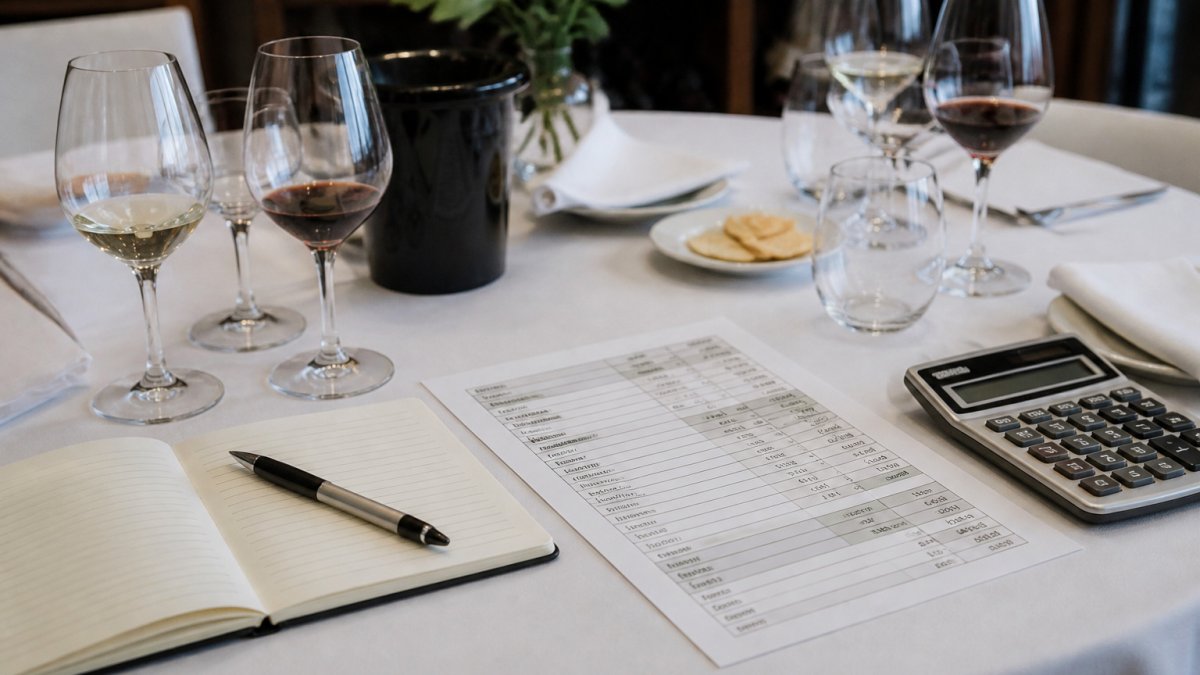
Your budget is the heart of any wine tasting event business plan, and it needs to do two jobs: show what one event costs to run, and show what it costs to get the business to its first event. Split it into startup costs and per-event costs so you can see both.
Startup costs (one-off, before your first tasting)
| Item | What to include | Typical range (GBP) |
|---|---|---|
| Company formation and insurance | Company registration, public liability cover | 50-400 |
| Glassware | 60-120 tasting glasses, plus spittoons and decanters | 300-900 |
| Branding and website | Logo, one-page site, booking and payment setup | 200-800 |
| Licences and notices | Temporary event notices or premises licence fees, depending on your council | 21-300 |
| Initial stock | A small opening wine inventory | 500-2,000 |
| Contingency | 10 percent of the above | , |
Per-event costs
| Cost area | What to include | How to estimate |
|---|---|---|
| Venue | Hire fee, deposit, cleaning, staff | Quote per event; many venues charge by the hour |
| Wine | Bottles, delivery, spillage allowance | Budget 6-8 tasting pours per bottle at 50ml, plus one spare bottle per wine |
| Supplies | Note cards, water, napkins, ice | Small but recurring; track per head |
| Staff | Pourers, host, clearing | Hourly rate × hours × headcount |
| Marketing | Invitations, social posts, printing | Set a fixed cap per event |
| Payment fees | Card processing on ticket sales | Check your provider's rate and build it in |
Add a 10 percent contingency to every event budget. Keep the wine line realistic, because it is usually your largest variable cost. For the wine itself, a specialist importer can supply distinctive bottles that are hard to find on the high street. Pricing depends on quantity, dates and delivery, so request a quote for current figures from 79North Ltd or your chosen supplier.
Cash flow and break-even
A budget is not complete until you know when money leaves and when it arrives. Ticket revenue often lands weeks before the event, while venue deposits and wine orders go out earlier. Build a simple cash-flow line for each event: deposits out, stock out, ticket income in, final supplier payments out. Maintaining this liquidity becomes even more critical when scaling your operations to include intimate private events that require distinct procurement timelines and separate financial tracking.
Your break-even point is the number of guests needed to cover total event costs at your ticket price. Calculate it as total costs divided by (ticket price minus payment fees per ticket). If that number is close to your venue capacity, the event is fragile; either raise the price, cut a cost line, or choose a smaller venue.
Setting Wine Tasting Event Pricing and Revenue Targets
Pricing decides whether the event pays for itself, and it is where most wine tasting business plans are thinnest. Work from unit economics, not from a gut feel about what guests will pay.
Build the per-head cost first
Add every variable cost for one guest: wine share, supplies, staff time, venue share, payment fees. Fixed costs (venue hire, marketing, insurance) are then spread across the expected guest count. Your per-head cost is the floor under your ticket price.
Choose a business model
Different models carry different price points and margins:
- Ticketed public tastings: fixed ticket price, capacity-limited, easiest to market but sensitive to no-shows.
- Private bookings: priced per group or per head with a minimum spend; higher margin but relies on referrals.
- Corporate events: invoiced per head or as a package; longer sales cycle, stronger cash flow per booking.
- Partnerships: venue or restaurant splits revenue in exchange for space and audience.
- Memberships: recurring revenue from a monthly or quarterly tasting club; smooths cash flow but needs retention.
Pick one primary model for your first year and note the others as future channels. A plan that tries to sell all five at once is hard to finance and harder to operate. For ideas on sourcing premium bottles to feature, read about investing in rare Portuguese vintage wines.
Set the price and the margin
- Add up your total event costs.
- Divide by the number of guests you expect to get your per-head cost.
- Add your target margin, most small event businesses aim for a margin that covers overheads and leaves a reserve.
- Add payment fees so the card processor does not eat your margin.
This gives you a minimum ticket price. Your break-even point is the number of guests needed to cover costs at that price. If the break-even number looks unrealistic for your venue size, adjust the price, the format or the venue.
Worked example
Suppose an event for 30 guests has total costs of £1,500, giving a per-head cost of £50. At a £75 ticket, each guest contributes £25 before payment fees. Break-even is 20 guests; selling all 30 leaves a surplus to cover overheads and reinvestment. If your venue only holds 22, the event is too fragile, raise the price or cut a cost line.
Revenue targets and sales channels
Set a revenue target per event and a sales deadline. For example, aim to sell 80 percent of tickets within a fixed number of weeks before the event, and track sales weekly. Use a booking page with card payment, an email list, and one or two local partnerships to fill seats. Record which channel produced each sale so you can drop what does not work.
Licensing, Insurance and Operational Planning
This is where many wine tasting plans become incomplete. Before you host, check what you need to legally serve alcohol at an event. In the UK, the rules for selling and serving alcohol are set out in licensing law, and your local council can explain whether you need a temporary event notice or a premises licence (Temporary Events Notice (England and Wales)). Check the official guidance on gov.uk.
You should also consider:
- Public liability insurance to cover guests and the venue.
- Supplier management, including delivery dates and a backup wine if a bottle does not arrive.
- Staff roles for pouring, checking ages, and clearing up.
Watch out: serving alcohol to anyone under 18, or to someone who is already drunk, is a legal offence. Build an age-check step into your plan.
Wine Tasting Event Business Plan Examples and Template Structure
A good plan is short and easy to update. For a concrete model you can adapt, see how to host European wine tasting events for profit. Use this structure as your wine tasting event business plan template:
- Concept: One paragraph on the event, theme and guest.
- Market: What your research showed and who will buy.
- Budget: The cost table from above, with a contingency line.
- Pricing: Ticket price, break-even point and revenue target.
- Compliance: Licences, insurance and safety checks.
- Operations: Suppliers, staffing and timeline.
- Review: How you will measure success after the event.
Keep the whole plan to two or three pages. A clear plan you use beats a long one you never open. You can also look at published wine tasting event business plan examples from small-business advice sites to compare how others lay out their figures.
Reviewing Your Plan and Booking Your First Event
Read your plan once more and check the numbers. Does the break-even point make sense? Are the licences and insurance in place? Could you explain the event to a stranger in one sentence?
When the plan holds up, book a small first event. Keep it modest. Treat it as a test, then record what sold, what cost more than expected, and what guests said. Use those notes to update the plan before your next event.
Ready to source distinctive Portuguese and Italian wines for your tasting? Speak to the 79North Ltd team today. Let's talk.
Frequently Asked Questions
What should a wine tasting event business plan include?
A wine tasting event business plan should cover the event concept and target guest, market research on local demand, a detailed budget covering venue hire, wine purchases, glassware, staff and marketing, pricing and revenue projections, a break-even calculation, licensing and insurance requirements, and an operations timeline. Include the assumptions behind each figure so you can test them. Pricing depends on quantity, dates and delivery, so get current wine prices from your supplier or a quote rather than relying on estimates. Keep the plan to a few pages you will actually update after each event.
How do you price tickets for a wine tasting event?
Start with your cost per guest: wine, glassware, food, venue share and marketing divided by the number of attendees. Add the margin you need to cover fixed costs and profit, then compare the result with what similar local events charge. Test a couple of price points in your projections and calculate the break-even attendance for each. Tickets for a premium theme can sit higher, but only if the wines and experience justify it to your guests. Revisit the price after the first event using actual sales and feedback.
How much does it cost to run a wine tasting event?
The total depends on venue, guest numbers, the number and quality of wines, food, glassware, staffing and marketing. Build the figure line by line in your budget rather than using a single guess. Pricing depends on quantity, dates and delivery, so request current quotes from venues and wine suppliers, and check 79North Ltd's website for current prices or a quote on imported Portuguese and Italian wines. Include a contingency of around 10 per cent for unexpected costs.
What licences or permissions might a wine tasting event need?
Selling or serving alcohol at a wine tasting generally requires a premises licence or a temporary event notice issued by your local council, and rules on personal licences depend on the event. Check the venue's existing licence, your liability insurance and any food hygiene requirements with the local authority. Rules differ in Scotland and Northern Ireland, so confirm the position with your council before you commit to a date.
