
Wholesale Italian Wine Pricing Guide 2026
Table of Contents
- Understanding Wholesale Italian Wine Pricing in 2026
- Impact of 2026 Wine Tariffs on Wholesale Pricing
- UK Wine Import Duty and VAT: Calculating Your True Cost
- Key Italian Wine Regions and Their Wholesale Value
- Wine Profit Margins in UK Wholesale: What to Expect
- Italian Wine Distributors in the UK: Sourcing Strategies
- Building Your Wholesale Italian Wine Pricing Strategy
- Conclusion: Navigating 2026 Italian Wine Wholesale Markets
Last Updated: July 29, 2026
Understanding Wholesale Italian Wine Pricing in 2026
When sourcing wholesale Italian wine, understanding the true cost structure is critical to building sustainable margins. At 79North Ltd, we help independent retailers and restaurants navigate Italian wine procurement. The wholesale italian wine pricing guide 2026 reveals that landed costs have shifted significantly due to tariff changes and currency fluctuations. The difference between a €6 ex-winery cost and a £12 shelf price includes import duty, excise duty, VAT, shipping, insurance, and broker fees. Understanding each layer ensures you're negotiating from a position of knowledge and can identify where you're winning or losing margin.
Impact of 2026 Wine Tariffs on Wholesale Pricing
Still wines from EU countries (including Italy) face a duty rate of £0.00 per litre under the UK-EU Trade and Cooperation Agreement, provided they meet rules of origin requirements. However, sparkling wines and fortified wines face different rates. The real cost impact comes from how tariffs interact with your supply chain timing and volume. A bulk order of Prosecco enters the UK at a different tariff classification than still wine, and timing your imports around tariff announcements can shift your landed cost by 3-5% per bottle.
For importers working with small producers, tariff planning becomes a strategic advantage. Many family-owned wineries pass tariff costs directly to importers, so understanding the tariff structure lets you negotiate payment terms or adjust order timing to protect margin.
Currency Fluctuation Hedging Strategies for Importers
The pound-to-euro exchange rate volatility in 2026 has made currency hedging essential for wholesale wine importers. When you're ordering wine in euros but pricing in pounds, a 5% swing in GBP/EUR can wipe out your entire margin on a shipment.
Forward contracts with your bank lock in an exchange rate 3-6 months ahead. For a £50,000 order, hedging costs £50-150 but protects against £1,500-2,500 in currency risk. This is far cheaper than losing 3-5% to unexpected currency movement.
UK Wine Import Duty and VAT: Calculating Your True Cost
The landed cost of imported wine includes multiple tax layers. Excise duty on still wine is currently £2.868 per litre (approximately 47p per 750ml bottle), applied regardless of origin or ex-winery cost. For Prosecco and sparkling wines, excise duty is £3.867 per litre (approximately 65p per 750ml bottle).
VAT is applied at 20% on top of the landed cost (ex-winery price plus import duty, shipping, and insurance). This creates a compounding effect: if your landed cost before VAT is £5 per bottle, VAT adds £1, making your true cost £6 per bottle. The sequence matters: you pay import duty first, then VAT is calculated on the total including duty.
Landed Cost Breakdown: From Winery to Warehouse
Here's a real-world example for a 750ml bottle of Italian Pinot Grigio:
| Cost Component | Per Bottle | Notes |
|---|---|---|
| Ex-winery price | £4.50 | Negotiated with producer |
| Shipping (bulk) | £0.40 | Amortized across 500-bottle container |
| Insurance | £0.08 | Approximately 2% of cargo value |
| Import duty | £0.00 | Duty-free under UK-EU TCA |
| Subtotal (pre-VAT) | £4.98 | This is your true landed cost before tax |
| VAT (20%) | £1.00 | Applied to subtotal |
| Final landed cost | £5.98 | What you actually pay |
From this £5.98 landed cost, you must cover warehouse storage, distribution logistics, marketing support, and broker commission (5-10% of landed cost). This leaves a wholesale margin of £1.50-2.50 per bottle before retailer markup. Direct-from-winery sourcing (eliminating broker fees) can improve margins by 5-8%.
Key Italian Wine Regions and Their Wholesale Value
Italian wine regions command different wholesale prices based on reputation, production scale, and sustainability certification.
Prosecco (primarily Veneto) remains the highest-volume Italian wine in UK wholesale markets. Entry-level Prosecco lands at £3-4 ex-winery, commanding wholesale prices of £6-8 per bottle retail. Premium Prosecco Superiore (DOCG designation) lands at £5-7 ex-winery and retails at £10-15.
Pinot Grigio (Friuli-Venezia Giulia and Alto Adige) is the second-largest category. Standard Pinot Grigio lands at £3.50-5 ex-winery; premium Alto Adige versions at £6-9. Retail positioning typically adds 80-120% markup.
Native varieties, Barbera, Nebbiolo, Vermentino, Greco di Tufo, represent where 79North Ltd focuses. These wines land at £6-12 ex-winery but command premium retail positioning (£15-25 retail) because they're distinctive. A restaurant stocking Barbera from a small Piedmont producer can justify a £40 wine list price, whereas a Pinot Grigio at £40 feels overpriced.
Sustainability Certification Impact on Wholesale Pricing
Certified organic, biodynamic, or regenerative wines command a wholesale premium of 10-20% over conventional wines from the same region. An organic-certified wine can retail at £24-26 versus £20 for a conventional equivalent, allowing your retail partner stronger margins while you maintain your wholesale price.
Wine Profit Margins in UK Wholesale: What to Expect
Wholesale wine margins vary dramatically by volume tier, wine type, and distribution channel.
Margin Benchmarks Across Volume Tiers and Wine Types
For importers selling directly to independent retailers or restaurants:
- Volumes under 50 cases annually: Margins of 25-35% are typical. A £10 landed cost wine wholesales at £13-13.50.
- Volumes 50-200 cases annually: Margins compress to 18-25%. A £10 wine wholesales at £12-12.50.
- Volumes 200+ cases annually: Margins drop to 12-18%. A £10 wine wholesales at £11.20-11.80.
Premium wines (landing costs above £15) support slightly higher margins (3-5% more) because the absolute pound value of margin is larger.
Direct-from-Winery Versus Distributor Pricing Comparison
| Factor | Direct from Winery | Through Distributor |
|---|---|---|
| Ex-winery cost | €5.00 | €6.50 (includes distributor margin) |
| Minimum order | 300+ bottles | 24-36 bottles |
| Lead time | 6-8 weeks | 3-5 days |
| Payment terms | 30-50% deposit upfront | Net 30 standard |
| Logistics | Your responsibility | Included |
| Duty/VAT handling | Your responsibility | Included |
| Support | Limited | Dedicated account manager |
| Customization | Possible | Limited to catalog |
Direct sourcing saves 20-30% on per-bottle cost but requires you to handle import logistics, customs documentation, and minimum order commitments. Distributors charge 25-35% margin but absorb all logistics, duty, and timing risk. Many successful independent retailers use a hybrid model: 60% of Italian wine from direct orders placed 12 weeks ahead (locked-in pricing, better margins), and 40% from distributor stock for flexibility.
Italian Wine Distributors in the UK: Sourcing Strategies
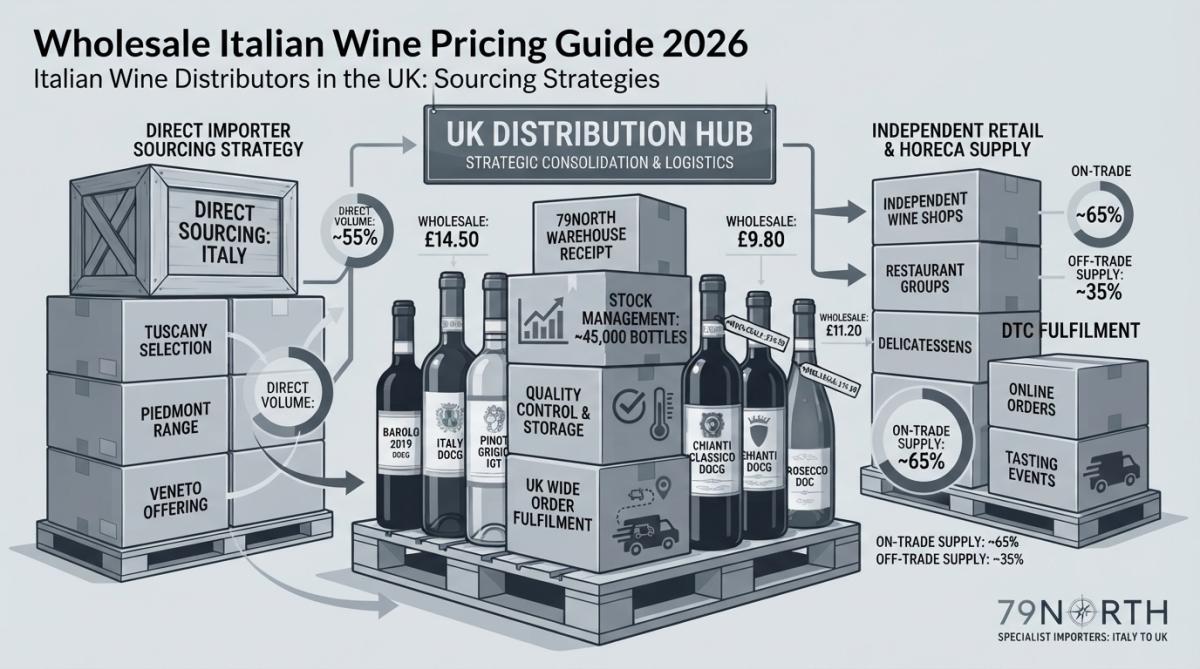
Most large UK wine distributors operate on a tiered pricing model where MOQs determine your cost per bottle. When evaluating a distributor, ask about MOQs for target wines, mixed case options, payment terms, on-time delivery rates, and whether they support small producers. The best distributors for independent retailers have 50+ Italian producers in their catalog and willingness to work with mixed cases.
Quality Scoring Systems and Premium Wine Selection
Parker Points (Robert Parker's 100-point scale): Wines scoring 90+ are considered premium and command 15-25% premium pricing. However, Parker scores are most relevant for Bordeaux and Burgundy; Italian wines receive less coverage.
Galloni Points (Antonio Galloni's scale for Italian wines): Galloni is the most credible scorer for Italian wines, particularly Piedmont and Tuscany. A Galloni 92-point wine justifies premium positioning. Many small Italian producers don't pursue Galloni scores, so absence of a score doesn't indicate low quality.
The real opportunity is finding wines with strong scores that distributors haven't discovered yet. A 92-point Italian wine that costs £8 landed but retails for £22 is far more profitable than a 92-point wine that's widely distributed and retails for £16.
Building Your Wholesale Italian Wine Pricing Strategy
Pricing strategy should balance margin protection with competitive positioning.
Negotiating with Winery Direct Suppliers and Brokers
When negotiating directly with Italian wineries or brokers, several levers affect pricing:
Volume commitment: Offering to buy 500+ bottles annually typically unlocks 5-10% better pricing. Only commit to volumes you can genuinely move.
Payment terms: Wineries prefer 50% upfront, 50% on shipment. Full payment upfront earns a 2-3% discount.
Exclusivity: Some small producers offer better pricing in exchange for regional exclusivity.
Multi-vintage or multi-wine deals: Bundling wines often unlocks 3-5% better pricing.
Timing: Ordering during the producer's off-season (June-August) sometimes yields better pricing than peak season (September-November).
Brokers representing multiple producers are often more flexible on MOQs and terms than dealing directly with wineries.
Logistics, Shipping Costs and Supply Chain Resilience
A 300-bottle order from Italy typically costs £150-250 via air-freight (2-3 weeks) or £80-120 via sea freight (6-8 weeks), translating to £0.27-0.83 per bottle. Consolidating orders with other buyers via a freight forwarder reduces per-bottle shipping costs by 30-40%.
A 12-week lead time (8 weeks production + 4 weeks shipping and customs clearance) is realistic for direct winery orders. Distributors offer 3-5 day delivery but at a cost premium. The strategic choice is between direct ordering (12-week lead time, lower cost, higher capital requirement) for wines you know will sell consistently, and distributor stock (3-5 day delivery, higher cost, lower capital requirement) for testing new wines.
Conclusion: Navigating 2026 Italian Wine Wholesale Markets
Sourcing Italian wine at wholesale requires balancing cost optimization with supply chain reliability. Understanding tariffs, duty, VAT, currency risk, and margin benchmarks lets you price confidently and protect profitability.
The complexity of managing direct-from-winery relationships, customs documentation, logistics, MOQ negotiation, and currency hedging is precisely where 79North Ltd adds value. We handle the import logistics, duty compliance, and small-producer relationship management so independent retailers and restaurants can focus on selling distinctive wines. Our portfolio includes 50+ Italian family-owned producers, we consolidate orders to eliminate restrictive MOQs, and we offer pricing 8-12% better than distributor rates.
Frequently Asked Questions
What are the current UK import regulations for Italian wine in 2026?
Italian wine imports to the UK are subject to customs duties, excise duty, and VAT under post-Brexit regulations. All shipments require proper customs documentation and must comply with Food Standards Agency requirements. Duty rates depend on alcohol content, and VAT is charged on the landed cost plus duty. Working with experienced importers familiar with current regulatory frameworks helps ensure compliance and avoid costly delays at customs.
How do excise duties and VAT affect wholesale Italian wine pricing?
Excise duty in the UK is charged per litre of alcohol content, adding significantly to the landed cost of imported wine. VAT at 20% is then applied to the total of the wholesale price plus duty. For example, a wine with £5 landed cost plus £1.50 duty incurs £1.30 VAT, raising the total cost to £7.80 before your wholesale margin. Understanding this stacking effect is critical for accurate pricing and margin forecasting in your wholesale Italian wine pricing strategy.
What are typical profit margins for wholesale Italian wine in the UK?
Wholesale wine profit margins in the UK typically range from 25-45% depending on volume, wine type, and distribution channel. Premium family-owned wines from smaller producers often command higher margins than commodity bulk wines. Direct-from-winery sourcing can improve margins by 5-10% compared to distributor purchases, though it requires higher MOQs and carries greater supply chain risk. Margins also depend on sustainability certifications and quality scoring (90+ point wines often justify premium positioning).
How can I find reliable Italian wine wholesalers and distributors in the UK?
Reliable Italian wine distributors can be found through wine merchant directories, trade associations, and direct winery contacts. Evaluate suppliers on their track record with independent retailers and restaurants, their MOQ requirements, and their ability to provide consistent supply. Look for distributors offering curated selections from established wine regions like Piedmont and Tuscany. Verify their expertise in handling customs, duty compliance, and shipping logistics to avoid supply chain disruptions.
What impact will 2026 wine tariffs have on wholesale pricing?
The 2026 tariff environment remains uncertain, but any increases in import duties will directly raise landed costs for wholesale Italian wine. Currency fluctuation hedging becomes more important in volatile markets to protect margins. Working with importers who understand tariff structures and can forecast cost changes helps you plan pricing and procurement strategies. Building relationships with multiple suppliers and considering direct-import options may help mitigate tariff exposure.
Does sustainability certification affect wholesale wine pricing?
Yes, sustainability certification (organic, biodynamic, carbon-neutral) typically increases wholesale costs by 5-15% due to stricter production standards and certification fees. However, certified wines often command premium retail prices and appeal to environmentally conscious consumers, justifying the higher wholesale cost. For independent retailers and restaurants seeking differentiation, sustainable Italian wines from family-owned producers can strengthen brand positioning and customer loyalty despite higher wholesale pricing.
Ready to simplify your Italian wine sourcing? Let's talk about how 79North Ltd can help you access premium, family-owned Italian producers without the logistics headache. Get in touch and we'll show you how better pricing and distinctive wines can strengthen your offering.
This article was written using GrandRanker