
Stock Undiscovered European Wines: B2B Guide
Table of Contents
- Understanding the Market for Undiscovered European Wines
- Identifying Underrated European Wine Regions Worth Stocking
- Indigenous European Grape Varieties: What to Look For
- Sourcing Undiscovered Wines: Direct vs. Importer Partnerships
- Legal Compliance and Import Regulations for UK Stockists
- Shipping Logistics and Cold-Chain Management
- Buying European Wines Online: Vetting Suppliers and Placing Orders
- European Wine Cellar Management for Retail and Restaurant Stock
Stock Undiscovered European Wines: B2B Guide
Last Updated: July 20, 2026
Understanding the Market for Undiscovered European Wines
Stocking undiscovered European wines creates competitive advantage for independent retailers and restaurants. The gap between supermarket selections and genuinely exciting wines continues to widen, creating opportunity for businesses willing to source differently. Real differentiation happens when you source directly from small producers and build relationships with winemakers most competitors haven't discovered.
Sourcing undiscovered wines isn't straightforward. Direct vineyard relationships create compliance headaches, customs regulations shift, cold-chain logistics fail silently, and minimum order quantities can bankrupt a small business if you misjudge demand. This is precisely why most retailers stick with what they know.
Why Independent Retailers and Restaurants Are Turning to Lesser-Known Producers
According to Wine Intelligence's 2026 Consumer Trends Report, consumers increasingly seek authentic, story-driven products over premium brand names. This shift has created an opening for independent retailers who can tell compelling narratives about their wines.
Lesser-known producers offer direct advantages. First, they command better margins: 40-50% wholesale discounts compared to 25-35% on established labels. Second, they provide differentiation, when customers can't find a wine elsewhere, they return to you specifically. Third, they build loyalty through scarcity. Limited production runs create urgency and encourage repeat visits.
Wine drinkers today want to understand terroir, winemaking philosophy, and family history. A small estate in the Douro Valley can provide that narrative in ways a 50,000-case facility cannot.
The Gap Between Direct Sourcing and Professional Representation
Direct vineyard relationships maximize margins in theory but create significant problems in practice. Minimum order quantities from small producers often start at 12 cases (144 bottles). If you miscalculate demand, you're holding dead stock. Communication barriers emerge quickly, many family-owned wineries have limited English capacity and email responses take weeks. Export documentation, customs declarations, and phytosanitary certificates require expertise most retailers don't possess. Temperature control during shipping becomes your responsibility, and a single failed shipment means thousands in losses.
Professional importers exist specifically to absorb these friction points. They handle export licensing, manage temperature-controlled logistics, negotiate minimum orders on your behalf, and provide ongoing support if quality issues arise. You're paying 15-25% margin for this service, but that margin buys reliability, compliance, and peace of mind.
The real insight: direct sourcing works only if you're buying in volume (minimum 100+ cases per SKU annually) and have staff capacity to manage international logistics. For most independent retailers and restaurants, working with a specialized importer is the economically rational choice.
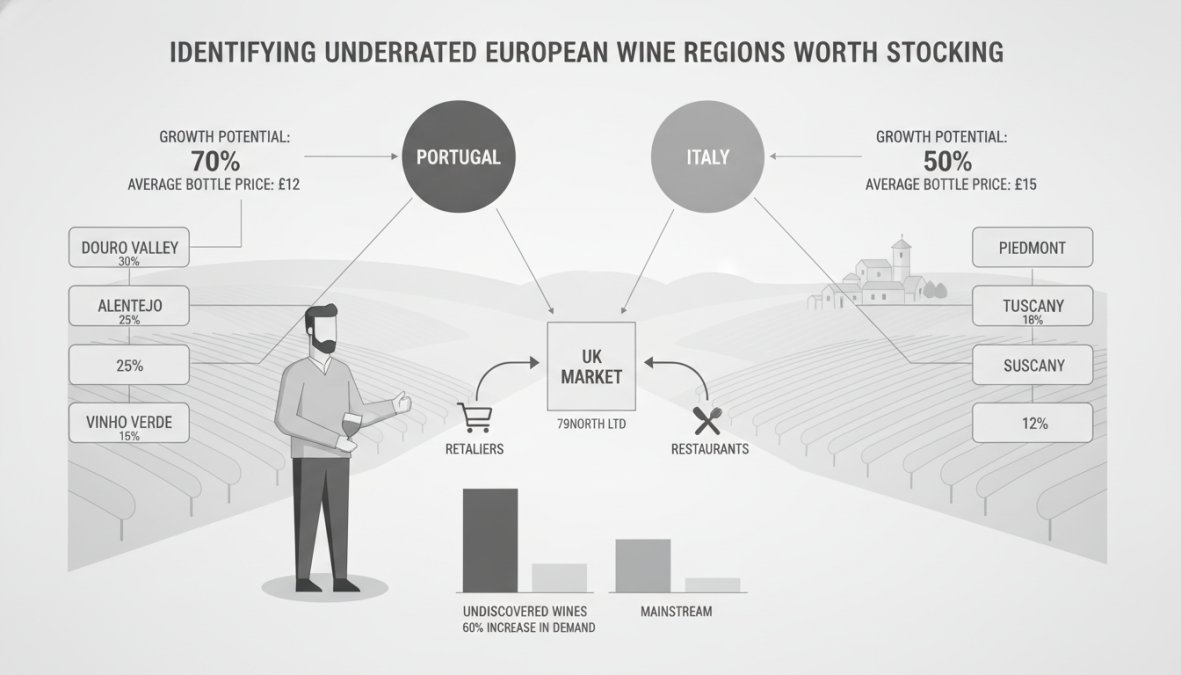
Identifying Underrated European Wine Regions Worth Stocking
The most exciting opportunities lie in regions producing world-class wines at a fraction of the price of prestigious appellations like Bordeaux, Burgundy, or Tuscany.
Portugal's Hidden Terroirs and Native Producers
Portugal represents perhaps the most undervalued wine region in Europe. It produces exceptional wines at price points impossible in France or Italy, yet remains largely unknown outside the UK. This creates significant stocking opportunity.
The Douro Valley produces exceptional dry red wines from native Portuguese grape varieties like Touriga Nacional, Touriga Franca, and Tinta Roriz. These are legitimate fine wines competing directly with Bordeaux blends at half the price. A Douro red typically costs £8-12 wholesale and retails at £18-24, offering margins that justify shelf space.
Alentejo offers fruit-forward reds with lower tannins and higher alcohol (14.5-15%), suited to restaurants seeking wines that pair broadly across menus. Portuguese wine is a value category, not a budget category. You can stock excellent wines your competitors haven't discovered and price them aggressively while maintaining healthy margins.
Italy's Small-Batch Winemakers Beyond the Mainstream
Puglia, in southern Italy, has quietly become one of Europe's most exciting wine regions. It produces wines from indigenous varieties like Primitivo and Negroamaro that remain virtually unknown outside Italy.
Small-batch producers typically make 5,000-15,000 cases annually, ensuring genuine scarcity. A Primitivo from Salento offers dark fruit, spice, and structure appealing to serious wine drinkers, yet costs substantially less than comparable Piedmont reds. Wholesale costs typically range from £6-10, with retail potential at £14-20.
Campania produces wines from Greco and Fiano grapes offering complexity and aging potential rivaling white Burgundy, yet priced like entry-level whites. The key to stocking Italian small-batch wines is understanding production scale. Wineries producing fewer than 10,000 cases annually need importers and retailers more than you need them, allowing you to negotiate better terms.
Indigenous European Grape Varieties: What to Look For
Stocking wines built on native grape varieties creates compelling customer stories and genuine differentiation. Mass-market wines use international varieties; undiscovered wines use indigenous varieties cultivated in specific regions for centuries.
Portuguese Native Varieties and Their Market Appeal
Touriga Nacional produces wines with deep color, firm tannins, and dark fruit characteristics (plum, blackberry, licorice) that age beautifully. Tinta Roriz produces slightly softer wines with red fruit and spice characteristics, offering versatility across diverse menus. Baga, from Bairrada, produces tannic, structured reds requiring 5-10 years aging but developing remarkable complexity.
For white wines, Alvarinho and Trajadura offer crisp, mineral-driven profiles appealing to customers seeking alternatives to Sauvignon Blanc or Pinot Grigio. These varieties produce wines with higher acidity and lower alcohol (11-12.5%), ideal for food pairing.
Italian Heirloom Grapes for Differentiation
Primitivo produces full-bodied reds with jammy fruit and spice, offering an entry point into Italian native varieties. Negroamaro blends with Primitivo to create wines with darker tannins and more structure, representing traditional Puglian winemaking.
Greco di Tufo produces white wines with mineral intensity and aging potential. These are serious wines with phenolic structure improving over 5-10 years. The market appeal of indigenous varieties lies in storytelling. Explaining that customers are drinking grapes cultivated in the same region for centuries using traditional methods creates emotional connection that justifies premium pricing.
Sourcing Undiscovered Wines: Direct vs. Importer Partnerships
The decision between direct sourcing and working with an importer represents the most consequential choice in stocking undiscovered European wines.
Why Direct Vineyard Sourcing Creates Compliance Headaches
Direct relationships feel appealing in theory but are substantially more complicated in practice. Small Portuguese estates cannot afford to sell 6 cases to a UK retailer, they need 24-48 case minimums. If you miscalculate demand, you're holding inventory that ties up capital and shelf space.
Export documentation creates compliance barriers. Exporting wine requires export licenses, phytosanitary certificates, certificates of origin, customs declarations, and UK import documentation. A customs broker typically charges £50-150 per shipment. For 4-6 annual shipments, you're spending £200-900 on documentation alone.
Temperature control during transport becomes your responsibility. Wine can spend 2-4 weeks in transit, and summer shipping containers can reach temperatures exceeding 25°C, causing premature aging and cork degradation. Communication barriers emerge quickly, and UK wine import regulations shifted substantially post-2020, requiring ongoing attention most retailers lack capacity for.
The Importer Advantage: Handling Customs, Licensing, and Supply Chain
A specialized wine importer absorbs these friction points entirely. They maintain current knowledge of UK customs regulations, handle export licensing, manage phytosanitary certificates, and navigate customs declarations. Professional importers maintain temperature-controlled shipping networks, negotiate shipping rates based on volume, and aggregate orders from multiple retailers to meet minimum order requirements.
An importer has built relationships with producers over years. When supply issues arise, they can negotiate solutions based on existing relationships. They taste every wine before importing, verify bottles meet quality standards, and typically offer net-30 or net-60 payment terms. The importer's margin, typically 15-25%, buys reliability, compliance, and peace of mind.
Legal Compliance and Import Regulations for UK Stockists
Understanding UK wine import regulations is non-negotiable for stocking undiscovered European wines. Violations carry penalties ranging from inventory confiscation to substantial fines.
Export Licenses, Customs Duty, and Duty Deferment
Wine imported from EU countries is subject to customs duty of £2.08 per liter, plus VAT on total value. For an £8 wholesale wine, duty adds approximately £1.50-2.00 per bottle, significantly impacting landed cost.
Duty deferment allows you to defer customs duty payment for up to 30 days after goods clear customs. This requires registration as an importer with HMRC and completion of a Customs Deferment Account application. An importer managing this on your behalf simplifies the process substantially.
Appellation Verification and Authenticity Documentation
UK regulations require wines be labeled accurately according to their appellation of origin. For wines from lesser-known producers, request certificates of origin, copies of producer export licenses, phytosanitary certificates, and proof of customs clearance. These documents should accompany every shipment.
Shipping Logistics and Cold-Chain Management
Wine is perishable. Proper temperature control during transport is non-negotiable for maintaining quality. A single shipment exposed to excessive heat can degrade wines worth thousands of pounds.
Temperature-Controlled Distribution for Wine Integrity
Wine quality deteriorates rapidly when exposed to temperatures above 18°C for extended periods. Summer shipping without temperature control can expose wine to temperatures exceeding 25°C, causing premature aging, cork degradation, and loss of aromatic compounds.
Professional cold-chain logistics maintain temperatures between 12-16°C throughout transit. For direct shipments, you arrange temperature-controlled transport at costs of £400-800 for a standard pallet (approximately 600 bottles) from Portugal to the UK. An importer consolidates shipments from multiple retailers, reducing per-unit expense to £0.50-1.00 per bottle.
Managing Inventory Turnover and Storage Conditions
Once wine arrives, proper storage becomes critical. Wine should be stored in cool environments (ideally 12-16°C, never exceeding 18°C), away from direct sunlight, in stable temperature conditions, and on its side for cork-sealed bottles.
Most independent retailers and restaurants lack dedicated wine storage facilities. The solution is managing inventory turnover aggressively. Wines should move through inventory within 3-6 months of arrival. This requires accurate demand forecasting, staff training, pricing that encourages purchase, and regular tastings. A common mistake is stocking wines speculatively. Undiscovered wines don't sell themselves, they require active merchandising, staff knowledge, and customer education.
Buying European Wines Online: Vetting Suppliers and Placing Orders
Sourcing undiscovered wines involves identifying reliable suppliers, evaluating their track records, and negotiating terms that work for your business.
Evaluating Supplier Reliability and Track Record
A reliable supplier should demonstrate established relationships with producers, transparent sourcing philosophy, quality verification practices, references from existing customers, complete documentation practices, and clear complaint resolution processes.
Ask whether they taste every wine before importing. Professional importers do and can discuss specific characteristics of each wine. Request contact information for 2-3 existing customers and ask specific questions: Do shipments arrive on time? Are quality issues handled fairly? Do they provide good support?
Verify they provide complete documentation with every shipment: certificates of origin, phytosanitary certificates, customs clearance confirmation, and detailed invoices. Ask how they handle quality issues, a professional importer should offer replacements or credits for damaged bottles.
Negotiating Terms, Minimum Orders, and Payment
When evaluating a supplier, negotiate these key terms:
Minimum order quantity. Some suppliers require 6-12 cases per SKU. Others work with single-case orders. For small retailers, single-case minimums are essential for managing inventory risk.
Payment terms. Standard terms are net-30 (payment due within 30 days). Some suppliers offer net-60 for established customers.
Pricing structure. Wholesale pricing typically ranges 40-50% off retail. Negotiate based on volume; larger orders should receive better pricing.
Exclusivity arrangements. Be cautious of exclusivity terms locking you into minimum commitments you can't meet.
Return and exchange policy. Clarify what happens if wine arrives damaged or if you miscalculate demand. A professional supplier should offer replacements for quality issues.
Tasting and training. Request in-person tastings with your staff. A supplier willing to invest time in training your team demonstrates commitment to your success.
| Negotiation Point | Standard Terms | What to Request |
|---|---|---|
| Minimum Order | 6-12 cases per SKU | 1-3 cases for flexibility |
| Payment Terms | Net-30 | Net-60 for established accounts |
| Pricing | 40-50% wholesale discount | Volume-based tiering |
| Exclusivity | Region-specific for premium wines | Only if you commit to volume |
| Returns | Quality issues only | 30-day exchange period for demand miscalculation |
| Training | Optional | Mandatory staff tastings before launch |
European Wine Cellar Management for Retail and Restaurant Stock
Once you've sourced undiscovered wines, managing your cellar becomes critical for protecting quality and maximizing profitability.
Organizing Inventory by Vintage, Appellation, and Terroir
Organize inventory by appellation (Douro, Alentejo, Puglia, Campania), by grape variety within each appellation, by vintage year, and by price point. This makes it easy to locate wines, discuss them knowledgeably with customers, and identify gaps in your portfolio.
For restaurants, prioritize accessibility. Wines you expect to sell within 2-3 weeks should be immediately accessible. Wines held for aging can be stored in less-accessible areas.
Rotation Strategies to Prevent Dead Stock
Dead stock represents significant financial drain. Prevent it through aggressive rotation: set clear sales targets (e.g., "this wine should move 3 cases per month"), price aggressively for movement if targets aren't met, conduct regular tastings, create limited-time promotions, and track sell-through rates.
After 90 days, any wine selling fewer than 2 cases per month should be evaluated for discontinuation or aggressive repricing. Some undiscovered wines will succeed and some will fail, this is normal. The key is identifying failures quickly and taking action before dead stock accumulates.
Stocking undiscovered European wines requires navigating compliance complexity, managing supply chain risk, and building customer relationships. The process is substantially easier when working with a dedicated importer who understands both the wines and the regulatory landscape. 79North Ltd specializes in representing small, family-owned producers from Portugal and Italy, wineries producing exceptional wines yet remaining unknown to most UK retailers. We handle export licensing, manage temperature-controlled logistics, verify authenticity, and provide staff training. Let's talk about how we can help you build a distinctive wine portfolio that sets your business apart.
Frequently Asked Questions
What makes underrated European wine regions worth stocking for my business?
Underrated European wine regions offer distinctive terroir, unique native grape varieties, and authentic small-batch production that differentiate your inventory from competitors. Regions like Alentejo in Portugal and smaller Italian appellations produce fine wines at better value-for-money than established areas. These wines appeal to customers seeking discovery and authenticity, helping independent retailers and restaurants build loyal followings around curated, lesser-known selections.
How do I navigate customs and import regulations when stocking undiscovered European wines?
Import regulations require export licenses from the producer, customs duty documentation, and compliance with UK appellation standards. Working with a professional importer handles this complexity, they manage export licensing, verify authenticity, process customs declarations, and ensure duty deferment arrangements. Direct sourcing from vineyards often fails because small producers lack export infrastructure. An importer bridges this gap, ensuring your wines arrive legally compliant and ready for retail or restaurant service.
What indigenous European grape varieties should I prioritize when buying European wines online?
Focus on native varieties that create market differentiation: Portuguese grapes like Jampal, Touriga Nacional, and Baga offer distinctive character; Italian heirlooms such as Nero d'Avola and Vermentino provide authentic regional expression. These varieties showcase terroir better than international grapes, appeal to wine enthusiasts seeking blind tasting experiences, and support small winemakers committed to preserving cultural heritage. Prioritize producers using traditional winemaking methods over industrial bottling.
Can small retailers and restaurants actually work with specialist wine importers, or do they require large volume commitments?
Professional importers serving independent businesses understand diverse volume needs. Unlike major distributors requiring substantial minimum orders, specialist importers work with small restaurants and wine shops through flexible terms, smaller initial commitments, tailored selection, and support for inventory management. They provide supply chain reliability, cold-chain logistics, and wholesale representation that direct vineyard sourcing cannot match, making partnership viable regardless of your business size.
This article was written using GrandRanker