Serving Temperature for Mature Red Wines
Table of Contents
- Why Serving Temperature Matters for Mature Red Wines
- Understanding the Red Wine Serving Temperature Chart
- How to Serve Aged Red Wine at the Perfect Temperature
- How to Decant Mature Red Wine Properly
- How Long to Decant Old Red Wine
- Common Mistakes When Serving Mature Red Wines
- Frequently Asked Questions
Last Updated: October 17, 2026
Why Serving Temperature Matters for Mature Red Wines
Getting the serving temperature right transforms how a mature red wine tastes. Too cold and the flavours shut down. Too warm and the alcohol burns through, drowning everything else.
This is where many people stumble. They pull a mature red from storage and serve it at room temperature without thinking. But "room temperature" is a relic from colder British homes.
At 79North Ltd, we work with independent restaurants and wine shops stocking premium Portuguese and Italian wines. The difference between 16°C and 19°C isn't trivial, it's the difference between a wine tasting balanced and refined versus hot and one-dimensional.
The serving temperature for mature red wines sits lower than most people assume. Mature reds develop delicate secondary flavours, leather, tobacco, dried fruit, that vanish when heat overwhelms them. Tannins, which were aggressive when the wine was young, have softened and integrated.
Understanding the Red Wine Serving Temperature Chart
The ideal serving temperature for mature red wines depends on age, style, and, critically, how the wine has been stored. Wines aged 10+ years typically perform best between 15°C and 17°C. Wines aged 5-10 years sit comfortably at 16°C to 18°C. Younger reds, even premium ones, can handle 18°C to 20°C. But these figures assume the wine has been held at a stable cellar temperature; a bottle that has endured temperature swings needs more careful handling.
These aren't arbitrary numbers. Temperature affects how tannins present on the palate, how volatile compounds reach your nose, and how the wine's structure unfolds. A mature Barolo tastes completely different at 14°C versus 19°C. The difference is not linear, the perception of sweetness, acidity, and body all shift as the wine warms.
Temperature Ranges by Wine Age and Style
Very old wines (15+ years): 14°C to 16°C. These have lost most aggressive tannins and developed fragile secondary characteristics. Heat accelerates oxidation and flattens complexity.
Mature wines (8-15 years): 15°C to 17°C. This range preserves the wine's balance while allowing flavours to open gradually. It is the sweet spot for most aged reds from Bordeaux, Burgundy, and the Douro.
Mid-aged wines (5-8 years): 16°C to 18°C. Still developing, these wines have structure to handle slightly warmer temperatures without losing definition.
Premium young reds (2-5 years): 17°C to 19°C. More tannin structure means these can tolerate warmth without losing definition. But even here, avoid the modern centrally heated room at 21°C, that is too warm for any red wine.
The key insight: older wines need cooler service. As wine ages, its fragility increases. What seemed strong at five years becomes delicate at fifteen.
How Temperature Affects Tannin Structure and Aroma
Temperature controls how tannins feel in your mouth and how aromatic compounds volatilize into your nose. Tannins become softer and rounder as they age through oxidation and polymerization. Serve an old wine too warm and you reactivate that astringency, the wine tastes harsh again.
Aromatic compounds behave differently at different temperatures. Some volatile esters evaporate faster when warm, which is why young wines benefit from slightly higher serving temperatures, you want those fresh fruit aromas to jump out. Mature wines develop less volatile, more complex aromas, leather, tobacco, dried fruit, forest floor.
This is why thermal insulation matters. Once you reach the right temperature, you want to maintain it. A wine served at 16°C that warms to 18°C during the meal tastes progressively different, and usually worse, with each sip.
The Storage-to-Service Temperature Gradient
A factor most guides overlook: the temperature at which the wine has been stored directly affects how long it takes to reach serving temperature and how gracefully it makes the transition.
If your storage runs warmer, say 16°C, the wine is already close to service temperature and needs only 10-15 minutes to adjust. But if storage has fluctuated between 10°C and 20°C over the wine's life, the wine's structure may already be compromised, and it will be less forgiving of any serving temperature error.
For restaurants and wine shops, the practical takeaway is to measure the temperature of the wine as it leaves storage, not just the room. A wine that has been sitting in a warm back-of-house area for a week may already be too warm before it reaches the table. Use a wine thermometer to check the bottle temperature before service, and adjust your timing accordingly.
How to Serve Aged Red Wine at the Perfect Temperature
Start by knowing your wine's age and style. Check the vintage and ask the producer or importer about the wine's development profile. Different regions age differently. A Portuguese Touriga Nacional from a warm year ages faster than a cooler-vintage Barolo.
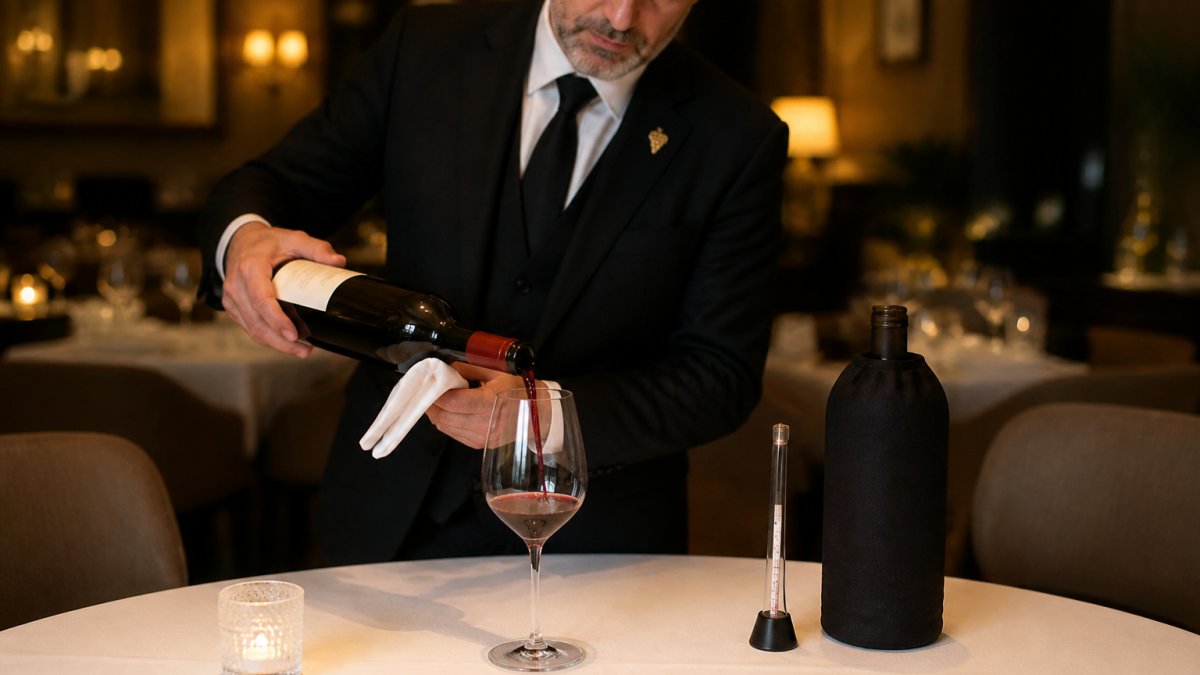
Measure the temperature. Use a wine thermometer, they cost a few pounds and are far more reliable than guessing. Place it in the bottle or in a glass after pouring a small sample. This takes thirty seconds and changes everything.
Bringing Wine to Temperature Without Damage
Never use heat directly. No microwave, no hot water immersion, no radiator. These methods heat unevenly and damage the wine's structure. Instead, move the bottle gradually from cool storage into your service area thirty to forty minutes before opening.
For wines stored too cold, remove them from the fridge and let them sit on a sideboard. The ambient temperature of a restaurant or dining room (typically 18-20°C) will warm them naturally.
If your storage runs too warm, the inverse applies: chill the bottle gently in an ice bucket for ten to fifteen minutes before service. Fill the bucket with ice and water, not ice alone, which chills too aggressively.
The goal is stability. A wine that drifts from 15°C to 22°C over two hours tastes worse with every pour. Thermal mass, the bottle's ability to resist temperature change, depends on the glass thickness and the wine's volume.
The Role of Thermal Insulation in Maintaining Consistency
Wine sleeves and insulated buckets preserve serving temperature throughout the meal. A good insulated sleeve keeps a bottle at its target temperature for two to three hours. This matters for restaurants and wine shops where service stretches across multiple hours.
Thermal insulation works by slowing heat transfer. The wine inside the bottle radiates heat outward. Insulation creates a barrier that slows this process. Materials like neoprene or thick foam work well. Even a simple linen napkin wrapped around the bottle helps.
Herdade da Calada 2020 Caladessa Reserva Tinto Vinho →
A wine that starts at 16°C shouldn't reach 19°C by the time the customer reaches the bottom of the glass.
How to Decant Mature Red Wine Properly
Decanting serves two purposes for aged wines: it separates the wine from sediment, and it introduces oxygen gradually. Mature reds develop sediment as tannins and colour compounds precipitate over years. This sediment tastes bitter and gritty.
The decanting process also aerates the wine. Young wines need vigorous aeration to open up. Mature wines need gentle aeration, you want oxygen exposure without aggressive splashing that accelerates oxidation.
Decanting Technique and Sediment Settling
Pour slowly and deliberately. Tilt the bottle at a shallow angle and let the wine flow down the side of the decanter. Watch the neck of the bottle against a light source, you'll see sediment approaching as a dark shadow. Stop pouring when sediment reaches the bottle's neck.
This takes practice, but the principle is simple: move wine into the decanter until you see sediment starting to flow. The first few bottles might waste an ounce or two, but you'll refine the technique quickly.
Use a funnel with a fine mesh if you're nervous. It catches larger particles. For very old wines prone to heavy sediment, you might decant through cheesecloth or a coffee filter, though this slows the process considerably.
The decanter itself should be clean and dry. Any residual water dilutes the wine. Use a decanter brush and hot water to clean, then dry thoroughly before use.
How Long to Decant Old Red Wine
Decanting time depends on the wine's age and condition. Very old wines (20+ years) need only five to ten minutes. They're fragile. Extended aeration accelerates oxidation and can flatten delicate flavours.
Mature wines (10-20 years) benefit from fifteen to twenty minutes of decanting. This allows gentle aeration without over-exposing the wine to oxygen.
Younger premium reds (5-10 years) can handle thirty to forty minutes of decanting. They still have structure to support more vigorous aeration.
The rule of thumb: the older the wine, the shorter the decant. If you're uncertain, start conservative. You can always leave the wine open longer. You can't undo over-oxidation.
Air Circulation and Oxidation During Decanting
Oxidation is both beneficial and dangerous for mature wines. A small amount of oxygen exposure opens the wine and softens harsh edges. Too much oxygen damages it irreversibly.
When you decant, you increase the wine's surface area exposed to air. The wider the decanter's opening, the faster oxidation occurs. A narrow-necked decanter exposes less surface area and slows oxidation. A broad, shallow decanter accelerates it.
This is why decanter shape matters. For aged wines, choose a decanter with a narrower opening and taller profile. These designs minimize oxidation risk while still providing gentle aeration.
Once decanted, keep the wine away from direct sunlight and heat sources. UV light and warmth accelerate oxidation. Serve the decanted wine within two hours for optimal results. After that, oxidation becomes noticeable and usually negative.
Common Mistakes When Serving Mature Red Wines
The biggest mistake is serving too warm. Restaurants often keep wines in warm back-of-house areas, then serve them at 20-22°C. For a mature wine, this is too hot.
Another common error is decanting too aggressively. People assume all red wines need vigorous aeration. Mature wines don't. Gentle aeration is all they need.
Serving in the wrong glassware also undermines the effort. Use a bowl-shaped glass that concentrates aromas and allows the wine to open gradually.
Storing bottles upright before service is another mistake. Mature wines with cork closures should rest on their side so the cork stays moist. A dry cork shrinks, lets air in, and allows oxidation.
Finally, rushing the process. Mature wines need time to transition from storage to service. Don't pull a bottle from a cool cellar and serve it immediately.
Serving mature red wines correctly isn't complicated, but it does require attention to detail. Our portfolio includes mature Reserva wines like the Herdade da Calada 2020 Caladessa Reserva Tinto and elegant aged selections that demand proper handling.
Frequently Asked Questions
What is the ideal serving temperature for mature red wine?
Mature red wines typically serve best between 16°C and 18°C. This range preserves the wine's complexity and allows its developed flavours to emerge without volatilising the aromatic compounds. Wines aged 10 years or longer benefit from the lower end of this range, while younger reds (5-10 years old) can handle 17-18°C. Temperature stability matters more than hitting an exact degree; fluctuations damage the wine's structure more than a consistent 1-2°C variance.
How long should mature red wine decant before serving?
Mature red wines typically need 30 minutes to 2 hours of decanting, depending on age and style. Wines over 20 years old may need only 30-45 minutes to separate sediment without excessive oxidation. Wines aged 10-20 years benefit from 1-1.5 hours, allowing air circulation to soften tannins whilst preserving delicate aromatics. Decant slowly and stop if the wine's aroma becomes thin or flat; some mature wines deteriorate quickly once opened.
Should mature red wine be served at room temperature?
Not modern room temperature. The phrase 'room temperature' originated when homes averaged 16-18°C. Today's heated interiors reach 20-22°C, which is too warm for mature reds and causes alcohol to dominate, masking subtle flavours developed through ageing. Serving at 16-18°C reveals the wine's true character: balanced tannins, integrated oak influence, and the complexity that makes mature wines worth their investment. Use a wine cooler or ice bucket to bring the bottle down if necessary.
Can you chill mature red wine before serving?
Yes, light chilling is beneficial. Bringing a mature red from cellar temperature (10-12°C) to serving temperature (16-18°C) actually enhances the experience by preventing alcohol warmth from overwhelming delicate aromatics. However, avoid aggressive chilling below 10°C, which numbs the palate and masks the wine's developed complexity. If a bottle is warm, place it in an ice bucket for 10-15 minutes rather than the freezer, which risks thermal shock and cork degradation from rapid temperature swings.