Sicilian volcanic wines for restaurant menus
Table of Contents
- Why Sicilian volcanic wines belong on your restaurant menu
- Understanding volcanic terroir and what it means for your wine list
- Etna Rosso: the red wine that defines Mount Etna's reputation
- Nerello Mascalese and Nerello Cappuccio: native grapes worth featuring
- Carricante wine and white varieties from volcanic slopes
- Sicilian wine and food pairing: building a cohesive menu strategy
- Practical buying and service considerations for independent restaurants
- Frequently Asked Questions
Last Updated: October 8, 2026
Why Sicilian volcanic wines belong on your restaurant menu
Sicilian volcanic wines are among Europe's most distinctive, food-friendly expressions for independent restaurants. Grown on mineral- and ash-rich volcanic slopes, they deliver clarity, precision, and natural acidity that work across diverse menus.
Independent restaurants can use Sicilian volcanic wines to differentiate instantly. They tell a story of place and pair intelligently with contemporary food without extensive staff training.
The challenge is sourcing them reliably. Direct importing means customs paperwork, minimum order quantities, and relationship management most restaurants can't sustain alone.
Understanding volcanic terroir and what it means for your wine list
Volcanic terroir refers to the environmental and geological characteristics of vineyards on volcanic land.
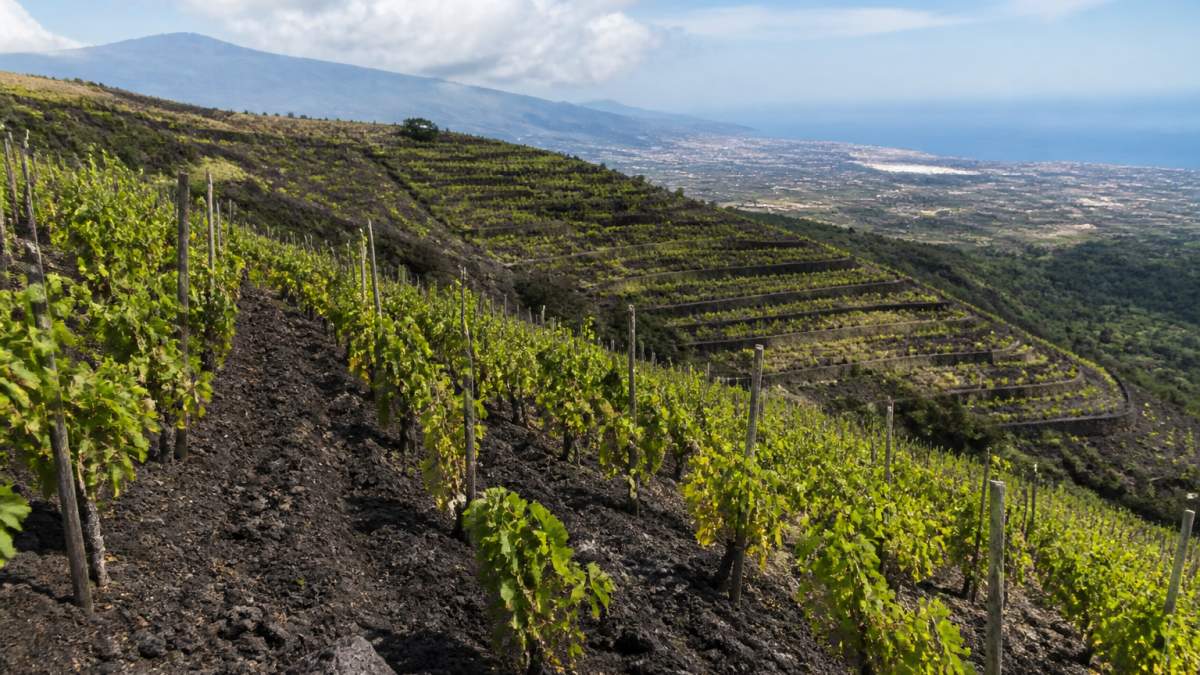
For menus, this means built-in food compatibility: the acidity cuts through rich dishes, while the mineral character complements seafood, vegetables, and lighter proteins.
Mount Etna dominates the conversation, and rightfully so: its slopes create microclimates and soil variations that allow remarkable range.
The practical advantage: volcanic wines age gracefully without decades in cellar.
Etna Rosso: the red wine that defines Mount Etna's reputation
Etna Rosso is the principal red from Mount Etna's volcanic slopes and the wine most diners will recognise.
Serious producers' Etna Rosso ages remarkably: young bottles show bright red fruit and mineral precision, while after five to ten years they develop dried herbs, leather, and earth.
Quality varies considerably by producer: smaller, family-owned wineries on the volcano's slopes often produce more compelling wines than larger commercial operations.
Nerello Mascalese and Nerello Cappuccio: native grapes worth featuring
Nerello Mascalese is Mount Etna's principal red grape and the primary component in Etna Rosso.
For wine buyers, Nerello Mascalese is an opportunity to educate diners about authentic Sicilian wine culture.
Nerello Cappuccio is a related variety, darker and slightly riper, often blended into Etna reds. Some producers make single-varietal bottlings showing deeper colour and riper fruit while keeping volcanic mineral precision.
Both grapes need proper service temperature and glassware: serve slightly cooler than a Bordeaux, in glasses that let the wine open without overwhelming the palate. Staff familiarity with these details drives repeat orders.
Carricante wine and white varieties from volcanic slopes
Carricante is Mount Etna's signature white grape, producing wines of remarkable precision and mineral intensity.
For menus, white volcanic wines solve a real problem: they work with seafood, lighter proteins, and vegetable-forward dishes without tasting thin or anonymous.
Beyond Carricante, Catarratto, Grecanica Dorato, and Grillo all show distinctive character in volcanic soils. A mix of white varieties demonstrates menu sophistication and gives diners options beyond the familiar.
The challenge is availability: whites are produced in smaller quantities than reds, and many bottles never leave Italy.
Sicilian wine and food pairing: building a cohesive menu strategy
Most articles on Sicilian volcanic wine stop at "seafood with white, red meat with red", true but useless when assigning a glass to each of twenty dishes.
Use the grid below as a starting point. It is organised by menu role rather than by grape, so you can drop it straight into a tasting note sheet for staff.
| Menu role | Dish examples | Best volcanic style | Why it works |
|---|---|---|---|
| Raw and cured seafood | Crudo, oysters, ceviche, smoked salmon | Etna Bianco (Carricante-led), young | High acidity and salinity lift briny, delicate flavours without masking them |
| Fried fish and seafood | Fritto misto, fried whitebait, salt cod fritters | Carricante or a Carricante/Catarratto blend, chilled | Acidity and mineral cut through batter and oil; citrus notes echo lemon garnish |
| Grilled and roasted fish | Grilled sea bream, roasted monkfish, swordfish | Etna Bianco with a year or two of bottle age | Slightly rounder texture matches char and olive oil without losing freshness |
| Shellfish pasta | Vongole, lobster linguine, crab tagliolini | Etna Bianco or a dry Grillo from volcanic soils | Saline edge mirrors the sea; acidity balances garlic, chilli and oil |
| Vegetable-forward and grilled vegetables | Aubergine, courgette, peppers, caponata | Etna Rosso served cool, or Etna Bianco | Nerello Mascalese's herbal, earthy notes echo charred vegetables |
| Tomato-based pasta and pizza | Norma, amatriciana, tomato sugo | Etna Rosso, young to mid-aged | Natural acidity meets tomato's own acidity instead of fighting it |
| Pork and pork sugo | Sicilian ragù, sausage, slow-roast pork belly | Nerello Mascalese-dominant Etna Rosso, mid-weight | Red fruit and fine tannin handle richness without overpowering |
| Richer red meats | Lamb, beef short rib, game | Etna Rosso with bottle age, or a Nerello Cappuccio-led blend | Deeper colour and riper fruit from Cappuccio stand up to fat and char |
| Aged hard cheeses | Pecorino, aged caciocavallo | Aged Etna Rosso | Savoury, leathery secondary notes mirror the cheese's umami |
Three rules make the matrix work in service:
- Match acidity to acidity, not colour to colour. Tomato, lemon, vinegar and fried coatings all respond to a wine with high natural acidity, which is why a chilled Etna Rosso can outperform a heavier red on a tomato dish.
- Serve volcanic reds cooler than you would a Bordeaux. Around 13-14°C keeps the mineral and red-fruit character forward; warmer and the wines can read thin rather than generous.
- Keep one wildcard by the glass. A skin-contact white or a single-varietal Nerello Cappuccio gives curious diners a talking point and lifts average spend without complicating the core list.
For a tasting menu, a workable arc is: a young Etna Bianco with the opening seafood course, a bottle-aged Etna Bianco with a grilled or roasted fish course, a young Etna Rosso with a tomato or vegetable course, and an aged Etna Rosso with the pork or red-meat main.
In restaurants that adopt this approach, the same three or four volcanic wines typically do most of the pairing work. That's a feature, not a limitation: fewer references means faster staff fluency, tighter stock control, and less waste from open bottles.
Practical buying and service considerations for independent restaurants
This is the section most Sicilian volcanic wine articles skip, the working framework covering sourcing, pricing, vintage and service that independent operators actually need.
Sourcing and availability
Etna DOC wines are produced in relatively small volumes compared with mainstream Italian appellations, and the better producers allocate tightly. In practice this means:
- Plan a season ahead. Most specialist importers open allocations in spring for autumn delivery. Waiting until you need the wine usually means taking whatever is left.
- Expect tiered pricing within Etna. Entry-level Etna Rosso and Etna Bianco sit at accessible price points; single-vineyard (contrada) bottlings and Riserva-level wines can be two to three times the entry price. Build your list around the entry and mid tiers, and use one or two contrada wines as your top-end by-the-bottle options.
- Ask about vintage continuity. Volcanic vintages vary more than many regions because of altitude and exposure. A reliable importer will tell you which vintages are drinking well now and which to hold, rather than pushing whatever is in the warehouse.
- Confirm the appellation on the label. Etna DOC, Etna Rosso DOC and Etna Bianco DOC are the protected names. Wines labelled simply "Sicilia DOC" may still come from volcanic soils but carry no guarantee of origin, grape composition or ageing. For a menu that leans on the volcanic story, the DOC label is your proof point.
- Have a substitution ready. If your chosen Carricante sells out, a dry Grillo or a Catarratto-led white from volcanic soils is the closest stylistic stand-in. Note the swap on your list rather than leaving a gap.
Pricing and by-the-glass economics
Volcanic wine economics are more favourable than their reputation suggests: the story justifies a modest premium without the wine being a luxury item. A workable approach:
- Target a bottle cost that lets you hit a 3x to 3.5x multiplier on the list. This is the common range for independent restaurants and keeps the wine accessible enough to sell by the glass as well as by the bottle.
- Work out your pour yield before you set the glass price. A standard 175ml pour gives roughly four glasses from a 75cl bottle; a 125ml pour gives roughly six. If you sell both by the glass and by the bottle, price the glass so four glasses recover more than the bottle price, otherwise guests will simply order the bottle.
- Protect against waste on slower lines. For a white you expect to sell two or three glasses a night, consider a preservation system or list it by the bottle only. Volcanic whites are delicate and do not hold well once opened.
- Use the story to justify the price, not to inflate it. Diners accept a premium for a wine with a genuine place-based narrative. They resist a premium for a wine that is merely unfamiliar.
Storage and service
- Cellar temperature: 10-15°C, away from light and vibration. Volcanic wines are not fragile, but heat and light will strip the freshness that makes them worth listing.
- Red service temperature: around 13-14°C. Cooler than a Bordeaux or Burgundy, which lets the mineral and red-fruit character lead rather than the alcohol.
- White service temperature: around 10-12°C. Slightly warmer than a typical fridge-cold white, so the salinity and stone-fruit notes are not muted.
- Glassware: a medium-bowl universal glass works for both reds and whites. You do not need a different glass per wine, which keeps the bar simple and the breakage bill down.
- Decanting: young Etna Rosso benefits from 20-30 minutes in a decanter or a wide glass to open up. Older bottles need less; a quick pour and a moment in the glass is usually enough.
Staff training in ten minutes
Staff don't need to recite soil types. Give them three sentences per wine, in their own words:
- Where it is from: "Grown on the slopes of an active volcano in Sicily."
- What it tastes like: "Fresh, mineral, more elegant than a typical Italian red."
- What to eat with it: "Great with the grilled fish" or "Works with the tomato pasta."
Run a short pre-service tasting once a week with one wine and one dish from the menu. Staff who have tasted the pairing sell it far more often than staff who have only read about it.
Get these four areas right, sourcing, pricing, service and staff fluency, and Sicilian volcanic wines can become a reliable, high-margin section of your list.
Frequently Asked Questions
What makes Sicilian volcanic wines different from other Italian wines?
Sicilian volcanic wines gain their distinctive character from the mineral-rich volcanic soils of Mount Etna and other volcanic zones. These soils impart a saline, mineral quality that sets them apart. Native grape varieties like Nerello Mascalese, Carricante, and Catarratto thrive in high-elevation, steep-slope vineyards, producing wines with bright acidity and complex flavours that reflect the unique terroir. This combination makes them ideal for restaurant menus seeking authentic, regionally distinctive offerings.
Which Sicilian grape varieties work best for a by-the-glass wine list?
Nerello Mascalese offers excellent versatility for by-the-glass service, with bright acidity and moderate tannins that pair well with multiple dishes. Carricante white wines provide crisp, mineral-driven profiles that appeal to diners seeking something different from mainstream whites. Grillo and Catarratto also perform well by the glass, offering approachable flavour profiles with good food compatibility. High-elevation vineyard wines tend to have fresher, more vibrant character that translates well in smaller pours.
How should I describe Sicilian volcanic wines on my restaurant menu?
Lead with terroir and grape variety rather than generic descriptors. For example: 'Nerello Mascalese, Mount Etna, mineral-driven red from volcanic slopes' or 'Carricante, high-elevation white with saline character.' Mention the volcanic soil connection, as it signals quality and authenticity to knowledgeable diners. Reference specific food pairings if space allows. This approach educates your staff and justifies premium pricing while positioning your list as curated rather than generic.
What food pairings make Sicilian volcanic wines sell better on a restaurant menu?
Nerello Mascalese pairs beautifully with pork-based dishes, lamb, and tomato-based sauces common in Mediterranean cuisine. Carricante and other white varieties complement fried fish, seafood, and lighter pasta dishes. The high acidity and mineral character of volcanic wines cut through rich, fatty foods effectively. Positioning these wines as 'chef's recommendations' for specific tasting menu courses increases sales and creates a cohesive dining narrative that justifies their presence on your list.