Benefits of Sourcing Organic Wines from Small European Vineyards
Table of Contents
- Why Small European Vineyards Are Changing the Organic Wine Conversation
- What Is Organic Wine? A Practical Definition for Buyers
- Organic Wine Certification Standards: EU Organic, Euro-Leaf, and National Labels
- Environmental Benefits of Organic Viticulture in Small Vineyards
- The Benefits of Native Grape Varieties for Terroir and Flavour
- Natural vs Organic vs Biodynamic Wine: What's the Difference?
- How Small-Batch European Sourcing Supports Rural Communities and Local Economies
- Conclusion
- Frequently Asked Questions
Last Updated: September 13, 2026
Why Small European Vineyards Are Changing the Organic Wine Conversation
The benefits of sourcing organic wines from small european vineyards start with a simple fact: scale changes everything. A family estate farming a few hectares can treat every vine individually, while an industrial operation manages thousands of acres by formula. At 79North Ltd, we import from family-owned producers in Portugal and Italy precisely because that difference shows up in the glass.
Small estates also protect grape diversity. Many still grow heritage varieties that large producers abandoned decades ago, and those vines carry flavours you simply cannot buy elsewhere. Below, we break down what organic certification actually means, how small-batch sourcing supports rural communities, and why the practical advantages go well beyond the label.
What Is Organic Wine? A Practical Definition for Buyers
Organic wine is wine made from grapes grown without synthetic pesticides or fertilisers, produced under strict certification rules that cover the vineyard and the winery. In practice, that means the grower works with compost, cover crops and natural pest controls rather than chemical sprays.
The EU organic farming rules set out exactly what growers may and may not use, and every bottle sold as organic in the UK must carry a certification code. For buyers, the useful test is simple: check the code, then check who grew the grapes. A certified small estate and a certified industrial vineyard meet the same legal standard, but they rarely farm the same way.
Organic Wine Certification Standards: EU Organic, Euro-Leaf, and National Labels
Organic wine certification standards vary by scheme, and the differences matter when you build a wine list. The EU organic logo, commonly called the Euro-leaf, guarantees the wine meets EU-wide production rules. National labels, such as the organic marks issued by individual member states, add their own inspection regimes on top.
- EU Organic / Euro-leaf: the baseline certification recognised across Europe
- National organic marks: country-specific schemes with their own inspection bodies
- In-conversion status: vineyards mid-way through the multi-year switch to organic
What most buyers miss is that certification is audited annually, so a producer cannot quietly cut corners. Ask your importer for the certification body and certificate number before you list a wine as organic. That single question separates genuine organic sourcing from marketing copy.
Environmental Benefits of Organic Viticulture in Small Vineyards
The environmental case for organic viticulture is strongest where farming is intensive and hands-on. Small vineyards that avoid synthetic pesticides protect soil structure, encourage biodiversity and keep chemicals out of local water systems. But the mechanisms matter more than the headline, because they explain why a three-hectare family estate often outperforms a certified industrial vineyard on the same standard.
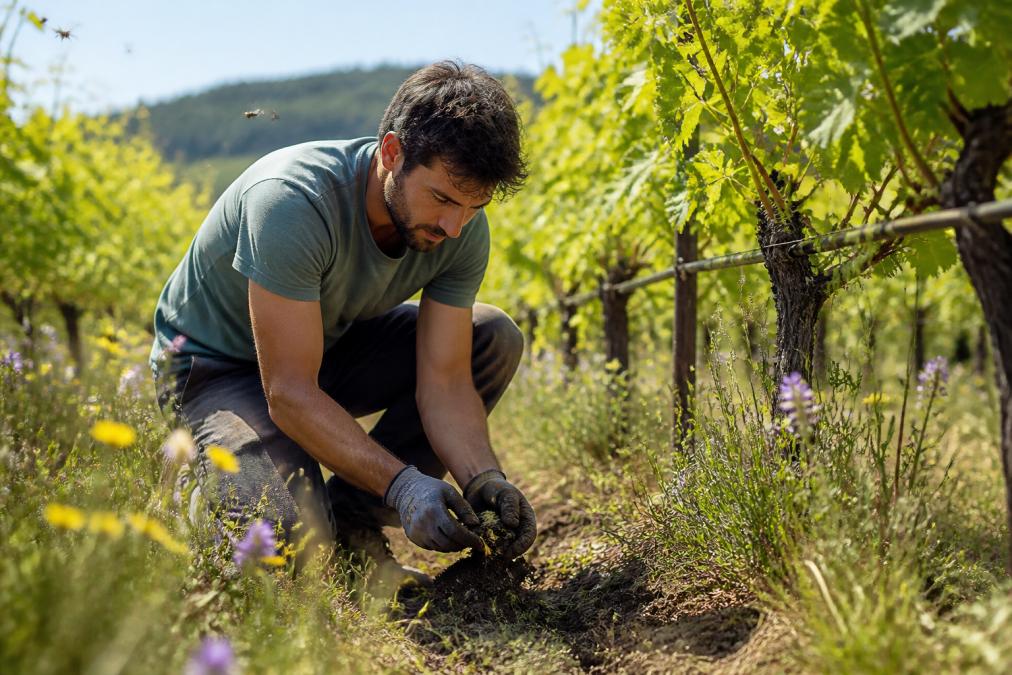
Soil health and water retention. Organic growers build organic matter through compost, cover crops and reduced tillage. That organic matter acts like a sponge: it holds water during dry spells and improves drainage during heavy rain. A common pattern on small estates is that the grower knows each block's water behaviour individually and can adjust cover-crop mixes row by row, rather than applying one field-wide prescription. The practical result is a vineyard that stays productive through a drier summer without leaning on irrigation or chemistry.
Biodiversity in the vineyard. Avoiding synthetic pesticides and herbicides allows beneficial insects, wildflowers and soil fauna to return. Small estates often plant hedgerows, leave wild margins and mow between rows rather than spraying them bare. These habitats support predatory arthropods that keep pest populations in check, which reduces the need for intervention in the first place. The vineyard becomes a working ecosystem rather than a monoculture kept alive by inputs.
Pest management without synthetic pesticides. Organic does not mean passive. Growers manage pests through beneficial arthropods, pheromone traps, kaolin clay, copper and sulphur preparations, and careful timing of interventions. The trade-off is real: organic control is slower and more labour-intensive, and a small estate has less buffer if a season goes wrong. That is precisely why small-scale growers tend to scout their vines constantly rather than following a calendar spray programme.
Water systems and local landscapes. Because synthetic pesticides and soluble fertilisers are not applied, there is less risk of run-off into streams, groundwater and neighbouring land. On a small estate surrounded by other farms, that matters beyond the vineyard boundary. The wider landscape stays alive around it, and the grower has a direct interest in keeping it that way because the family lives there.
The small-estate advantage. A large operation can meet the same legal organic standard by formula. A family estate can meet it by attention: choosing the right cover crop for one slope, delaying a treatment by two days because the weather is about to change, or leaving a wild margin because the beneficial insects need somewhere to overwinter. That is the difference between certification as a baseline and certification as a starting point.
The Benefits of Native Grape Varieties for Terroir and Flavour
Native grape varieties are the clearest advantage of small European estates. Because these vines evolved in one place over centuries, they express that site's terroir in ways international varieties cannot.
Portugal alone grows hundreds of indigenous grapes, and small producers still bottle varieties that rarely leave the region. A grower working with heritage vines picks at the moment that suits that grape, not the moment that suits a tank schedule. The trade-off is real: native varieties can be lower-yielding and harder to sell to buyers who only recognise famous names. But they give your list something no supermarket can replicate, and customers remember wines they cannot find elsewhere.
Natural vs Organic vs Biodynamic Wine: What's the Difference?
Natural, organic and biodynamic wine are three different things, and conflating them causes most of the confusion in this category. The distinction is not academic: it determines what you can legally claim on a wine list, what your importer can prove, and what your customers are actually drinking.
Organic wine is a certified farming and production standard. In the EU, organic wine must be made from organically grown grapes and produced under rules that cover both the vineyard and the winery, including permitted additives and sulfite limits (ec.europa.eu). Every bottle sold as organic in the UK carries a certification code and the Euro-leaf logo or an equivalent recognised mark. The standard is audited annually, so a producer cannot quietly cut corners between inspections.
Biodynamic wine starts from organic certification and adds a specific holistic philosophy, typically associated with Demeter certification. Biodynamic growers treat the farm as a single organism and follow preparation and timing protocols that go beyond organic rules. The certification is separate and stricter in its own way, which is why biodynamic bottles usually carry both marks.
Natural wine has no single legal definition in the EU or the UK. In practice it usually means minimal intervention: native yeast fermentation, no or very low added sulfites, no filtration or fining, and nothing added or removed. Because there is no binding standard, quality and stability vary enormously between producers. Some natural wines are outstanding; others are volatile or unstable. Without certification, you are trusting the producer's word.
| Type | What It Means | Certification | Typical Sulfite Levels |
|---|---|---|---|
| Organic | Grapes grown without synthetic pesticides, winery rules apply | Legally certified (EU Organic / Euro-leaf or recognised national mark) | Lower than conventional, capped by regulation |
| Biodynamic | Organic plus holistic farming methods and preparations | Certified by specific bodies (e.g. Demeter) | Lower than conventional |
| Natural | Minimal intervention, additive-free leaning | Often uncertified, no single legal definition | Varies widely, often very low or none added |
Certification nuances buyers should know. The Euro-leaf is the baseline EU-wide mark. National organic marks issued by individual member states add their own inspection regimes on top, so a bottle can carry both. Vineyards mid-way through the multi-year switch to organic are described as 'in-conversion' and cannot yet be sold as organic. For a wine list, organic is the safest claim because it is auditable: ask your importer for the certification body and certificate number. Biodynamic is equally auditable if the producer holds the relevant certification. Natural is a useful descriptor but not a guarantee.
What this means for sulfites and how a wine feels. Lower sulfite levels are a genuine plus for many drinkers, and organic and biodynamic rules cap them more tightly than conventional production. But sulfites are not the only thing that affects how a wine feels the next morning: alcohol, histamines, tannins and how much you drank all play a part. Treat 'low sulfite' as one useful signal among several, not a health claim.
How Small-Batch European Sourcing Supports Rural Communities and Local Economies
Small-batch European sourcing keeps money in rural areas that larger supply chains bypass. When a family estate sells directly to an importer, the margin stays with the people who farmed the grapes rather than disappearing into a bulk blend.
Rural depopulation is a real pressure across wine-growing regions, and a reliable export partner can be the difference between a village keeping its winery and losing it. The European Commission's long-term vision for rural areas highlights how farm-level economic activity sustains services and jobs in the countryside. There is a logistical advantage too: small-batch shipments let you test a wine, gauge demand and reorder before committing to volume, which suits independent shops and restaurants far better than container-load buying.
Conclusion
Building a wine list that stands out now means looking past the biggest names to the estates doing the most interesting work. 79North Ltd imports premium, family-owned wines from Portugal and Italy, representing small, innovative wineries that would otherwise stay undiscovered in the UK market. Our portfolio celebrates unique terroirs and native grape varieties, from Jampal to estate-grown heritage vines, and every producer we work with is committed to sustainability. If you want a wine list your customers cannot find on every high street, get started with 79North Ltd and let's talk about the right portfolio for your business.
Frequently Asked Questions
What are the benefits of organic wine?
Organic wine is made from grapes grown without synthetic pesticides or herbicides, and the winemaking process restricts additives. The main benefits include fewer chemical residues, lower sulfite levels, and farming methods that support soil health and biodiversity. For buyers, organic wines from small European vineyards also offer traceability and a distinctive sense of place that mass-produced wines rarely match.
What defines organic certification for wine in the European market?
In the EU, organic wine must be certified under EU Organic regulations. The Euro-leaf logo confirms the wine meets those standards. Growers must avoid synthetic pesticides and follow strict rules on permitted additives, including lower maximum sulfite levels than conventional wine. Some countries also have national organic labels that work alongside the EU certification.
How do small-scale European vineyards differ from large commercial producers?
Small vineyards typically farm fewer hectares, which allows more hands-on vineyard management and selective harvesting. They often preserve heritage grape varieties and traditional techniques that large producers abandon for volume. Yields are lower, but the resulting wines tend to express terroir and micro-climate more clearly. Small-batch production also means each vintage reflects that year's conditions rather than a standardised taste profile.
Is it worth buying organic wine from small European vineyards?
For independent retailers and restaurants, the value lies in differentiation. Small organic vineyards offer exclusive vintages, native grape varieties, and a story that resonates with customers seeking authenticity. The environmental impact is lower, and sourcing from family-run estates supports rural economies. Pricing depends on quantity, vintage, and delivery, so it is best to request a quote for your specific needs.