
Best Practices for Storing Vintage European Wines
Table of Contents
- Why Vintage European Wines Demand Different Storage
- Ideal Wine Storage Temperature and Humidity Control
- How to Store Wine Without a Cellar
- Bottle Orientation, Light Exposure and Vibration
- The Ageing Potential of Italian Wines and Portuguese Varieties
- Inventory Management and Insurance for Vintage Collections
- Post-Storage Preparation: Decanting and Serving
- Frequently Asked Questions
Last Updated: September 16, 2026
Why Vintage European Wines Demand Different Storage
Vintage European wines are living products, and the best practices for storing vintage european wines come down to four things: temperature, humidity, light and vibration. Get those wrong and even a great bottle from Alentejo or Vinho Verde will fade before its drinking window opens.
At 79North Ltd, we import small-batch Portuguese and Italian wines, and we see the same pattern: bottles are bought with enthusiasm, then stored somewhere convenient rather than correct. A kitchen cupboard, a radiator-adjacent shelf or a sunny windowsill will undo years of careful winemaking.
What makes these wines different from mass-market bottles is that many are cork-finished and made in tiny quantities. There is no second batch if a case spoils. Cork-finished wines also depend on the cork staying supple, which is why humidity matters as much as temperature. And because these are often structured, tannic reds built for maturation, premature aging shows up as flattened fruit and dulled aromatics rather than obvious spoilage.
Ideal Wine Storage Temperature and Humidity Control
The ideal wine storage temperature is a steady 10-13°C, paired with relative humidity of 60-70%. Stability matters more than the exact figure: a cellar that sits at 14°C year-round treats wine better than one swinging between 8°C and 20°C.
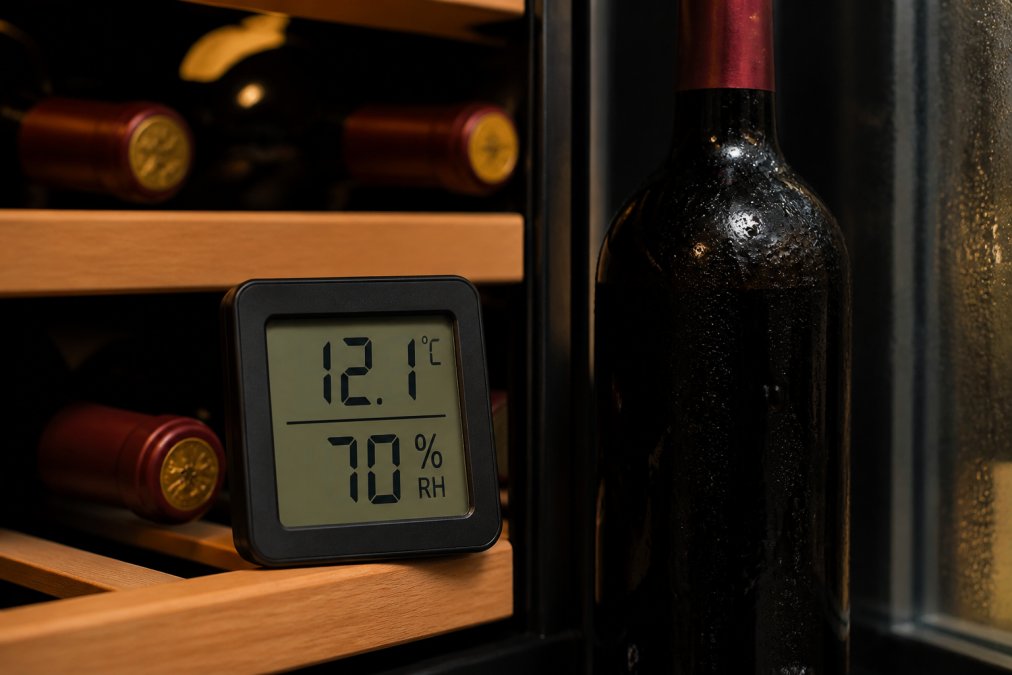
For traditional-method sparkling wines the same range applies, though consistent coolness protects the fine bubble structure. Natural cellar conditions in older properties often land close to this without equipment, which is why so many wine regions were built around underground storage.
Why Temperature Fluctuations Cause Thermal Shock
Thermal shock is the damage caused when wine moves rapidly between temperatures. The liquid expands and contracts faster than the cork can respond, pushing wine past the seal and letting oxygen in.
In practice, the greatest threat to a collection is not a slightly warm room but the daily cycle of a kitchen or boiler cupboard, where ambient temperature climbs and falls by several degrees every day.
Humidity Levels That Protect Cork Elasticity
Humidity control exists to protect cork elasticity. Below roughly 50% relative humidity, corks dry out, lose their seal and allow air ingress. Above about 80%, mould becomes the problem and labels start to suffer.
How to Store Wine Without a Cellar
You can store wine without a cellar by finding the coolest, darkest, most stable spot in the building and treating it as a dedicated zone, under-stairs cupboards, north-facing pantries and unheated basements are the usual candidates. But rising summer ambient temperatures mean the spot that worked for a 1990s collection may no longer hold a stable 10-13°C through July and August.
Why the Old Assumptions Are Failing
Traditional advice assumes a Victorian or Edwardian property has a naturally cool ground floor. In practice, many older homes now sit several degrees warmer in summer than twenty years ago. A north-facing pantry that once held 12°C year-round may now peak at 19-20°C for six to eight weeks, not catastrophic for a bottle you will drink this year, but enough to accelerate ageing in a vintage wine you intend to hold for a decade.
A Practical Sequence for Setting Up a Cellar-Free Zone
- Log temperature and humidity for seven days before committing any wine to the space, then repeat in midsummer
- Choose the location with the smallest daily and seasonal swing, not the lowest average
- Keep bottles away from boilers, radiators, washing machines, tumble dryers and external doors
- Add a hygrometer and, if needed, a small dehumidifier or water tray
- Block direct light with a curtain, box or closed cabinet
- Rack bottles horizontally so corks stay in contact with wine
- Keep a written or digital log of what went in and when
- Re-check the space each June, because the building's thermal behaviour changes as summers warm
When a Cabinet Beats a Cupboard
For serious collections, a climate-controlled cabinet is the most reliable substitute. It is not cheap, but it removes the guesswork and protects provenance if you ever resell. The trade-off: a cabinet only protects what fits inside it, so size it to your realistic five-year collection, not your current one.
Bottle Orientation, Light Exposure and Vibration
Bottle orientation, light exposure and vibration are the three factors collectors most often overlook. All three affect maturation quietly, over years, without visible warning. For vintage European wines, many cork-finished, low-production and already partway through their drinking window, the margin for error is narrower than for a young mass-market bottle.
Horizontal Racking and Cork Contact
Horizontal racking is the default for cork-finished wines because the wine itself keeps the cork moist. A moist cork stays expanded and maintains a proper seal; a dry cork shrinks, cracks and lets oxygen through. Cork is not a perfect barrier even when healthy, it allows slow, controlled micro-oxygenation that helps structured reds soften. Once the cork dries and shrinks, that exchange becomes uncontrolled and the wine oxidises far faster than the drinking window assumes.
Light Exposure and UV Damage
UV light breaks down the organic compounds in wine and speeds up premature aging. Clear glass is the worst offender, which is why so many fine wines are bottled in darker glass. The damage is cumulative: a bottle that spends a year on a bright shelf will not recover in a dark cellar, because the compounds giving the wine its fruit and aroma are already degraded.
Vibration and Sedimentation
Vibration disturbs sedimentation, keeping fine particles suspended instead of settling, and agitates the wine unnecessarily. A vibration-free location means away from washing machines, fridge compressors, stair treads and busy walkways. If you can feel the floor move when someone walks past, the wine can too.
How the Three Factors Interact
These factors do not act in isolation. A bottle stored horizontally in a warm, vibrating, light-exposed spot ages faster than the sum of those three problems suggests, because heat accelerates the chemical reactions light and vibration set in motion. The practical rule: fix the worst factor first, control temperature, then vibration, then light. Orientation is the easiest and cheapest to get right, so it should never be the limiting factor.
The Ageing Potential of Italian Wines and Portuguese Varieties
The ageing potential of Italian wines varies enormously by region and grape, and Portuguese varieties are just as uneven. Structured reds from warm inland areas can improve for a decade or more, while lighter, aromatic whites are usually best within a few years.
| Wine | Style | Storage Priority |
|---|---|---|
| Caladessa Reserva Tinto 2020 | Structured red | Long-term, stable temperature |
| Vale da Calada Tinto 2021 | Approachable red | Short to medium term |
| Arinto Reserva 2020 | White, cork-finished | Cool and dark, drink sooner |
| Manz Espumante 2018 | Traditional-method sparkling | Constant cool, minimal vibration |
Inventory Management and Insurance for Vintage Collections
Inventory management is where most home storage falls down. Once a collection passes a few dozen bottles, memory stops being reliable and you lose track of what is ready to drink.
Post-Storage Preparation: Decanting and Serving
Post-storage preparation decides whether years of careful cellaring pay off. A well-stored wine served badly tastes no better than a badly stored one.
Frequently Asked Questions
What is the ideal temperature range for long-term storage of vintage European wines?
For long-term storage, aim for a stable 10°C to 13°C. The critical factor is consistency, not a single perfect number. A constant 12°C is safer than a range that swings between 8°C and 18°C. Fluctuations cause the wine to expand and contract, pushing liquid out past the cork and letting oxygen in, which speeds up premature aging. A thermocline-controlled cabinet or a naturally cool, stable room works well.
Do I need a professional cellar to store vintage European wines properly?
No. A dedicated wine fridge or a consistently cool, dark cupboard can work for medium-term storage. For long-term aging of high-value bottles, a climate-controlled cabinet is the most reliable option. If you are storing wine without a cellar, focus on three things: stable temperature, darkness, and no vibration. A wardrobe or under-stairs space away from radiators and boilers can work if you monitor conditions with a hygrometer.
How does humidity affect the ageing process of vintage wines?
Humidity between 50% and 80% keeps corks from drying out. If humidity drops below 50%, corks lose elasticity and shrink, allowing air into the bottle and causing oxidation. Above 80%, labels can peel and mold may develop on the cork surface. Use a hygrometer to monitor levels. For bottle orientation, store horizontally so wine stays in contact with the cork, keeping it swollen and sealing the bottle.
Should vintage wines be stored horizontally or vertically?
Store cork-finished vintage wines horizontally. This keeps the wine in contact with the cork, preventing it from drying out and maintaining a proper seal. Vertical storage is only suitable for screw-cap wines or bottles you plan to drink within a few weeks. For long-term vintage preservation, horizontal racking is essential for cork elasticity and to reduce oxidation risk.
Storing vintage European wines well is unglamorous work: stable temperature, controlled humidity, darkness and stillness. The challenge is consistency, not knowledge. 79North Ltd imports premium, family-owned wines from Portugal and Italy, working with small, innovative wineries and native grape varieties that rarely reach these shores. If you run an independent wine shop or restaurant and want a portfolio built around distinctive terroir, let's talk.