
Importing Portuguese Wines for Personal Collection
Table of Contents
- Why Portuguese Wines Belong in a Personal Collection
- Understanding HMRC Alcohol Duty Rates for Wine Imports
- Importing Wine from EU to UK Personal Use: Rules and Allowances
- Shipping Wine from Portugal to UK: Couriers, Logistics and Insurance
- Step-by-Step Customs Clearance for Individual Importers
- Choosing Independent Vineyards and Producers in Portugal
- Prohibited and Restricted Wine Types for Personal Import
- Frequently Asked Questions
Last Updated: September 25, 2026
Why Portuguese Wines Belong in a Personal Collection
Portugal packs more native grape varieties into a small country than almost anywhere else in Europe, and most never reach a supermarket shelf. For collectors, that scarcity is the appeal: importing Portuguese wines for personal collection opens up small family estates, old-vine field blends and grapes such as Jampal that survive in tiny quantities.
Understanding HMRC Alcohol Duty Rates for Wine Imports
Alcohol duty on wine depends on strength and style, and the rules changed in 2023 when the UK moved to duty based on alcohol by volume. You pay duty on top of the wine's value, plus import VAT and courier handling fees. HMRC publishes current rates, which shift with each Budget, so check the official figures before you order.
HMRC guidance on alcohol duty for wine imports
Still Wine, Sparkling Wine and Fortified Wine: Different Rates
Still wine carries one rate, sparkling another, and fortified wines such as port sit in a higher band because of their strength. A 13% ABV dry red is taxed differently from a 20% port, even at the same shelf price, which matters in a mixed consignment, because duty is calculated bottle by bottle.
Importing Wine from EU to UK Personal Use: Rules and Allowances
Personal imports from the EU are simpler than commercial imports, but not duty-free. Since Brexit you cannot move wine across the border without paying UK duty and VAT, what changes is the paperwork and scale, not the tax.
Personal Allowance vs Commercial Import: Where the Line Sits
Your personal allowance covers wine you bring back yourself in luggage or a vehicle. When a courier shipment looks like it's for resale, HMRC treats it as commercial. The difference is volume, frequency and intent.
| Import Type | Duty and VAT | Typical Paperwork | Best For |
|---|---|---|---|
| Personal allowance (accompanied) | Paid at point of entry | None beyond declaration | A few bottles in your luggage |
| Personal courier shipment | Paid before delivery | Invoice, customs declaration | Mixed cases from a producer |
| Commercial import | Paid via duty deferment | Full customs entry, licences | Trade and resale |
Shipping Wine from Portugal to UK: Couriers, Logistics and Insurance
Wine is heavy, fragile and temperature-sensitive, so the shipping method matters more than almost any other decision. Here is the practical breakdown.
Three shipping routes, three trade-offs
General parcel networks. Mainstream international couriers carry alcohol only if the sender holds a permitting account, and even then it moves in the standard network: no temperature control, limited handling care and a liability cap far below the value of a serious case. Fine for everyday wine, risky for anything collectible.
Temperature control: what actually protects the wine
Heat damage is cumulative and invisible until the cork pushes; a case left on tarmac in August can arrive cooked. Look for:
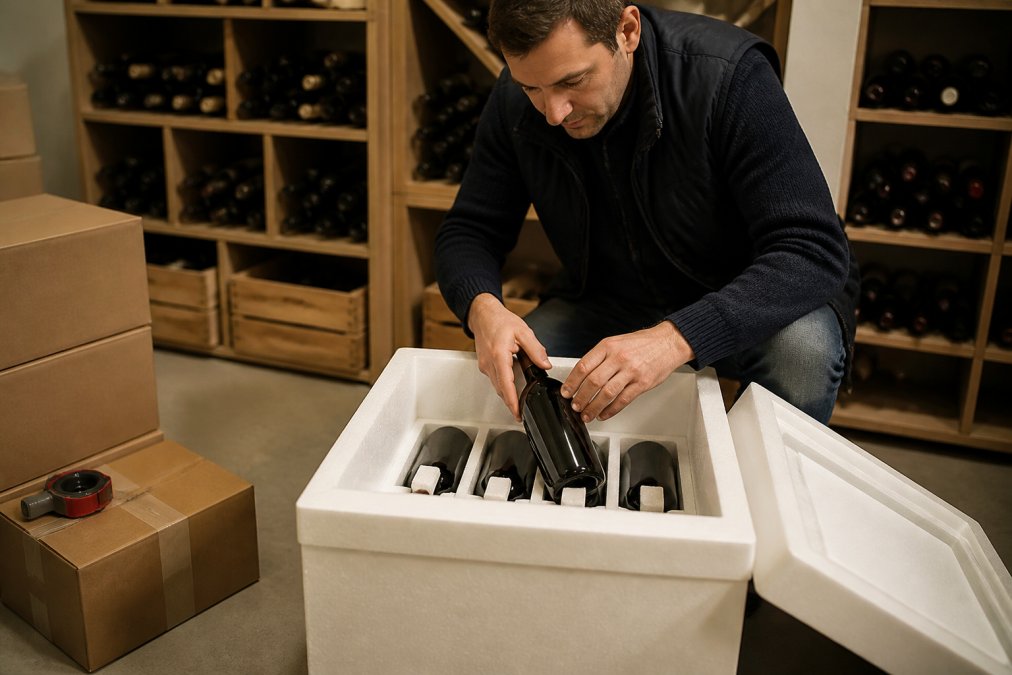
- Insulated liners or expanded polystyrene shippers for short journeys
- Refrigerated vehicles for long road legs
- Avoidance of Friday dispatch, which leaves wine sitting in depots over the weekend
- Delivery windows that let you receive the wine into a cool space the same day
Insuring a high-value personal collection
Standard courier liability is not insurance, it is a capped liability, often a nominal amount per kilogram or consignment. If a case worth several hundred pounds goes missing, the default cover rarely pays the full value.
What to do instead:
- Declare the true value on the commercial invoice. Under-declaring to reduce duty is a false declaration and voids most cover.
- Buy shipment insurance through the courier or a specialist broker. Premiums are typically a small percentage of the declared value, with an excess per claim.
- Photograph the packed consignment before it leaves. Bottle shots, box shots and the sealed outer carton. Insurers ask for this on every claim.
- Keep the original invoice and the shipping documents. Without them, a claim stalls.
- Report damage within the courier's stated window. Most require notification within a few days of delivery, and some require it before you sign.
Bottle protection: the details that save a case
Moulded pulp or foam inserts hold each bottle in its own cell and stop movement; polystyrene shippers are lighter and cheaper but less protective. For older vintages or large formats, ask the producer to ship in the original wooden case inside an outer carton, the wood absorbs impact and the packaging supports resale value.
Herdade da Calada 2020 Caladessa →
Choosing between them
For a single mixed case from a small producer, a specialist wine courier is usually right: higher liability, temperature control and a claims process that understands wine. For a larger collection, a forwarder with a wine division is cheaper per bottle and handles customs. General parcel networks are a last resort, only for wine you would not mind losing.
Step-by-Step Customs Clearance for Individual Importers
For a private collector, customs clearance works differently: you are not filing a full customs entry, but usually clearing a single consignment through a courier or forwarder acting as your indirect representative. Here is the path that works in practice.
Before the wine leaves Portugal
- Confirm the producer will export to the UK. Many small quintas sell only cellar-door or to Portuguese distributors, so ask directly whether they ship to a UK private address and have done so since Brexit.
- Agree the Incoterms in writing. DAP (Delivered At Place) means the producer or their forwarder handles export and you handle UK duty and VAT on arrival; DDP (Delivered Duty Paid) means the seller pays everything, but small estates rarely offer it. For a personal collection, DAP is the most common and transparent.
- Request a commercial invoice that meets HMRC's requirements. Per line it must show producer name, wine name, vintage, bottle size, bottle count, ABV, unit value and total value in the currency of sale. HMRC accepts euros, but the declaration converts to sterling at the prevailing rate.
- Ask for the exporter's EORI-equivalent details. Since Brexit, the Portuguese producer needs a Portuguese tax number and, if shipping regularly, an EU EORI. You may also need a GB EORI if clearing the goods yourself rather than through a courier's deferred scheme.
When the consignment lands
- The courier or forwarder raises a customs declaration. For a case or two, this is usually a simplified declaration under the courier's own authorisation, not a full CDS entry; you confirm the goods description, value and commodity code.
- Commodity codes matter. Still wine of fresh grapes sits under heading 2204. Sparkling wine is 2204 10. Fortified wine such as port is 2204 21 or 2204 29 depending on container size. Getting the code wrong is the single most common cause of a held consignment.
- Duty and import VAT are assessed on the landed value, wine value plus international shipping plus any insurance, converted to sterling. Duty is charged per litre of pure alcohol at the rate for the wine's strength band; import VAT at the standard rate on the total of value, shipping, insurance and duty.
- Pay through the courier's deferment account or directly to HMRC. Most couriers will advance the duty and VAT and invoice you before delivery, adding a disbursement fee. If you import regularly, a duty deferment account lets you pay monthly rather than per consignment.
A worked example
A collector orders 12 bottles of 14% ABV dry red from a Douro producer at €18 per bottle, with €60 shipping, a landed value of roughly €276. Duty is calculated on the pure alcohol content (12 × 0.75 L × 14% = 1.26 litres) at the current still wine rate, then import VAT is applied to the sum of wine value, shipping and duty.
Documents you need, in one place
- Commercial invoice (value, vintage, ABV, bottle count)
- Packing list (confirms what is physically in the box)
- Shipping manifest or air waybill / bill of lading
- Proof of origin if the producer can supply it (useful if any preferential treatment ever applies)
- Your own ID and address confirmation if the courier requests it
How long it actually takes
A clean personal consignment from a Portuguese producer typically clears within one to three working days of arrival if the paperwork is complete. A mismatched commodity code, under-declared value or missing ABV figure can hold it a week or more while the courier's customs team raises a query. The delay is almost never the wine, it is the data.
HMRC guidance on importing goods for personal use
Choosing Independent Vineyards and Producers in Portugal
Small estates hold the interesting bottles but are the hardest to vet from a distance. Look for producers who bottle their own wine, farm specific parcels and work with native grape varieties rather than international ones. Provenance, the documented chain from vineyard to bottle, tells you whether a wine is genuine and well stored.
Prohibited and Restricted Wine Types for Personal Import
Most wine moves freely, but some categories face restrictions. Wine above certain strength thresholds, or tied to sanctions, can be refused entry; counterfeit or mislabelled wine is seized, and labelling requirements must be met for legal entry to the UK.
- Fortified wines above 22% ABV attract extra scrutiny
- Wine from sanctioned regions cannot be imported
- Bottles without proper labelling may be held at customs
- Homemade or unbonded wine needs special clearance
Frequently Asked Questions
Can I import wine to the UK for personal use?
Yes, you can import wine for personal use, but you must pay UK excise duty and VAT on the alcohol. If you bring wine back yourself from Portugal, you benefit from the personal allowance for alcohol. For shipped consignments, you need to arrange customs clearance and pay the relevant charges. The key distinction is whether the wine is for your own consumption or for resale. Personal imports are allowed, but commercial imports require a licence and different compliance steps.
How does HMRC alcohol duty rates affect importing Portuguese wines?
HMRC sets excise duty based on the type and strength of the wine. Still wine between 5.5% and 15% ABV has a specific rate per litre, while sparkling wine and fortified wine are charged at higher rates. You also pay VAT on the total value plus duty and shipping. For example, a case of still red wine at 13% ABV will attract duty per bottle plus 20% VAT. Always check the current HMRC duty rates before budgeting your import.
What is the personal allowance for alcohol brought into the UK?
If you travel to Portugal and bring wine back yourself, you can bring up to 4 litres of still wine and 2 litres of sparkling wine duty-free, as long as you transport it personally and it is for your own use. Anything above that allowance must be declared and you pay duty and VAT. This allowance does not apply to wine shipped separately as freight. For shipped consignments, you pay duty and VAT on the full amount.
Do I need a licence to import wine for a private collection?
No, you do not need a licence if the wine is strictly for your personal collection and not for resale. However, you must still comply with HMRC requirements, including paying excise duty and VAT. If you import more than the personal allowance or if HMRC suspects commercial intent, you may need to register as a trade importer. For large collections, it is wise to keep records of your purchases and payments to demonstrate personal use.