
Pairing Aged Douro Reds with Roasted Vegetables
Table of Contents
- Understanding Aged Douro Valley Reds and Their Characteristics
- How Age Transforms Douro Red Wine Flavours and Pairing Potential
- Douro Red Wine Food Pairing Fundamentals
- Wine Pairing with Roasted Root Vegetables: A Vegetable-by-Vegetable Guide
- Douro Wine Serving Temperature and Preparation
- Decanting Aged Red Wine: Technique and Timing
- Building a Complete Menu: Aged Douro Reds with Roasted Vegetables
- Frequently Asked Questions
Last Updated: October 15, 2026
Understanding Aged Douro Valley Reds and Their Characteristics
Aged Douro reds roasted vegetables develop complexity in bottle or barrel, transforming from fruit-forward young wines into sophisticated expressions of terroir that pair beautifully with roasted vegetables.
As they age, bold berry flavors soften into leather, tobacco, dried fruit, and earth, while harsh tannins polymerize and become silky, a transformation that matters when pairing with food.
Most Douro reds are blends:
- Touriga Nacional - the backbone of many blends, offering dark fruit and firm structure
- Touriga Franca - adds floral notes and elegance
- Tinta Roriz - contributes spice and mid-palate weight
- Tinta Barroca - brings ripe fruit and accessibility
Knowing these varieties helps predict how a wine will age.
How Age Transforms Douro Red Wine Flavours and Pairing Potential
Age fundamentally changes what a Douro red can pair with. A young Douro red, bold, tannic, fruit-driven, demands equally bold food: grilled meat, rich stews, aged cheeses.
Chemically: tannins soften, acidity stays stable, and fruit compounds break down into earth, leather, and mineral notes, less power, more finesse.
A 5-year-old Douro red still shows fruit with developing complexity; a 10+ year-old has moved into secondary flavor territory. This distinction matters when building a menu.
Douro Red Wine Food Pairing Fundamentals
Pairing works on two principles: harmony and contrast. Harmony matches the wine's weight and intensity to the food, a light wine gets lost beside a heavily roasted dish, a powerful one overwhelms delicate flavors. Contrast uses the wine's acidity or tannins to cut richness, or the food's flavors to complement the wine's secondary notes.
Pairing aged Douro reds roasted vegetables works primarily through harmony and flavor alignment:
- The wine's earthy notes echo the caramelized, slightly bitter edges of roasted vegetables
- The wine's moderate acidity brightens the richness of oil-roasted vegetables
- The wine's tannins (now softened by age) provide structure without overwhelming delicate vegetable textures
- The wine's alcohol warmth complements the savory depth of roasted roots
The key is respect: the wine should enhance the vegetables, not compete with them, and vice versa.
Wine Pairing with Roasted Root Vegetables: A Vegetable-by-Vegetable Guide
Roasting concentrates sugars and creates caramelisation, and different vegetables caramelise differently. Match the wine to the roasted vegetable's final character, not its raw state.
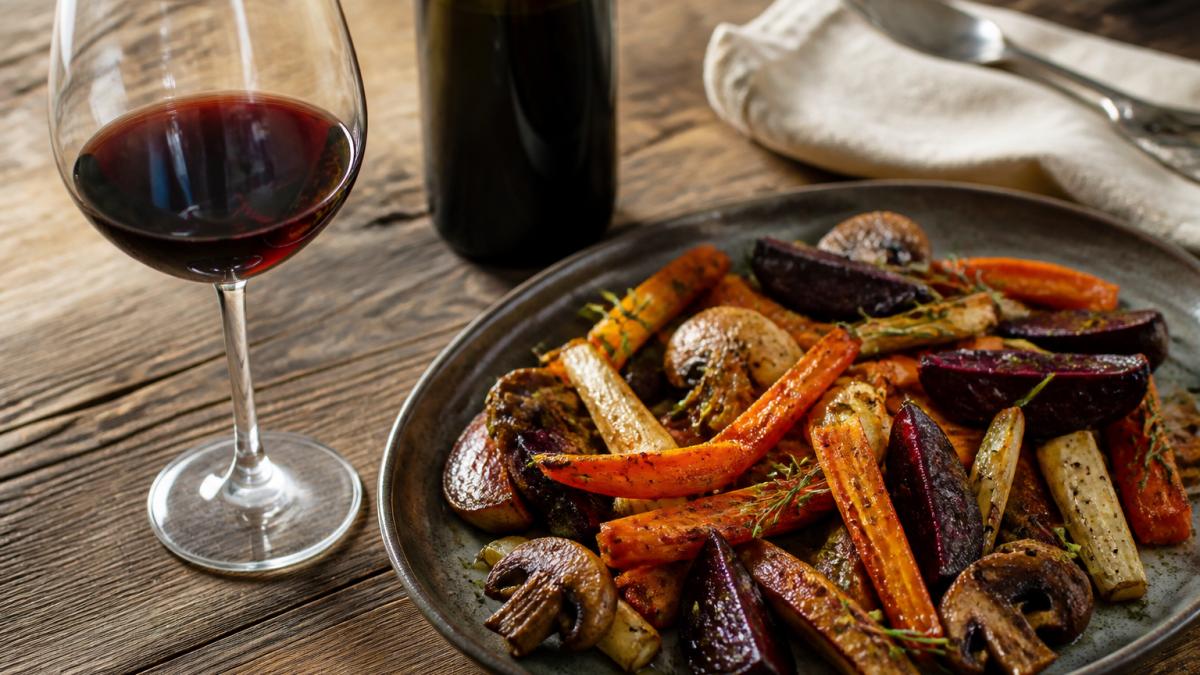
This guide goes vegetable by vegetable, accounting for the two variables that change the match most: how dark you roast and what you season with.
A quick rule: the darker and more caramelised the vegetable, the more the wine's tertiary, earthy and savoury notes should lead.
Beetroot and Aged Douro Reds
Roasted beetroot develops earthy sweetness with a subtle mineral edge, the ideal partner for aged Douro reds.
Pair a 7-10 year-old Douro blend with roasted beetroot: softened tannins won't fight the texture, and the wine's earth and mineral notes amplify the beetroot's character.
Seasoning that works: flaky salt, black pepper, a little orange zest, or a spoonful of crème fraîche at the table. Avoid heavy balsamic glazes, which add a sweet-sour note that can make an aged red taste hollow.
Parsnips, Carrots, and Caramelised Sweetness
Parsnips and carrots caramelise aggressively when roasted, creating darker, more complex flavours at their edges.
Roast until the edges brown deeply, the slight bitterness balances the natural sweetness, and pair with a 5-8 year-old Douro blend, whose acidity cuts the richness without overwhelming.
Seasoning that works: cumin, coriander seed, or a little honey and thyme. Honey pushes the dish sweeter, so lean toward the older end of the 5-8 year window where the wine's fruit has receded.
Mushrooms and Earthy Umami Pairings
Mushrooms are the secret weapon for aged Douro reds: roasting intensifies their umami, the savoury, mouth-filling quality that makes aged wines sing.
Button mushrooms, cremini, and larger varieties all work. Slice, toss with olive oil and salt, and roast at 200°C until they release their moisture and begin to caramelise.
Roasting treatment: roast mushrooms in a single layer with space between them.
Seasoning that works: garlic, parsley, a splash of sherry vinegar, or a little soy for extra depth.
Onions, Shallots, and Alliums
Roasted alliums are the underrated partner: whole shallots and quartered red onions roasted until their layers collapse and edges blacken develop a deep, sweet-savoury character between caramelised root vegetables and mushrooms.
Roasting treatment: roast whole shallots or thick onion wedges at 200°C for 35-45 minutes with their skins on, then slip the skins off.
Wine match: a 6-9 year-old Douro blend. The alliums' sweetness needs the wine's acidity, and their slight bitterness needs the softened tannins.
Brassicas: Sprouts, Cauliflower, and Cabbage
Brassicas are the hardest roasted vegetable to pair with aged reds, and most guides skip them.
Roasting treatment: roast hot and fast, at 220°C for 20-25 minutes, until the outer leaves char and crisp. The char is the point: it converts the brassica's raw bitterness into something closer to toasted nuts.
Wine match: a 5-7 year-old Douro red, not an older one. You need enough remaining fruit to stand up to the char, and enough acidity to cut the brassica's richness.
A Quick Reference by Roasting Treatment
| Roasting treatment | Vegetable examples | Best-aged Douro red |
|---|---|---|
| Pale gold, lightly caramelised | Carrots, celeriac | 5-7 years |
| Deep golden-brown, chewy edges | Parsnips, shallots | 6-9 years |
| Charred, crisp outer leaves | Brussels sprouts, cauliflower | 5-7 years |
| Foil-roasted, then dried and caramelised | Beetroot | 7-10 years |
| Slow-roasted until concentrated | Mushrooms, onions | 10+ years |
Use the table as a starting point, then adjust for your seasoning. Heavy umami (soy, miso, mushroom stock) pushes every row one step older. Heavy sweetness (honey, balsamic, maple) pushes every row one step younger, because you need the wine's acidity to do more work.
Douro Wine Serving Temperature and Preparation
Aged Douro reds are temperature-sensitive. Serve at 16-18°C, cooler than room temperature, warmer than a cellar. At this temperature:
- Tannins feel refined, not harsh
- Acidity stays bright without becoming sharp
- Earthy and mineral flavors emerge clearly
- Alcohol warmth is noticeable but not hot
Above 20°C, alcohol dominates and the wine feels unbalanced; below 14°C, it tastes thin and closed.
Open the bottle 30-45 minutes before serving, brief air exposure begins oxidation without overwhelming the wine. For very old Douro reds (15+ years), open just before service to preserve their delicate aromatics.
Decanting Aged Red Wine: Technique and Timing
Decanting separates sediment from the wine and exposes it to oxygen, softening harsh tannins and opening aromas. Aged Douro reds often throw sediment, fine particles accumulated over years of aging.
How to decant:
- Stand the bottle upright for 24 hours before service. This allows sediment to settle at the bottom.
- Inspect the bottle's shoulder by candlelight or flashlight. You'll see where the sediment begins.
- Pour slowly and steadily into a clean decanter, stopping when sediment reaches the bottle's neck.
- Discard the sediment-laden final pour.
Timing matters. Decant aged Douro reds 30-60 minutes before serving. This window allows oxygen exposure without over-oxidizing the wine.
For wines under 8 years old, decanting is optional. These wines usually have minimal sediment and may not need the oxygen exposure.
Building a Complete Menu: Aged Douro Reds with Roasted Vegetables
Most pairing content stops at a single vegetable and a single glass. A complete menu is where the pairing gets tested, because the wine must carry across several roasted dishes without repeating itself.
The principle is intensity sequencing: start with the lightest, least caramelised roast and finish with the deepest, most savoury one. The wine's tannins and acidity feel different against each, and the meal reads as a progression rather than disconnected plates.
A Four-Course Vegetable-Led Menu
Course two: roasted beetroot with crème fraîche and orange zest. Foil-roast whole beetroot at 200°C for 45-60 minutes, unwrap, then roast a further 10 minutes to caramelise the skin.
Course three: roasted parsnips and carrots with cumin and thyme. Roast at 200-220°C for 30-40 minutes until the edges are deep golden-brown.
Course four: roasted mushrooms with garlic and parsley on toast. Roast at 200°C for 20-25 minutes in a single layer, then toss with garlic and parsley and pile onto sourdough.
Why the Order Matters
Serve the mushrooms first and the beetroot and parsnips would taste flat by comparison, the wine seeming to lose energy as the meal went on.
This is why a single wine works: four courses with four wines is a tasting, but four courses with one wine is a pairing, the format that lets a customer understand what an aged Douro red does with roasted vegetables.
Practical Timings for a Service
| Component | Role | Timing |
|---|---|---|
| Cauliflower | Opening course | Roast 25 minutes before service |
| Beetroot | Second course | Foil-roast 60 minutes ahead, finish 10 minutes before service |
| Parsnips and carrots | Third course | Roast 35 minutes before service |
| Mushrooms | Final course | Roast 25 minutes before service |
| Aged Douro red | Wine partner | Open 30-45 minutes before the first course |
| Fresh herbs | Brightness | Add just before plating |
| Fleur de sel | Flavour lift | Sprinkle at table |
If you're running this in a restaurant, the beetroot can be roasted earlier in the day and finished to order. The mushrooms should be roasted to order, because they lose their texture quickly.
Optional Additions That Don't Break the Theme
A small plate of aged Portuguese sheep's milk cheese between courses three and four echoes the wine's savoury notes without becoming a cheese course, and simply dressed bitter leaves, chicory or radicchio, cleanse the palate between the sweeter parsnips and savoury mushrooms.
Avoid anything heavily vinegared, sweet chilli-glazed, or strongly citrus-dressed: all three make an aged Douro red taste thinner than it is.
For independent restaurants, this approach differentiates your menu. Most establishments pair wine with meat and fish. Offering a thoughtful aged Douro red with roasted vegetables signals sophistication and culinary confidence.
Frequently Asked Questions
What roasted vegetables pair best with aged Douro red wine?
Aged Douro reds pair exceptionally well with roasted root vegetables, particularly beetroot, parsnips, carrots, and mushrooms. Beetroot's earthy sweetness complements the wine's mature fruit notes, whilst mushrooms enhance the wine's umami depth. Caramelised parsnips and carrots add sweetness that balances the wine's tannins. The key is roasting at high temperature to develop caramelisation and concentrate flavours, which creates natural harmony with aged red wine's complexity.
How does decanting aged red wine improve the pairing experience?
Decanting aged Douro reds softens harsh tannins and allows the wine to breathe. This opens up the wine's profile, making it more food-friendly and revealing subtle characteristics that complement roasted vegetables. For wines aged 10+ years, decant 30-60 minutes before serving. Decanting also separates sediment that naturally accumulates in mature bottles.
What temperature should aged Douro wine be served at?
Aged Douro reds should be served at 16-18°C, slightly cooler than room temperature. This temperature preserves the wine's complexity whilst allowing its mature fruit and secondary flavours to express fully. If your bottle has been stored at cellar temperature (around 12°C), remove it before serving to reach the ideal range naturally.
Can roasted vegetables overpower the flavours in an aged red wine?
Roasted vegetables won't overpower aged Douro reds if you balance the intensity of both elements. Heavily charred or overly seasoned vegetables can compete with delicate mature wines. Instead, roast vegetables until caramelised but not burnt, and use complementary seasonings like rosemary, thyme, or sea salt. This approach lets the wine's evolved complexity shine whilst the vegetables' natural sweetness and umami enhance the pairing rather than overwhelm it.