
Sourcing Jampal Grapes for UK Menus: A 2026 Guide
Table of Contents
- Understanding Jampal: History and Near-Extinction
- Why Sourcing Jampal Grapes Matters for UK Hospitality
- Seasonal Availability of Jampal Grapes and UK Import Windows
- UK Fruit Import Regulations: What You Need to Know for Jampal
- Finding Reliable Exotic Grape Suppliers UK: A Sourcing Strategy
- Culinary Uses for Jampal Grapes: Menu Integration and Pairings
- Integrating Sourced Jampal Grapes into Your Wine List and Menu
- Conclusion: Building Your Jampal Sourcing Partnership
Sourcing Jampal Grapes for UK Menus: A 2026 Guide
Last Updated: July 26, 2026
The challenge of sourcing jampal grapes for UK menus has become increasingly urgent for independent wine merchants and hospitality professionals seeking to differentiate their offerings. At 79North Ltd, we work directly with small Portuguese producers to bring rare varieties like Jampal to UK tables, varieties that mainstream distributors won't touch due to small volumes and tight margins. This guide walks you through understanding why Jampal matters, navigating post-Brexit import regulations, and integrating these distinctive grapes into your wine list and culinary offerings.
Understanding Jampal: History and Near-Extinction
The Jampal grape variety originates from the Alentejo region in southern Portugal, where it thrived for centuries before nearly vanishing entirely. By the 1980s, fewer than a handful of vineyards still cultivated Jampal. Near-extinction stemmed from economic pressure and agricultural consolidation: larger producers favoured high-yield varieties that could be harvested mechanically and sold at volume. Jampal, with its lower yields and demanding viticulture, couldn't compete on price. By the early 1990s, Jampal was effectively lost, preserved only in a few isolated vineyards where elderly growers refused to replant with something more profitable.
André Manz and the Rescue of the Variety
André Manz, a Portuguese winemaker and viticulturist, became obsessed with rescuing Jampal from obscurity. He located surviving Jampal vines, worked with remaining growers to preserve their stock, and began experimenting with modern production methods that respected the grape's traditional character while improving consistency and quality. Manz's efforts transformed Jampal from a nearly-extinct relic into a celebrated example of Portuguese vinic quality and cultural preservation. His work proved that rare varieties could be commercially viable if positioned correctly, not as bargain wines, but as distinctive products for educated consumers willing to pay for uniqueness and provenance. Today, a small but growing network of producers in the Alentejo region cultivates Jampal, largely inspired by Manz's success. For UK hospitality professionals, Manz Wine represents the gold standard: a producer committed to sustainable viticulture, transparent supply chains, and consistent quality that justifies premium pricing.
Why Sourcing Jampal Grapes Matters for UK Hospitality
In a market saturated with Spanish Albariño, Italian Pinot Grigio, and mass-produced Portuguese whites, Jampal offers something competitors cannot easily replicate: a distinctive, story-driven product that commands attention and justifies premium margins. Independent wine merchants and restaurants cannot compete with supermarket chains on price. What you can win is exclusivity, authenticity, and the ability to tell a compelling story that connects customers to the product. Jampal delivers all three.
From a menu integration perspective, Jampal's crisp acidity, mineral character, and moderate alcohol content (typically 12.5-13.5%) make it exceptionally versatile. It pairs beautifully with seafood, white fish, lighter poultry dishes, and vegetable-forward plates. Unlike heavily oaked Chardonnays or high-alcohol Sauvignon Blancs, Jampal doesn't overpower delicate flavours, increasing its utility across your menu.
Seasonal Availability of Jampal Grapes and UK Import Windows
Understanding seasonal availability is critical when sourcing jampal grapes for UK menus. Most Alentejo producers release their current vintage in late autumn (October-November) after fermentation and initial ageing. Availability peaks from December through March, when UK wine merchants and restaurants place orders for the new vintage. Supply tightens significantly from April through August, with many producers selling out by late spring.
This seasonal pattern means you cannot treat Jampal like a standard wine list item. You must plan ahead, commit to volumes, and manage inventory strategically. Jampal grapes are typically harvested in late August or early September, fermented through autumn, and not released for export until November at the earliest. If you're planning menu features for spring, you need to place orders by February at the latest.
UK Fruit Import Regulations: What You Need to Know for Jampal
Post-Brexit, importing wine into the UK requires strict compliance with phytosanitary regulations, customs documentation, and health standards. Every shipment of Jampal wine must be accompanied by a completed customs entry form (C88 form), an invoice detailing origin and vintage, proof of duty and VAT payment, and a certificate of origin confirming Portuguese origin.
Post-Brexit Compliance and Documentation
Since January 2021, wine imports into the UK from the EU require completion of customs declarations under the UK's Import of Products, Animals and Food and Animal Feed (Revision) (EU Exit) Regulations 2020. For independent importers, these requirements can feel overwhelming. Working with an established importer like 79North Ltd simplifies the process: you order from an importer who has already cleared the wine through UK customs and holds proper documentation. The wine arrives ready for sale with all regulatory requirements satisfied.
Phytosanitary Certificates and Health Standards
Although wine is a processed product, Portuguese producers must comply with UK food safety standards, including UK labelling requirements, the Food Safety Act 1990, and documentation confirming the winery operates under approved food safety protocols. The UK Food Standards Authority (FSA) sets these standards. Reputable Portuguese producers maintain compliance automatically. When sourcing directly from small family wineries, verify these certifications exist before placing your first order.
Finding Reliable Exotic Grape Suppliers UK: A Sourcing Strategy
Sourcing jampal grapes for UK menus requires a fundamentally different approach than ordering standard wines from large distributors. You need a sourcing strategy that identifies reliable suppliers, vets their reliability, and establishes long-term relationships.
The most reliable suppliers fall into three categories: established Portuguese wine importers specialising in rare varieties (like 79North Ltd, which maintains ongoing relationships with Portuguese family producers and ensures every bottle meets UK regulatory standards); wine brokers and consolidators (useful for sampling multiple producers but typically charging higher markups); and direct relationships with Portuguese producers (tempting but risky, requiring you to handle customs, documentation, and minimum order quantities).
Vetting Suppliers for Reliability and Sustainability
Before committing to a supplier, verify their track record with UK hospitality, their producer relationships, and their sustainability commitment. Ask for references from UK restaurants and wine bars currently stocking their wines. Request a list of producers they work with and ask whether they have exclusive or semi-exclusive UK distribution. Ask whether their producers practice organic viticulture, use sustainable packaging, or participate in environmental certification schemes.
Wholesale Pricing, Margins, and Volume Commitments
Expect to pay between £8-£14 per bottle at wholesale. Retail prices for Jampal typically range from £18-£28 per bottle on wine lists, yielding margins of 50-70% for restaurants and 40-60% for independent retailers. However, these margins assume meaningful volumes. A supplier might quote £10 per bottle for a 12-bottle case but £12 per bottle for a 3-bottle trial order.
When negotiating with a supplier, be transparent about your expected volume. If a supplier demands a 24-bottle minimum when you've indicated you'll sell 6 bottles per month, that's a mismatch, walk away and find someone more flexible.
Culinary Uses for Jampal Grapes: Menu Integration and Pairings
Jampal's crisp acidity, mineral character, and moderate alcohol make it one of the most food-friendly white wines available. The wine's flavour profile typically includes notes of citrus (lemon, grapefruit), stone fruit (peach, apricot), and mineral salinity. These characteristics make Jampal exceptional with seafood and shellfish, lighter poultry, vegetable-forward dishes, soft cheeses, and light pasta dishes.
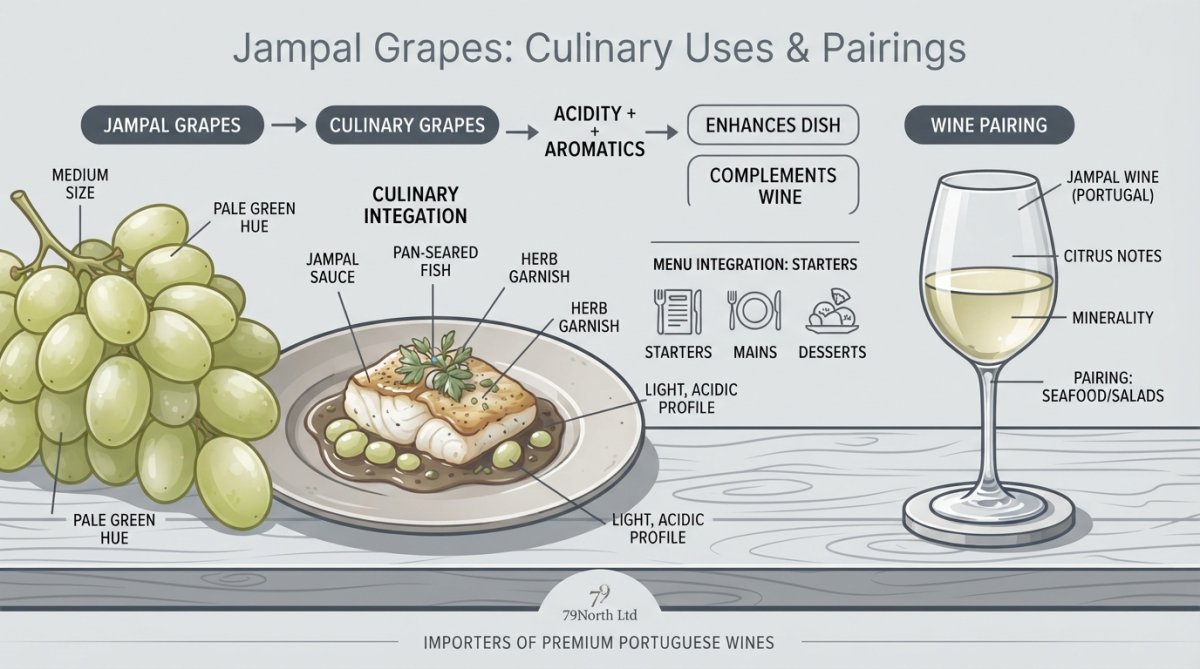
Seasonal Menu Pairing Guide for Jampal
Spring (March-May): Feature Jampal with spring vegetables and lighter proteins. Asparagus risotto, grilled sea bass with lemon, roasted chicken with herbs. Customers are moving away from heavy winter wines toward fresher options.
Summer (June-August): Position Jampal as an aperitif and seafood pairing. Offer it by the glass with charcuterie boards and oysters. Summer customers want wines they can drink multiple glasses of without fatigue.
Autumn (September-November): As availability peaks with the new vintage, feature Jampal alongside harvest-themed dishes. Wild mushroom risotto, roasted game birds, autumn vegetable tarts. This is prime ordering season.
Winter (December-February): Jampal pairs beautifully with lighter winter dishes: poached fish, white bean soups, roasted white fish with butter sauce.
| Season | Best Dishes | Service Style | Why It Works |
|---|---|---|---|
| Spring | Asparagus, grilled white fish, roasted chicken | By the glass | Fresh, light, mirrors seasonal ingredients |
| Summer | Oysters, charcuterie, grilled seafood | Aperitif or by the glass | Refreshing, moderate alcohol, food-friendly |
| Autumn | Game, mushrooms, roasted vegetables | By the bottle or glass | New vintage arrives, harvest flavours align |
| Winter | Poached fish, white beans, butter sauces | By the glass | Lighter alternative to winter reds |
Integrating Sourced Jampal Grapes into Your Wine List and Menu
Once you've secured reliable supply, position Jampal effectively so customers understand why it's worth ordering. This requires thoughtful wine list placement, staff training, and inventory management.
Wine List Curation and Staff Training
Jampal should occupy a distinct position on your wine list, featured prominently with context. Write a tasting note that explains the grape's history and character, include the producer name and a brief food pairing suggestion.
Example wine list entry:
Jampal, Manz Wine 2024, Alentejo, Portugal 16.50 by glass / 54 by bottle
A rescued Portuguese white from the Alentejo. Crisp citrus, mineral salinity, and moderate alcohol make it exceptional with seafood and lighter poultry. Manz Wine pioneered the modern revival of this nearly-extinct variety.
Staff training is equally critical. Your team needs to understand the grape's history, its flavour profile, which dishes pair best with it, and the producer's background. Train staff to offer Jampal proactively when customers order white wine with seafood or ask for something "interesting."
Managing Supply Chain Risk and Inventory
Forecast demand quarterly based on your sales history. If you sold 12 bottles in March-April, forecast 12-15 for June-August. Monitor inventory weekly and use this data to place orders by the seasonal deadline. Build relationships with your supplier: if you're consistently ordering and paying on time, a good supplier will work with you on small additional orders or hold stock if the seasonal window is closing.
Never overstock Jampal hoping to build inventory for months ahead. Order what you can realistically sell within 2-3 months. It's better to have a waiting list than to sit on unsold inventory.
Conclusion: Building Your Jampal Sourcing Partnership
Sourcing jampal grapes for UK menus requires commitment, planning, and the right supplier partnership. For independent wine merchants and restaurants serious about differentiation, Jampal offers authenticity, story, and genuine quality that justifies premium positioning. You need a supplier who can guarantee consistent supply within seasonal constraints, handle all regulatory compliance, train your team, and support your menu integration efforts. 79North Ltd specialises in exactly this, working exclusively with small, innovative Portuguese and Italian producers, managing all UK import logistics, and providing ongoing support to independent retailers and restaurants. Our portfolio includes direct relationships with Jampal producers like Manz Wine, ensuring you get genuine, traceable product with full documentation.
Frequently Asked Questions
What are Jampal grapes and why should UK hospitality venues care about sourcing them?
Jampal is a rare Portuguese white wine grape variety from southern Portugal's Alentejo region, nearly extinct until rescued by André Manz and Manz Wine. For UK hospitality venues, sourcing Jampal grapes offers a distinctive, authentic offering that sets independent restaurants and wine merchants apart from competitors. The variety's unique terroir and vinic quality provide menu differentiation, particularly for establishments seeking to showcase innovative, family-owned Portuguese producers and native grape varieties that resonate with discerning diners.
What are the main UK fruit import regulations I need to follow when sourcing Jampal grapes from Portugal?
Post-Brexit, importing fresh grapes from Portugal requires compliance with UK phytosanitary standards and customs procedures. You'll need a phytosanitary certificate from the Portuguese exporter confirming the grapes meet UK plant health requirements. Importers must register with UK customs and provide proper documentation including origin certification. Import duties and VAT apply, and grapes must pass UK Border Force inspection. Working with an experienced wine distributor familiar with post-Brexit logistics simplifies this process significantly, as they handle documentation, certificates, and regulatory compliance.
When is the best season to source Jampal grapes for UK menus, and how does seasonal availability affect planning?
Jampal grapes are typically harvested in Portugal during late summer and early autumn (August-September). Seasonal availability directly impacts menu planning, sourcing windows are concentrated, requiring advance ordering and stock planning. UK hospitality venues should coordinate with suppliers several months ahead to secure inventory for autumn and winter menu features. Understanding this seasonal rhythm allows venues to create limited-time offerings around Jampal availability, building anticipation with customers and justifying premium positioning on wine lists and seasonal menus.
How do I find reliable exotic grape suppliers in the UK who actually stock Jampal and understand its terroir?
Reliable exotic grape suppliers who specialise in rare Portuguese varieties are typically specialist wine importers focused on family-owned producers rather than mass-market distributors. Look for importers with established relationships in Portugal's Alentejo region and documented experience with vineyard preservation initiatives. Evaluate suppliers by their knowledge of Jampal's history, André Manz's rescue efforts, and the variety's vinic characteristics. Request references from other independent restaurants or wine merchants. Specialist importers often provide better pricing transparency, smaller minimum orders suited to independent venues, and expert support for menu integration and staff training.
[EXTERNAL_LINK: UK Food Standards Authority guidance on wine imports and labelling | food.gov.uk]
[EXTERNAL_LINK: HM Revenue & Customs wine import procedures and customs documentation | gov.uk]
[EXTERNAL_LINK: Alentejo Wine Commission overview of Portuguese white wine varieties and terroir | vinhosdoalentejo.pt]
This article was written using GrandRanker