
Importing Portuguese Wine to the UK: A 2026 Guide
Table of Contents
- Step 1: Check You Are Eligible to Import Portuguese Wine
- Step 2: Register as an Importer and Apply for AWRS Approval
- Step 3: Vet Portuguese Suppliers and Gather Export Documents
- Step 4: Understand UK Wine Import Duty and VAT
- Step 5: Prepare Wine Import Paperwork and Customs Clearance
- Step 6: Arrange Shipping Wine from Portugal
- Step 7: Calculate Wine Import Costs and Landed Cost
- Common Mistakes to Avoid When Importing Portuguese Wine
- Frequently Asked Questions
Last Updated: October 12, 2026
Step 1: Check You Are Eligible to Import Portuguese Wine
You do not need a special licence to import wine into the UK as a business, but you must be a registered business and meet HM Revenue & Customs (HMRC) rules before your first shipment lands. This guide from 79North Ltd walks through tips for importing Portuguese wine to the UK.
To import commercially, you need:
- A registered business (sole trader, partnership or limited company)
- An Economic Operator Registration and Identification (EORI) number starting with GB
- A plan for duty and VAT payment before goods arrive
Private imports for personal use sit outside this process; commercial importing requires full customs declarations and duty payment.
Since the UK left the EU, wine moving from Portugal needs a customs declaration, and the supplier must provide the right export documents.
Step 2: Register as an Importer and Apply for AWRS Approval
The Alcohol Wholesaler Registration Scheme (AWRS) is the single most important approval for anyone selling alcohol wholesale in the UK. You must be listed on HMRC's public register before you trade.
AWRS exists to stop duty fraud: HMRC checks that everyone in the supply chain is legitimate. Buy from a non-approved supplier and you risk your own approval and stock.
What you need to do:
- Register for an EORI number with HMRC
- Set up a Government Gateway account for customs
- Apply for AWRS approval online
- Wait for your approval and URN before buying stock
Approval can take several weeks. Start early.
Once approved, you are a "registered owner" of alcohol for excise purposes, responsible for the duty on anything you hold or sell. Keep your AWRS number on every commercial invoice.
Step 3: Vet Portuguese Suppliers and Gather Export Documents
Portugal has strong small-producer representation, which is why vetting matters: many excellent family wineries have never exported to the UK and are not set up for it.
Ask every potential supplier for:
- Proof they can legally export (Portuguese business registration)
- Their EU excise number
- A sample commercial invoice and packing list
- Confirmation they can provide proof of origin documents
Portugal-specific checks worth doing:
- Confirm the producer holds a valid Portuguese wine certification for their DOC or regional wines
- Check that the winery can issue an EU excise movement document (e-AD) if moving under duty suspension
- Ask about their previous UK export experience or lack of it
A producer new to exporting may need guidance. What matters is whether they can produce the documents your freight forwarder and HMRC need.
Step 4: Understand UK Wine Import Duty and VAT
UK wine import duty and VAT are the two biggest line items in your landed cost.
Wine duty in the UK is charged per litre of pure alcohol, not per bottle, and the rate depends on ABV (Alcohol Duty rates). Still wine at 11.5% to 14.5% ABV sits in a standard band; fortified and higher-ABV wines cost more.
VAT is charged on top. The taxable value is:
- The wine's cost
- Plus freight and insurance
- Plus any duty owed
That total is then multiplied by the standard VAT rate of 20%.
Duty rates change with each Budget, so always check current HMRC guidance before pricing a shipment, never work from memory.
Step 5: Prepare Wine Import Paperwork and Customs Clearance
Wine import paperwork and customs clearance is where most first shipments stall: documents must match and be complete.
The core documents for a Portuguese wine shipment are:
- Commercial invoice (with ABV, volume, value and commodity code)
- Packing list (cases, bottle counts, weights)
- Transport document (CMR for road freight)
- Proof of origin (to confirm EU origin)
- Import declaration submitted to HMRC
The commodity code for wine sits in Chapter 22 of the UK Trade Tariff, and still, sparkling and fortified wines all have different codes.
Wine from Portugal is a third-country import needing a full customs declaration; proof of origin matters if a preferential rate applies.
Your freight forwarder or customs broker usually submits the import declaration. Clean, matching documents make clearance routine; mismatched paperwork leaves your shipment in a bonded warehouse while you fix it.
Step 6: Arrange Shipping Wine from Portugal
Shipping wine from Portugal is a specialist job: wine is fragile, temperature-sensitive and heavy, and standard parcel networks are not built for it. Your chosen mode drives per-bottle freight cost, breakage exposure and capital in transit.
Choosing your shipment size
Groupage (shared trailer). Your pallets share space with other consignees' goods, the right starting point for a first order or mixed pallet.
Herdade da Calada 2022 Vale da Calada Rosé Vinho →
Full pallet freight. At consistent volume, whole pallets give a better rate per bottle and fewer handling steps.
Full container load. Only worth it at scale. A standard container holds around 10 pallets, subject to stacking.
A useful rule of thumb: the smaller the shipment, the more your landed cost is driven by fixed charges, clearance, delivery, documentation, rather than by the wine.
Temperature exposure is the real risk
Wine is perishable in transit in a way most general cargo is not: heat accelerates ageing and, past a certain point, cooks the wine. A pallet in a hot trailer over a summer weekend, or on a sun-exposed quay, can be compromised before it reaches you.
What to do about it:
- Ask your forwarder specifically about temperature-controlled or insulated trailers for shipments moving in warm months.
- Avoid shipments that will sit over a weekend at a port or hub without shade or climate control.
- Prefer routes with fewer handovers. Every transfer is another chance for the pallet to sit in the open.
- Ask for the temperature range the trailer maintains, not just whether it is "refrigerated".
Breakage and handling
Wine moves as fragile goods: a dropped pallet is a total loss, and glass-on-glass movement causes hairline damage that only shows when a customer opens the case.
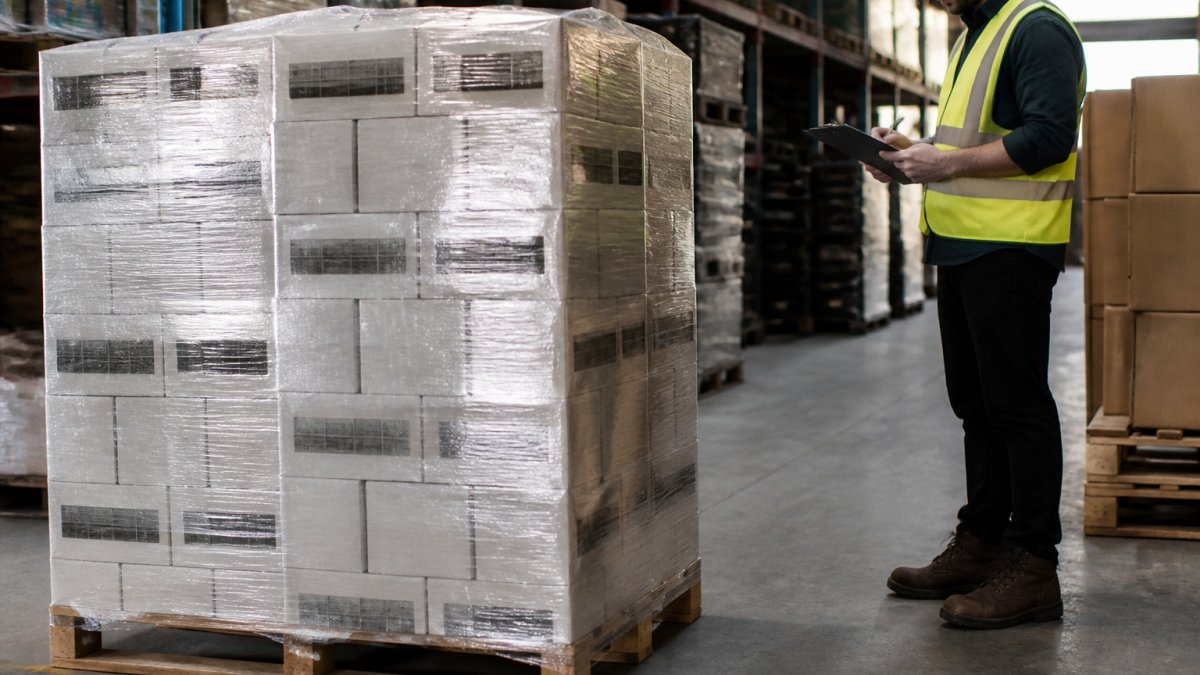
- Insist on shrink-wrapping and edge protection on every pallet.
- Ask whether the forwarder uses airbags or void fill to stop pallets shifting in the trailer.
- Check whether the carrier has experience with alcohol specifically. General hauliers often do not.
Insurance
Insurance is not optional. Declare the full commercial value of the shipment, not the ex-cellar value alone, and confirm in writing that cover includes:
- Breakage
- Theft
- Water damage
- Temperature-related spoilage, if available
Many standard cargo policies exclude or limit temperature damage. If yours does, you are carrying that risk yourself.
Transit time and planning
Road freight from Portugal to the UK typically runs to a few days door to door, assuming clean customs clearance. Add time for customs clearance at the border, any inspection or document query, and delivery scheduling at your end.
Step 7: Calculate Wine Import Costs and Landed Cost
Wine import costs and landed cost determine whether a wine is worth listing. Build the number before committing to a supplier, because the ex-cellar price tells you almost nothing about the bottle's true cost.
Landed cost has five layers, and they stack in a fixed order:
- Goods value, what you pay the producer, converted to pounds
- Freight and insurance, your share of the shipment, per bottle
- Duty, charged per litre of pure alcohol, not per bottle
- Clearance and handling, broker fees, port charges, delivery to your premises
- VAT, charged on the sum of everything above
The order matters. VAT is calculated last, on the duty-inclusive value, so every earlier cost is effectively 20% more expensive than it looks.
A worked example
Take a shipment of 1,200 bottles (100 cases of 12) of a dry Portuguese red at 13% ABV, in 75cl bottles.
Step 3, Duty-inclusive value. £6.00 + £1.20 + £0.40 + £2.44 = £10.04 per bottle.
Step 4, VAT. £10.04 × 20% = £2.01 per bottle.
Step 5, Landed cost. £10.04 + £2.01 = £12.05 per bottle, or roughly £144.60 per case of 12.
Notice the shape of that number: the wine was £6.00, but duty, freight, clearance and VAT added more than £6.00 on top.
The formula, compressed
Landed cost per bottle = (goods + freight + insurance + clearance + duty) × 1.20
The 1.20 factor applies standard-rate VAT. Duty is inside the bracket because VAT is charged on the duty-inclusive value.
Where the estimate usually goes wrong
- ABV assumptions. Duty scales with alcohol, so a 14.5% wine carries materially more duty than an 11% wine at the same price. Confirm ABV on the producer's specification, not the label artwork.
- Exchange rate. If the supplier invoices in euros, use the rate your bank or payment provider actually applies, plus any transfer fee. The headline rate is not the rate you get.
- Freight per bottle. This falls as shipment size rises. A single pallet spread across 600 bottles carries a much higher per-bottle freight share than a full container.
- Clearance fees. Brokers often charge per declaration, not per bottle, so small shipments carry a disproportionate fixed cost.
- Duty rate changes. Still, sparkling and fortified wines sit at different rates, and the rates move at Budgets. Re-check before every pricing decision.
Common Mistakes to Avoid When Importing Portuguese Wine
The same errors sink first-time importers again and again.
1. Ordering before AWRS approval. You cannot legally wholesale alcohol without it.
2. Using the wrong commodity code. Wine codes are specific by type and ABV.
3. Incorrectly declaring the wine's ABV. This directly impacts duty calculations.
4. Failing to account for currency fluctuations. Invoicing in euros can lead to unexpected costs.
5. Skipping temperature control in summer. A hot trailer can spoil a whole pallet.
6. Under-insuring the shipment. Declare the full value. Breakage happens.
7. Not keeping product records. HMRC expects full records of every alcohol movement.
Wine labelling is another compliance point.
Working with an importer who already knows the tips for importing Portuguese wine to the UK removes most of these risks. Our range includes small-batch producers like Herdade da Calada's Vale da Calada Rosé and the Quinta Pousada de Fora Arinto Reserva.
Importing Portuguese wine into the UK is a process, not a gamble.
Frequently Asked Questions
How much is import tax on wine from Portugal?
Import tax on Portuguese wine consists of excise duty and VAT. Excise duty depends on the wine's alcohol by volume (ABV) and still or sparkling status, while VAT is charged at 20% on the total of the wine value, shipping, insurance, duty, and fees. You pay both when the wine enters the UK unless it is moved into an excise warehouse for duty deferment.
What UK paperwork is needed to import wine from Portugal?
You will need a commercial invoice, packing list, transport document, proof of origin, and product records for each wine. A customs declaration must be submitted, and you need AWRS approval if you are a wholesaler. Product records should cover supplier details, ABV, volume, and duty paid. Keeping these documents accurate prevents delays at customs clearance.
How do I import wine from Portugal for commercial sale?
Register as an importer, apply for AWRS approval, vet your Portuguese supplier, and confirm the wine meets UK labelling rules. Then arrange shipping with a freight forwarder, submit customs declarations, pay excise duty and VAT, and store the wine in an excise warehouse if you want to defer duty. Using a specialist importer like 79North can simplify the whole process.
Can I import Portuguese wine for personal use?
Yes, you can bring back limited quantities for personal use without registering as a business importer. Personal allowances apply for alcohol brought back from Portugal, but if you exceed them you must declare the goods and pay duty and VAT. Commercial imports require full registration, AWRS approval, and customs declarations regardless of volume.