How to Optimise Inventory Management for Independent Wine Shops
Quick Summary
Good inventory management for an independent wine shop means keeping one stock record per bottle, tracking each vintage and format separately, and running regular stocktakes. Set a reorder point for each wine based on weekly sales and supplier lead time.
- Create one stock record per wine, holding producer, vintage, bottle size, cost and selling price.
- Keep each vintage as a separate stock line so a 2024 and 2025 bottle are tracked apart.
- Store ABV and duty category for each wine so margins reflect the true cost after duty.
- Run a full stocktake a few times a year and count fast-moving lines monthly.
- Set reorder points as weekly sales multiplied by lead time in weeks, plus a small safety buffer.
Table of Contents
- Why Inventory Management Matters for an Independent Wine Shop
- Step 1: Set Up a Stock Record for Every Bottle
- Step 2: Choose Wine Inventory Software or a Spreadsheet
- Step 3: Run Stocktakes Against Your Records
- Step 4: Calculate Reorder Points for Each Wine
- Step 5: Track Vintages, Dead Stock and Slow Lines
- Frequently Asked Questions
Why Inventory Management Matters for an Independent Wine Shop
Poor stock control costs independent wine shops money in two ways: tied-up cash in bottles that never sell, and lost sales when a popular wine runs out. For a small shop, both hurt. Good inventory management fixes both problems, and it starts with knowing exactly what you hold, where it sits and how fast it moves.
Wine adds complications that most retail advice ignores. Each bottle carries a vintage, a producer and sometimes a case format, so a single "Portuguese red" line can hide several separate stock items.
Independent shops and restaurants that track stock tightly tend to reorder at the right time, avoid over-buying slow lines and spend less time guessing. Those that don't often end up discounting old stock or missing sales on favourites.
Inventory management is the routine of recording, counting and reordering stock so the right wines are on the shelf at the right time.
Step 1: Set Up a Stock Record for Every Bottle
Start by creating one record for each wine you sell.
Keep the fields consistent. Use the same spelling for each producer every time, or your reports will split one supplier into several.
Give every wine a unique code, often called a SKU. A short code such as "PT-RED-2024-75" makes stocktakes and orders far quicker than typing full names.
Watch out: Do not merge different vintages into one line to save time. Your sales figures will look healthy while one vintage quietly stops moving.
To see how a wine importer organises its range by producer and vintage, you could look at how Casa Di Vini vs Raymond Reynolds Wine Importer Comparison sets out its options.
The essential fields for each wine record are summarised below.
| Field | Why it matters | Example |
|---|---|---|
| Producer and wine name | Identifies the product | Consistent producer spelling |
| Vintage | Keeps vintages as separate lines | 2024 and 2025 as two lines |
| Bottle size | Separates formats | 75cl |
| Cost and selling price | Shows whether a wine is profitable | Cost price and selling price |
| Supplier | Links stock to its source | One supplier per line |
| SKU code | Speeds up stocktakes and orders | PT-RED-2024-75 |
Step 2: Choose Wine Inventory Software or a Spreadsheet
You do not need expensive software to start. A well-built spreadsheet handles stock for many small shops, provided you design it around wine rather than generic retail.
Whichever you choose, check that it can handle vintages and case formats, that it reduces stock when a sale is rung up, and that you can export your data if you switch later. But the decisive test for a wine shop is whether the system can talk to your distributors and account for excise duty.
What Wine-Specific Software Must Do
A system built for wine retail should support:
- Vintage as a separate stock item, not a note in a description field. A 2023 and a 2024 Rioja are different products with different costs and selling prices.
- Multiple bottle formats, 75cl, magnum, half-bottle, and case equivalents. If you buy in cases of six and sell singles, the system must convert between them without manual arithmetic.
- Excise duty and VAT tracking, alcohol duty is charged per litre of pure alcohol, and the rate depends on the product type and strength (Alcohol Duty rates). Your system should store the ABV and duty category for each wine so you can calculate the duty element of your cost price and produce accurate margin reports. Without this, you cannot tell whether a bottle is actually profitable after duty.
- Distributor integration, the ability to import price lists and stock availability from your suppliers, or to place orders electronically. This is where most independent shops lose hours each week.
Integrating with Wine Distributors
Manually re-keying those prices into your system is slow and error-prone.
Ask your software provider whether the system can import a supplier price file in CSV or Excel format, and whether it supports EDI or API connections to distributors.
A practical middle ground for smaller shops is a spreadsheet that imports supplier price lists on a schedule, monthly, for example, and flags any cost price changes above a threshold you set. That way you catch a distributor's price rise before it erodes your margin on a wine you thought was profitable.
Using a Wine Inventory Spreadsheet Template
A basic wine inventory spreadsheet template needs these columns:
- SKU code
- Producer and wine name
- Vintage
- Bottle size
- Units in stock
- Cost price per bottle (excluding duty)
- Duty per bottle
- Selling price per bottle
- Reorder point
- Supplier and lead time in days
- Date of last stocktake
Add a formula that subtracts sales from opening stock, so the units column updates as you record sales. Include a duty column so your margin calculation reflects the true cost.
For a sense of how a producer collection is organised before you design your fields, Producers shows how a wine range is grouped by supplier.
Watch out: Do not choose software solely on the monthly fee.
Step 3: Run Stocktakes Against Your Records
A stocktake compares what your records say you hold with what is actually on the shelves and in the storeroom. Count the bottles, write down the numbers and then fix any gaps.
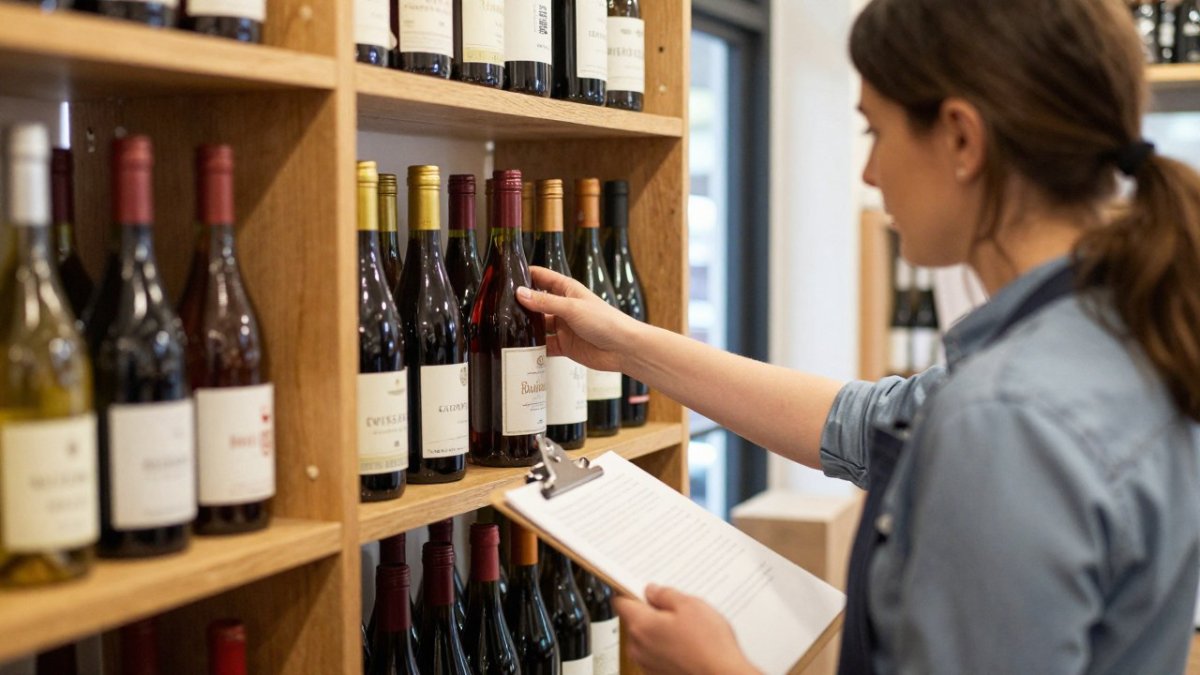
Run a full stocktake a few times a year and a partial count of your fastest-moving lines every month. Keeping case seals, loose bottles and vintage records aligned makes regular counts more reliable, and the same discipline helps Fairwood Coffee keep its inventory in order.
!A shop owner in a small independent wine shop counting bottles on a wooden shelf with a clipboard and tablet, warm lighting
Watch out: Do not adjust your records to match the count without finding out why they differed.
Keep a short note of each adjustment and its reason. Over time these notes show which lines are most at risk of loss.
Step 4: Calculate Reorder Points for Each Wine
A reorder point is the stock level at which you place a new order. Set it so the new stock arrives before you run out.
For example, if a white sells four bottles a week and the supplier takes three weeks to deliver, the base reorder point is 12 bottles. Add two or three bottles as a buffer for busy weekends or delays, which gives a reorder point of about 15.
Recalculate reorder points every quarter. Sales change with the seasons, and a wine that sells well in summer may slow down in winter.
Ordering in the right quantity also depends on the terms of your supplier. For current stock, delivery options and pricing, which depend on quantity, dates and delivery, visit the 79North Ltd website or request a quote.
Step 5: Track Vintages, Dead Stock and Slow Lines
Each month, review which wines are moving and which are sitting. A line that has not sold in 90 days is slow, and one that has not sold in six months is likely dead stock.
Track vintages separately. When a new vintage arrives, the older one should sell first, so keep older stock at the front and check dates on each delivery. Vintage changes can shift taste and price, and a customer who liked last year's wine may not enjoy the new one.
Seasonal Demand Forecasting for Wine
Wine sales often follow seasonal patterns. A framework for forecasting demand by season helps you avoid both overstock and stockouts:
- Christmas and New Year, sparkling wine, premium reds, and gift-packaged bottles spike from late November. Order early, as supplier lead times can stretch in December. Keep a buffer of your best-selling sparkling and a small allocation of higher-priced bottles for last-minute gift buyers.
- Summer, rosé, crisp whites, and lighter reds move faster from May to August. If you sell chilled wine, ensure your stock rotation accounts for the extra handling. Reduce orders of heavy reds that slow in warm weather.
- Spring and autumn, transitional periods when customers explore. Use these windows to clear slow lines with mixed-case offers rather than deep discounts that erode margin.
Build a simple seasonal index for your top 20 lines: compare each month's sales to your annual average. A wine that sells 50% above average in December and 30% below in February needs a reorder point that changes with the calendar, not a fixed number. Recalculate reorder points quarterly, as Step 4 explains, and adjust for the season ahead.
Clearing Dead Stock Without Breaking Compliance
When you decide to clear a slow or dead line, remember that alcohol duty has already been paid on stock you hold.
If you sell online or wholesale, keep records of discounted sales for VAT purposes. A clearance sale is still a taxable supply, and your VAT return must reflect the actual selling price, not the original. If you dispose of unsaleable stock, breakage, spoilage, or out-of-date wine, record the disposal and the duty paid.
A Decision Framework for Slow Lines
Use a simple rule set to avoid agonising over each bottle:
- 90 days no sale, move to a mixed-case offer or a shelf-talker with a staff recommendation. Give it one more quarter.
- 180 days no sale, discount by 15-20%, but not below duty-inclusive cost. Bundle with a faster-moving wine.
- 12 months no sale, stop reordering immediately. Clear remaining stock at cost or below, and record the loss. Do not let dead stock occupy shelf space that could hold a wine that sells.
Ask whether a wine still earns its shelf space. If you are reviewing your range, How To Curate Independent Wine Lists covers how to keep a range focused.
Collectible and aged wines need different handling. They can hold their value for years, but only if stored well and recorded accurately. Collecting Portuguese Wines for Investment: A Practical Guide explains how aged stock is valued and held.
- Review slow lines monthly
- Sell older vintages first
- Set a clear date for each clearance decision
- Stop reordering lines that do not earn their space
- Check duty-inclusive cost before discounting
Good stock control takes a few hours a month once the system is in place. The payoff is fewer gaps, less dead stock and more cash for the wines your customers ask for.
Frequently Asked Questions
How do independent wine shops manage inventory?
Most independent wine shops start by recording every bottle on arrival, with supplier, vintage, case size and cost in GBP. Stock is then checked against those records at regular stocktakes, and sales are logged at the till so the system reflects what has actually left the shop. Keeping one master list, rather than separate records for the shop floor and the stockroom, prevents most discrepancies. Pricing and availability for 79North Ltd wines depend on quantity, dates and delivery, so check the website for current prices or request a quote.
How often should a wine retailer review stock levels?
A weekly check of fast-moving lines and a full review each month works well for most independent shops. Lines with short shelf lives or limited allocations need closer attention, particularly around festive periods and summer trade. A quarterly stocktake against your records catches shrinkage and mis-recorded bottles before they distort your reorder decisions and your cash position.
How can a wine shop reduce dead stock?
Review every line that has not sold within a set period, such as six months, and decide whether to discount, bundle or return it to the supplier where terms allow. Avoid reordering slow lines at the same quantity, and reduce future orders for wines that sit unsold. Clear dead stock early, because the longer a bottle sits, the less capital it returns and the harder it becomes to move.
How do you calculate reorder points for wine?
Divide the average weekly sales of a wine by the number of weeks it takes to receive a new order, then add a safety buffer for delays. For example, a wine selling six bottles a week on a three-week lead time needs at least 18 bottles on hand before reordering, plus a buffer. Recalculate the figure each quarter, as seasonal trade shifts demand and lead times vary by importer.
