
Managing Wine Import Paperwork for Restaurants
Table of Contents
- Why Managing Wine Import Paperwork Matters for Restaurants
- Step 1: Register for an EORI Number and Understand Import Licensing
- Step 2: Prepare Your Customs Declaration and CDS Submission
- Step 3: Complete VI-1 Document Requirements for Wine Imports
- Step 4: Calculate and Pay Excise Duty on Wine Imports
- Step 5: Ensure Wine Labelling and Health Standards Compliance
- Step 6: Organize Your Import Records for Audit Readiness
- Common Mistakes to Avoid When Importing Wine
Last Updated: August 14, 2026
Why Managing Wine Import Paperwork Matters for Restaurants
Getting wine import paperwork right is the foundation of a compliant supply chain. Most restaurants underestimate the complexity until customs delays or audit queries halt operations. The difference between smooth imports and nightmare scenarios comes down to understanding what HMRC expects before you start.
Managing wine import paperwork requires coordination across multiple regulatory bodies, each with specific documentation requirements. Miss one step, and you risk duty recalculation, penalties, or inventory stuck in bonded warehouses for weeks.
This guide covers every essential step: EORI registration, Customs Declaration Service submissions, VI-1 certification, excise duty calculation, labelling compliance, and audit-ready record-keeping. By the end, you'll know exactly what documents to prepare, how to submit them correctly, and how to organize your records.
Step 1: Register for an EORI Number and Understand Import Licensing
Your EORI number is your entry ticket into the UK import system. Without it, you cannot legally import anything.
What Your EORI Number Does
An EORI number (Economic Operator Registration and Identification) is a unique identifier that links your business to HMRC's systems. It's required for all customs declarations, duty payments, and regulatory compliance. Think of it as your business's customs passport.
The EORI number establishes you as the legal importer of record for all wine shipments, allows HMRC to track your compliance history, and serves as the reference point for duty deferment accounts and VAT recovery claims. Without an EORI, you cannot submit Customs Declaration Service entries or legally clear goods through UK customs.
How to Apply for Your EORI Number
Visit the HMRC EORI registration service and select "Apply for an EORI number." You'll need:
- Your business registration number (Companies House reference)
- VAT registration number (if applicable)
- Business address and contact details
- Details of who will manage customs compliance
HMRC typically issues your EORI within 5 working days. You'll receive a letter confirming your number and can begin making customs declarations immediately.
Step 2: Prepare Your Customs Declaration and CDS Submission
The Customs Declaration Service replaced the old paper-based system. Every wine shipment requires a digital CDS declaration submitted to HMRC before goods can be released from customs.
Understanding the Customs Declaration Service (CDS)
The Customs Declaration Service (CDS) is HMRC's digital platform for submitting import declarations. For restaurants importing wine, a CDS declaration is mandatory for every shipment. The declaration tells HMRC what you're importing, where it came from, its value, and what duty and VAT you owe.
Your freight forwarder or customs broker typically submits the declaration on your behalf, but you remain responsible for accuracy. Errors in the CDS declaration can trigger HMRC queries, duty adjustments, or penalties.
Key Documents You'll Need
Before your freight forwarder can submit a CDS declaration, gather these documents:
Commercial Invoice - The supplier's invoice showing wine description, quantity, unit price, total value, and payment terms. HMRC uses this to assess duties and verify you're not under-declaring value.
Packing List - A detailed breakdown of what's in each carton: bottle counts, sizes, wine names, and producer details.
Certificate of Origin - Proof that the wine originated in the stated EU country. Most suppliers provide this automatically.
VI-1 Document - A phytosanitary or quality certification specific to wine imports (covered in Step 3). This is critical and often overlooked.
Bill of Lading or Airwaybill - The shipping document from the freight company proving goods are in transit.
Supplier's Business Registration - Confirmation that your supplier is a legitimate registered business.
Organize these documents in a shared cloud folder and share access with your freight forwarder before shipment.

Step 3: Complete VI-1 Document Requirements for Wine Imports
The VI-1 document is a compliance requirement that many small importers discover too late. It's not optional, and without it, your wine can be held at customs.
What the VI-1 Certification Covers
The VI-1 document is a phytosanitary or quality certificate required for wine imports into the UK. It certifies that the wine meets UK health and safety standards and that the producer is registered with their national wine authority.
For Portuguese and Italian wines, the VI-1 confirms that the producer is registered with the appropriate regulatory body and that the wine has been produced in compliance with EU wine regulations, which the UK has largely adopted post-Brexit.
How to Obtain Your VI-1 Document
Your supplier is responsible for obtaining and providing the VI-1. Request it when you place your order, not when the wine is already packed. This gives the supplier time to obtain it from their national wine authority.
The VI-1 is typically issued in the exporting country and provided as a PDF or printed document. Your freight forwarder needs a copy to include with the CDS declaration. Keep the original or a certified copy in your records.
If your supplier can't provide a VI-1 or doesn't know what it is, that's a red flag suggesting they may not be a legitimate, registered producer.
Step 4: Calculate and Pay Excise Duty on Wine Imports
Excise duty is a per-unit tax on alcoholic beverages. For wine, it's calculated based on alcohol content and quantity, not value. Understanding how it works prevents surprise costs and helps you price your wine accurately.
Excise Duty Rates and Calculation
Excise duty on wine is charged per litre of pure alcohol. A bottle of 750ml at 12% ABV contains 0.09 litres of pure alcohol. If you import 100 bottles at 12% ABV, you have 9 litres of pure alcohol and owe duty on those 9 litres.
Sparkling wines (including Prosecco and Champagne) are taxed at a higher rate than still wines. If your portfolio includes sparkling, budget accordingly.
Check HMRC's current excise duty rates for alcohol before calculating your costs. Rates vary by wine type.
VAT and Duty Deferment Options
You owe both excise duty and VAT on wine imports. VAT is calculated on the landed cost (cost of goods + shipping + duty). This can create significant cash flow challenges.
Duty deferment allows you to defer payment of excise duty until the end of the month following import. Instead of paying immediately on clearance, you accumulate a monthly bill and pay once.
To use duty deferment, apply to HMRC and be approved. Most restaurants qualify, but approval depends on your business history and credit rating. The process takes 2-4 weeks.
Duty deferment improves cash flow because you can sell the wine before paying duty. However, HMRC can suspend your account if you miss a payment. Always pay deferment bills on time.
Step 5: Ensure Wine Labelling and Health Standards Compliance
Wine labels must meet UK regulations. Post-Brexit, the rules changed, and many European wines need re-labelling before they can be sold in the UK market.
Wine labelling compliance is a legal requirement. Bottles without proper UK labelling cannot be legally sold to consumers. Required information includes the producer's name and address, country of origin, alcohol content, net volume, and allergen warnings.
Many European wines come with EU labels that don't include all required UK information. You can request your supplier to provide UK-compliant labels, or apply labels yourself after import. Many small importers add a back label with missing information (UK importer details, allergen warnings, etc.).
Health standards require that wine producers meet food safety regulations, covered by the VI-1 document. Ensure the wine hasn't been stored improperly before it reaches you. Work with suppliers who maintain proper storage conditions and can provide evidence if needed.
Step 6: Organize Your Import Records for Audit Readiness
HMRC conducts customs audits on importers. Having organized records means you can respond quickly and demonstrate compliance. Poor record-keeping is one of the most common reasons small importers face penalties.
What Documents to Keep and for How Long
Keep these documents for at least six years:
- CDS declarations and HMRC acknowledgments
- Commercial invoices and packing lists
- VI-1 documents and certificates of origin
- Duty deferment statements and payment records
- VAT invoices and VAT return records
- Freight and logistics documentation
- Supplier registration confirmations
- Bank statements showing payments to suppliers
- Email correspondence with freight forwarders and customs brokers
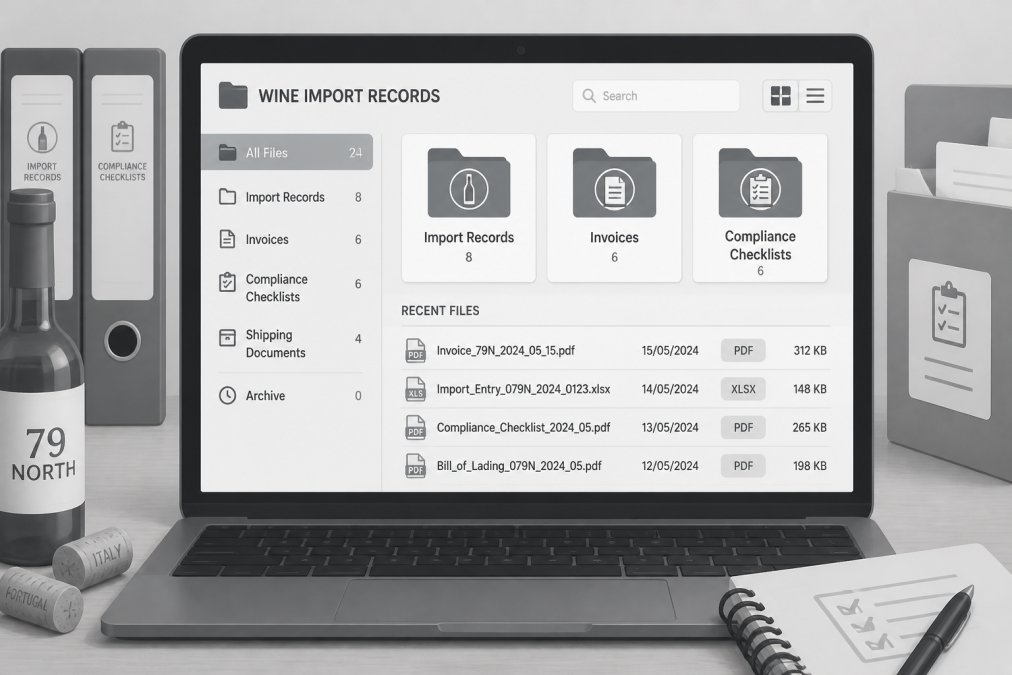
Organize by shipment and by month. Create a folder structure: Year → Month → Shipment. Include a summary sheet for each shipment: supplier name, wine names, quantities, values, duty paid, VAT paid, and release date.
Digital Record-Keeping Best Practices
Use cloud storage (Google Drive, OneDrive, Dropbox) to ensure records survive hardware failures and are accessible from anywhere.
Create a master spreadsheet tracking all imports: date, supplier, wine names, quantities, unit costs, total landed cost, duty, VAT, and release date. This becomes your audit-ready summary.
Scan all physical documents and store them in your cloud folder. Use consistent naming: "2026-08-ShipmentName-Invoice.pdf" makes files easy to find.
Back up your records monthly. If you use accounting software (Xero, FreeAgent, QuickBooks), ensure import costs are properly categorized for VAT recovery and duty calculations.
Common Mistakes to Avoid When Importing Wine
Undervaluing wine on the commercial invoice is a common mistake. HMRC has market data and will challenge undervalued shipments. If caught, you face duty recalculation plus penalties. Always declare the actual price you're paying.
Forgetting the VI-1 document stops shipments at customs. Request it upfront and verify you have it before the shipment leaves the supplier's warehouse.
Not applying for an EORI before importing creates legal liability. Apply early and keep your EORI active.
Mixing up excise duty rates leads to underpayment. Sparkling wines have higher duty than still wines. Calculate separately if your portfolio includes both.
Storing records poorly makes audits stressful. If you can't find a VI-1 or CDS acknowledgment when HMRC asks, you look non-compliant. Digital organization takes an hour upfront and saves weeks of stress later.
Working with unregistered freight forwarders shifts liability to you. Use forwarders registered with HMRC and ask for references from other wine importers.
Ignoring labelling requirements means wine can't be legally sold. Check UK labelling rules before the shipment arrives and plan time and budget for relabelling if needed.
Managing wine import paperwork for restaurants is complex, but entirely manageable with the right process. Each step, EORI registration, CDS submission, VI-1 certification, duty calculation, labelling, and record-keeping, serves a specific compliance purpose.
At 79North Ltd, we work with independent restaurants and wine shops navigating these requirements every day. We handle the regulatory complexity so you can focus on sourcing exceptional wines from Portugal and Italy. We manage HMRC submissions, duty calculations, and compliance documentation, turning bureaucratic challenges into a simplified process. Let's talk about how we can simplify your import workflow and get you access to distinctive, family-owned wines that stand out on your list.
Frequently Asked Questions
What documents are required to import wine into the UK?
To import wine, you'll need a commercial invoice, packing list, Certificate of Origin, VI-1 document (wine-specific certification), your EORI number, and a customs declaration submitted through CDS. Your freight forwarder can help prepare these, but as the importer, you're responsible for accuracy and compliance. Keep copies of everything for HMRC audit trails.
Do restaurants need an EORI number to import wine?
Yes. Every restaurant or hospitality business importing wine must register for an EORI number with HMRC before submitting any customs declarations. The EORI number identifies you as an importer and is required for all CDS submissions. Registration is free and typically takes 5-10 working days. Without it, your shipments cannot clear customs.
What is a VI-1 document and when is it needed for wine imports?
The VI-1 is a certificate issued by the exporting country's wine authority confirming the wine meets quality and labelling standards. It's required for all wine imports into the UK and must accompany your customs declaration. Your supplier should arrange this before shipping. Without a valid VI-1, your shipment will be held at the border and you'll face delays and additional costs.
How do I handle excise duty and VAT on imported wine?
Excise duty on wine is charged at the point of import based on alcohol content and volume. VAT is calculated on the total import value including duty. You can defer payment using duty deferment if you're approved by HMRC, which improves cash flow. Alternatively, pay upfront through your freight forwarder. Accurate tariff classification and commodity codes are essential to calculate the correct amounts.
This article was written using GrandRanker