
The Future of UK Native Grape Industry: Outlook to
Last Updated: November 2, 2026
Quick Summary
The future of the UK native grape industry is still being written, shaped by climate shifts, consumer appetite for distinctive local wine, and uncertain planting economics. Commercial outcomes depend heavily on site, scale and route to market, so growers should test varieties on their own land.
- Growing degree days track heat accumulation, which determines whether late-ripening varieties reach full maturity.
- Frost risk varies sharply between blocks a few hundred metres apart because cold air pools in hollows.
- Plan against a range of climate scenarios rather than a single projection, favouring varieties that perform across outcomes.
- Strictly speaking, no grape varieties are indigenous to the UK; 'native' usually means UK-bred, historic or locally grown.
- Many growers blend established varieties for volume with native or UK-bred varieties for differentiation.
Table of Contents
- Where the UK Native Grape Industry Stands Today
- UK Viticulture Climate Change Impact and Growing-Season Shifts
- Native Grape Varieties Versus Established Varieties
- Emerging Grape Varieties for UK Vineyards
- Sustainable Viticulture Practices for Long-Term Resilience
- Commercial Viability, Costs and Market Demand
- Planning Your Next Steps in a Changing Industry
- Frequently Asked Questions
Where the UK Native Grape Industry Stands Today
The UK wine sector has grown substantially over the past two decades, and native grape varieties are now part of the conversation for growers and buyers alike. For independent wine shops and restaurants, the question is no longer whether English and Welsh vineyards can produce serious wine, but which varieties will define the next decade. At 79North Ltd, we import family-owned wines from Portugal and Italy.
The honest picture is that the future of the UK native grape industry is still being written. Growing conditions have shifted, consumer appetite for distinctive, locally rooted wine has grown, and the economics of planting are still being tested. Native varieties can offer a point of difference on a crowded shelf, though commercial outcomes depend heavily on site, scale and route to market.
UK Viticulture Climate Change Impact and Growing-Season Shifts
Climate is the single biggest variable shaping UK viticulture, and the changes underway are more specific than a general warming trend. The growing season has lengthened in many areas, but the practical consequences vary sharply by site, soil and variety. Growers and buyers who understand the mechanisms behind the shift make better decisions than those who simply note that summers are warmer.
Temperature, Heat Accumulation and Frost Risk
Heat accumulation during the growing season is now the metric most growers watch closely. The standard measure is growing degree days, which sum the heat available above a base temperature through the season. Higher accumulation allows later-ripening varieties to reach full maturity, but it also shifts the timing of key stages. A key consequence is earlier budburst, after which vines are exposed to spring frost.
Frost risk is not uniform across a holding. Cold air drains downslope and pools in hollows, so two blocks a few hundred metres apart can face very different exposure. Growers manage this through site selection, avoiding known frost pockets, and through active measures such as frost fans, overhead irrigation where water resources allow, and careful pruning timing to delay budburst on the most exposed blocks. The trade-off is that delaying budburst can push ripening later into a cooler, wetter autumn, so the decision is a balance rather than a simple fix.
Climate Projections Through 2040 and Beyond
Climate projections point towards continued warming, with consequences that vary by region and variety. The most useful way to read them is as scenarios rather than certainties. Different emissions pathways produce different outcomes, and the uncertainty itself is worth planning for. Growers who model several outcomes, and who test varieties on their own sites rather than relying on a single forecast, are better placed than those who bet on one projection.
A practical framework helps translate projections into decisions. First, identify the heat accumulation your site currently achieves and the range of scenarios for the next two decades. Second, match varieties to that range rather than to the current average, favouring those that perform across a spread of outcomes. Third, assess frost exposure and water availability separately, because these risks do not move in step with average temperature. Fourth, build in flexibility: a block planted to a variety that may become marginal can be managed differently, or replanted, if projections shift.
Treating a single projection as a plan carries risk. A variety that looks well suited to a warmer scenario may still fail in a cold, wet season, so resilience across a range of years matters.
Regional variation is significant. Sites with good air drainage, favourable aspect and reliable water access will adapt more easily than exposed or frost-prone holdings. The broad direction of change is clear, but the local detail is where planting decisions are won or lost.
Native Grape Varieties Versus Established Varieties
The central strategic choice is between native varieties and the internationally established grapes that dominate most English and Welsh plantings, but the term 'native' needs clarifying before any comparison makes sense. Strictly, there are no grape varieties indigenous to the UK in the way that, say, Assyrtiko is indigenous to Santorini. What growers and buyers usually mean by 'native' is one of three things: varieties bred or selected in the UK for local conditions, often disease-resistant hybrids; traditional varieties long grown here, such as those used for historic English wines; or, more loosely, any wine made from UK-grown fruit. Clarity on which sense is meant matters, because the commercial case differs for each.
Established international varieties come with known market recognition and a deep body of growing knowledge. A buyer recognises the name, the style is predictable, and the grower can draw on decades of experience from other regions. The trade-off is that these varieties compete on a crowded shelf against the same names from elsewhere, often at lower prices. For the commercial case behind stocking native grapes, see the business case for native grape varieties. Native and UK-bred varieties offer distinctiveness and a story, but they often lack the consumer familiarity that makes a bottle easy to sell, and the growing knowledge base is thinner.
A common mistake is treating the decision as either-or. Many growers blend the two, planting established varieties for volume and reliable cash flow while trialling native or UK-bred varieties for differentiation. The practical comparison comes down to several factors. Establishment costs are similar per hectare, but disease-resistant varieties can reduce spray inputs and labour over the life of the vineyard, which matters more as chemical options narrow. Yields vary widely by variety and site, and a grower should model yields against the price the finished wine can achieve rather than against a generic average. Routes to market differ too: established varieties sell more easily through wholesale and multiple retail, while native varieties often suit direct sales, independent wine shops and restaurants where the story can be told.
For buyers, the useful question is not whether a variety is native but whether its character suits the style and price point of a given list. A variety that performs well in one site may behave very differently a few miles away, so variety-level decisions are best made with site-level data. The most credible position for a UK producer is usually to present a native or UK-bred variety with clear context about its origin, its breeding or history, and its character, rather than to rely on the label 'native' alone.
Overstating the native credentials of a variety that is neither indigenous nor long established here can undermine trust with informed buyers.
The article compares the main factors a grower or buyer should weigh when choosing between native and established varieties.
| Factor | Established varieties | Native or UK-bred varieties |
|---|---|---|
| Market recognition | Known names, easier to sell | Distinctive, but less consumer familiarity |
| Growing knowledge | Decades of experience from other regions | Thinner knowledge base |
| Disease and inputs | Higher spray inputs, labour | Disease-resistant hybrids can reduce spraying |
| Typical route to market | Wholesale and multiple retail | Direct sales, independent shops, restaurants |
| Establishment cost | Similar per hectare | Similar per hectare |
Emerging Grape Varieties for UK Vineyards
Emerging varieties for UK vineyards are attracting attention from growers who want resilience alongside quality. Disease-resistant and later-ripening varieties are being evaluated for their fit with cooler, wetter conditions and changing summers.
For buyers, the useful question is not whether a variety is fashionable but whether its character suits the style and price point of a given list. A variety that performs well in one site may behave very differently a few miles away, so variety-level decisions are best made with site-level data.
Sustainable Viticulture Practices for Long-Term Resilience
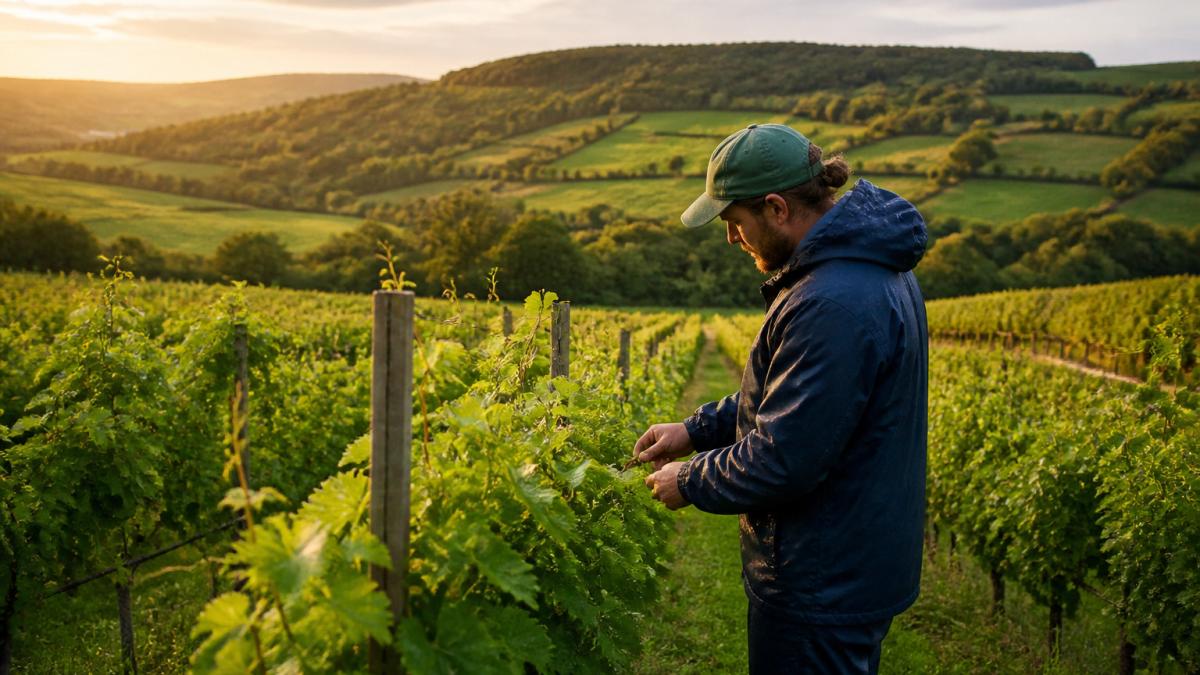
Sustainable viticulture practices are moving from optional to expected. Soil health, water management and biodiversity around the vineyard all affect how well vines cope with extreme weather. Cover cropping, reduced chemical inputs and careful drainage planning are among the approaches growers can use to build resilience over the long term. A separate buyer's guide to Alentejo white wine varieties covers another region's approach to resilient viticulture. For practical guidance on overcoming the challenges of growing native varieties, the approaches are set out in detail.
Commercial Viability, Costs and Market Demand
Commercial viability depends on establishment costs, time to first harvest, yields and the price a producer can achieve for finished wine. Pricing depends on scale, site and route to market, and anyone planning a planting should build a realistic model with their own advisers rather than relying on general figures. The return-on-investment factors that shape vineyard returns are a useful starting point for that model.
Retailers and restaurants weighing up new listings should ask what makes a wine distinctive, who the customer is, and how consistent supply is.
Planning Your Next Steps in a Changing Industry
The future of the UK native grape industry will be shaped by climate, economics and consumer taste, and none of these will stand still. Growers should test varieties on their own sites, buyers should favour producers who can explain their approach clearly, and everyone should plan for more than one climate scenario. If you are building a wine list around distinctive, family-owned producers, get in touch with 79North Ltd to talk through what we import from Portugal and Italy. Let's talk.
Frequently Asked Questions
Can native grape varieties thrive in the UK climate?
Some can, and the answer depends on site selection, variety and vintage conditions. Frost risk, late-season rain and disease pressure still determine whether a given variety performs. Growers usually trial a small number of varieties on a few sites before planting at scale, and they track heat accumulation and ripening data across several seasons before drawing firm conclusions.
How is climate change impacting UK wine production?
Warmer average temperatures have extended the growing season and increased heat accumulation, which has improved ripening for many vineyards. Climate change also brings higher frost, extreme weather and disease risks, and these vary widely between sites. The balance of benefits and risks differs by region and variety, so growers adapt through site choice and other management measures.
Are there any indigenous grape varieties native to the UK?
There are no widely established grape varieties that originated in the UK, and most UK vineyards plant varieties bred in France, Germany or elsewhere in Europe. Interest in native grape varieties is growing, with the sector examining which varieties suit UK soils and climate. Readers researching this should look for variety trial data from specific sites, since results vary considerably between regions.
What regulatory changes are affecting the UK wine industry?
Growers and producers in England and Wales operate under UK wine rules covering labelling, production and planting, and these can change as policy evolves. Anyone planning a new vineyard should check current planting requirements and consult the relevant government agencies before investing. Regulatory detail changes over time, so confirm the latest position directly with official sources rather than relying on older summaries.
