How Do You Write Effective Wine Shelf Talkers?
Last Updated: November 19, 2026
Quick Summary
Effective wine shelf talkers use 25 to 40 words of body copy plus the wine name, producer, vintage and price, and name the grape and region on every card. Write each card as if the shopper has never heard of the wine, using plain taste words and one specific food pairing.
- Keep body copy to 25 to 40 words, roughly four short lines that shoppers scan.
- Use a five-line template: headline, identity, tasting note, pairing, optional real rating.
- Add one specific food pairing rather than a list of five, which reads as a shrug.
- Use a minimum body type of around 12 point with strong contrast and a plain sans-serif face.
- Test one variable at a time for at least two to four weeks against a baseline and a control bottle.
Table of Contents
- What a Wine Shelf Talker Does for Your Shop
- Wine Shelf Talker Length: How Many Words Fit on a Card
- A Repeatable Wine Shelf Talker Template
- Wine Shelf Talker Examples You Can Adapt
- Wine Shelf Talker Best Practices for Independent Retailers
- Testing and Refreshing Your Shelf Talkers
- Stocking the Wines Worth Writing About
- Frequently Asked Questions
What a Wine Shelf Talker Does for Your Shop
Wine shelf talkers are short cards placed beside a bottle that describe the wine, name the grape and region, and give the shopper a reason to pick it up. A well-written card can sell the bottle when nobody is standing there to sell it for you.
That matters most for the wines that need explaining. A shopper who knows Chianti Classico will find it alone. A shopper facing a native Portuguese grape they have never heard of needs a hand.
Good shelf talkers do three things:
- Inform the buyer about grape variety, region, and style
- Describe what the wine tastes like in plain words
- Recommend it for a specific occasion or dish
The card is a marketing tool, but it works at the point of purchase decision. That is why how to write effective wine shelf talkers matters more than how many you print.
Wine Shelf Talker Length: How Many Words Fit on a Card
The right length is 25 to 40 words of body copy, plus the wine name, producer, vintage, and price. That is roughly four short lines. Anything longer stops being read.
Shoppers scan, they do not study. A card with a few clear lines reads as a recommendation.
Keep these rules in mind:
- Brief copy beats clever copy. Cut every word that does not help the sale.
- Large type wins. A readable font at a size you can read from arm's length.
- One idea per line. Grape, taste, food match.
- Leave white space. It makes the card look calm and easy to scan.
The wine name and price should be the largest items on the card. The tasting note is support, not the headline.
A Repeatable Wine Shelf Talker Template
Here is a template that independent wine shops can use. Fill in the blanks and you have a usable card quickly.
Line 1 (headline): Producer + wine name + vintage Line 2 (identity): Grape variety | Region | Style in three words Line 3 (tasting note): Aroma, flavour, body, finish in one or two sentences Line 4 (pairing): "Try it with..." plus one or two dishes Line 5 (optional): Expert rating or review, only if it is real
Worked example:
Casal do Conde Reserva 2021 Touriga Nacional | Lisbon Hills | Full, dark, warming Black plum and dried herb on the nose, firm tannins and a long finish. Try it with slow-roast lamb or aged hard cheese.
For deeper guidance on writing tasting-note copy that fills this template well, see how to write compelling descriptions for undiscovered wines.
Wine Shelf Talker Examples You Can Adapt
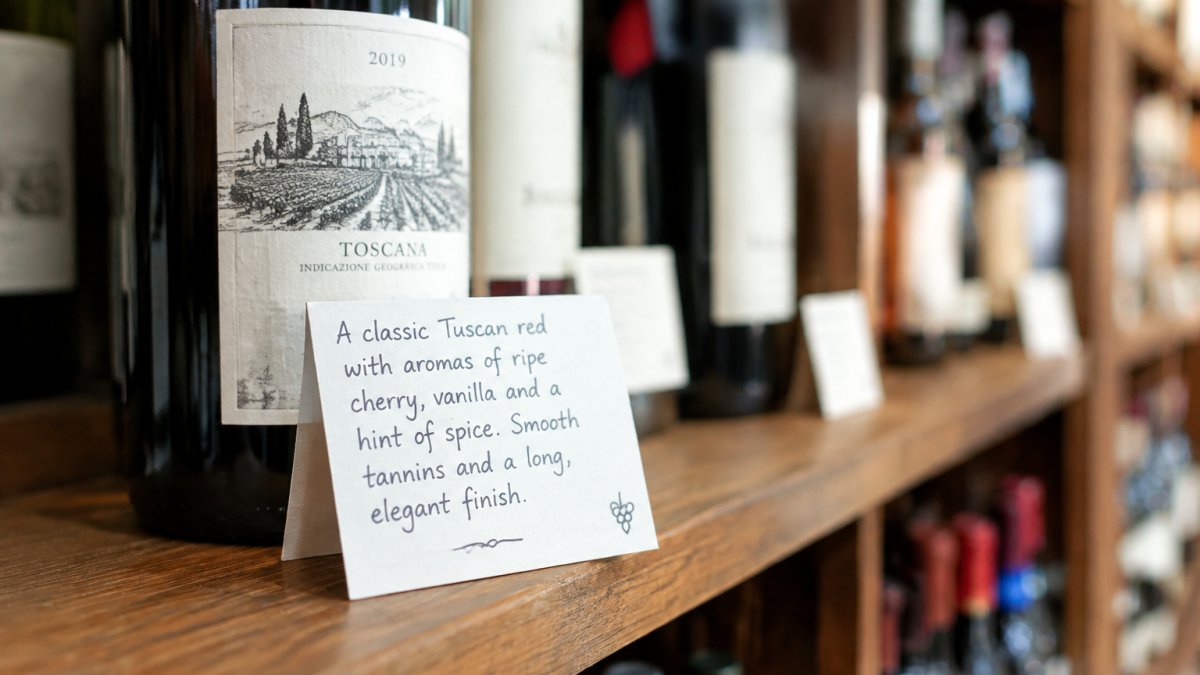
Three styles cover most situations. Each has trade-offs.
The Short Note. Twenty words, one taste line, one pairing. Best for busy shops and shoppers in a hurry. The drawback: it gives no context, so it cannot carry a wine nobody knows.
The Story Card. Adds two lines on the producer, the soil, or the production method. Best for native grape varieties and small family wineries. The drawback: it takes longer to write and needs a real story to tell.
The Score Card. Leads with an expert rating or point score. Best for shoppers who trust critics. The drawback: it leans on someone else's authority, and shoppers increasingly want the description first.
A simple way to choose:
| Style | Best for | Watch out for |
|---|---|---|
| Short Note | Familiar styles, high traffic | No context for unknown grapes |
| Story Card | Native varieties, family producers | Needs genuine detail |
| Score Card | Critic-led shoppers | Score can overshadow taste |
Wine Shelf Talker Best Practices for Independent Retailers
The best practice is to write every card as if the shopper has never heard of the wine, because for most of your range they have not. That single habit fixes most weak shelf talkers.
Name the grape and region on every card. Shoppers look for these first, and for native varieties the grape name is often the only familiar anchor. Put the grape and region on the identity line, not buried in the tasting note.
Use plain taste words with a physical referent. "Black plum" and "firm tannins" beat "complex and structured" because the shopper can picture them.
Add one food pairing, not three. A single specific dish ("slow-roast lamb") turns a description into a serving suggestion. A list of five pairings reads as a shrug.
Use ratings responsibly. Only print a score or review you can source and date, and never invent one. If the score refers to a previous vintage, say so or leave it off.
Give useful context in one line. Soil, altitude, geography, or production method all help a story land, but one concrete detail beats three vague ones. "Old vines on schist" does more work than "traditional methods".
Design for accessibility, not just appearance. Use a minimum body type of around 12 point, strong contrast between text and card, and a plain sans-serif face readable at arm's length to help shoppers, including those with reduced vision.
Watch out: a beautiful card that repeats the back label adds nothing.
Keep claims factual and compliant. Shelf talkers are marketing material, so the same care applies as to any other promotion.
Make the card match the bottle. Vintage, price, and producer must match what is on the shelf. A mismatch is the most common complaint customers raise about shelf talkers, and it undermines every other card in the shop.
Staff need to say the same things the cards say. For scripts and tasting techniques, see how to train staff on selling lesser known European wines. For broader tactics, our guide to marketing niche European wines covers the rest of the mix.
Testing and Refreshing Your Shelf Talkers
Most shelf-talker advice stops at writing the card. The harder question is whether the card is working, and how you know. Treat every talker as a small, testable intervention rather than a finished piece of decoration.
Set a baseline before you change anything. Pick the bottle, record its unit sales over the previous four weeks from your EPOS or till reports, and note the shelf position and facings. Without a baseline you cannot tell whether a lift came from the new card, a price change, or a neighbouring bottle going out of stock. A common pattern among independent retailers is to change three things at once and then credit the copy. Once the baseline is clear, test one change at a time, whether it is the wording, shelf position, or a move from a card to retail shelf danglers and wobblers.
Change one variable at a time. The variable can be the headline, the tasting note, the pairing line, or the presence or absence of a score. Keep the bottle, price, and position fixed. Run the test for at least two to four weeks, because wine sales are lumpy and a single busy Saturday can distort a short window.
Measure what the till can actually tell you. Unit sales and revenue per facing are the honest metrics. If your till system supports it, compare sell-through rate (units sold divided by units stocked) rather than raw units, so a restock does not flatter the result. For cards that prompt questions, ask staff to tally enquiries for a fortnight; a card that generates conversation but no sales is telling you the copy is interesting but not persuasive.
Watch out: a card that lifts sales of one bottle can cannibalise a neighbouring bottle at the same price point. Check the surrounding shelf, not just the test bottle, or you may record a win that is really a transfer.
Run a simple refresh cycle. Shelf talkers go stale faster than most retailers expect. Build the following into your routine:
- Check every card against the current vintage and price at each delivery; a card describing a vintage you no longer stock is a factual error, not a minor slip
- Rewrite cards for bottles that have not sold in a month, starting with the headline and pairing line
- Retire scores and reviews once the reviewed vintage has sold through
- Re-read each card aloud; if it sounds stiff or generic, rewrite it
- Photograph the shelf after each refresh so you can compare layouts over time
Keep a simple card register. A spreadsheet with columns for wine, vintage, price, card version, date written, and test result turns shelf talkers from a craft project into a managed asset. When a producer changes the blend or the label, the register tells you which cards need rewriting before a customer notices the mismatch.
Tie the in-store message to your repeat business. Our piece on why direct-to-consumer wine sales pay off for small shops shows how the same description can follow the bottle home.
Stocking the Wines Worth Writing About
A great card cannot rescue a dull bottle. The wines worth writing about are the ones with a story: a native grape, a family producer, a soil or method you can describe in one line. That is exactly the range we build at 79North Ltd.
We import premium, family-owned wines from Portugal and Italy, focusing on small wineries often new to the UK market. Our portfolio celebrates native grape varieties and unique terroirs, so your shelf talkers have something real to say.
If you want reasons to widen that range, read the benefits of stocking native grape varieties.
The hard part is not the writing. It is having bottles behind the card that deserve the words. If your shelf is full of wines that need no explanation, your cards will never earn their space. We can help you fix that. Get started with 79North Ltd and build a range of distinctive, family-owned Portuguese and Italian wines that your shelf talkers can genuinely sell.
Frequently Asked Questions
What should you include on a wine shelf talker?
A useful shelf talker carries the wine name, grape variety, region and vintage, then a short tasting note covering aroma, flavour, body and finish. Add a food pairing, a serving suggestion and a clear price. If you cite a rating or award, name the source and year so shoppers can trust it. Keep the producer in the copy too: for small family estates, the story of who made the wine is often the detail that turns a browser into a buyer.
How long should a wine shelf talker be?
Wine shelf talker length is decided by reading distance, not word count ambition. A shopper standing at the shelf scans in seconds, so aim for roughly 30 to 60 words of body copy in a large, readable font. Anything longer belongs on a back label or a tasting sheet. If you cannot say what the wine tastes like and who it suits in two short sentences, cut rather than cram.
Should wine shelf talkers include ratings or awards?
Include them only when they are real, current and attributed. A point score from a named critic or a medal from a recognised competition adds credibility, but an unattributed number reads as marketing noise. For lesser-known Portuguese and Italian estates, a short quote from a trusted importer or sommelier can work harder than a score. Keep awards in proportion: one credible line beats a wall of badges.
How often should wine shelf talkers be updated?
Review every card when a new vintage lands, when the price changes, or when stock runs out, because a talker for a wine you no longer sell is worse than none. Beyond that, set a seasonal sweep: refresh food pairings for the time of year and retire copy that has stopped earning attention. Keep a simple log of which cards you changed and when, so a busy shop floor never carries last season's promises.
