How to Train Staff on Selling Lesser Known European Wines
Table of Contents
- Why Selling Lesser Known European Wines Is a Competitive Advantage
- Wine Staff Training Scripts for Lesser Known European Wines
- Best Practices for Wine Staff Tastings That Build Confidence
- How to Describe Indigenous Grape Varieties Without Intimidation
- Storytelling That Sells: Terroir, Family and Authenticity
- Digital Training Tools and Micro-Learning for Wine Knowledge
- Measuring Results: From Staff Education to Revenue Growth
- Conclusion
- Frequently Asked Questions
Last Updated: September 14, 2026
Why Selling Lesser Known European Wines Is a Competitive Advantage
Selling lesser known European wines is one of the few remaining ways an independent wine shop or restaurant can differentiate itself from the supermarket aisle. When every high street stocks the same Pinot Grigio and Malbec, a bottle of Jampal or Arinto gives customers a reason to walk through your door. At 79North Ltd, we import family-owned wines from Portugal and Italy that most buyers have never encountered, and staff confidence in these bottles translates directly into margin.
Familiar labels compete on price; unfamiliar ones compete on story, scarcity and discovery. Staff who can talk about a grape saved from extinction or a granite-soil vineyard in the Dão hills turn a hesitant customer into a curious one.
Wine Staff Training Scripts for Lesser Known European Wines
Wine staff training scripts give your team repeatable language for bottles they have never sold before. Without one, staff default to apologetic phrasing: "It's a bit unusual, but..." With one, they lead with confidence.
Keep every script conversational and short enough to say in one breath, textbook phrasing is neither memorable nor believable.
The One-Sentence Pitch: Structure and Examples
The one-sentence pitch follows a simple formula: grape or region, one sensory detail, one human detail.
- "This is an Alvarinho from northern Portugal: bright and citrusy, made by a family who have farmed the same vines for generations."
- "It's 100% Jampal, a grape that nearly disappeared: crisp, elegant, and the only bottle of its kind on our shelf."
- "An Arinto from Vinho Verde: fresh and mineral, aged on fine lees for nine months, from a single estate."
Have each staff member write five pitches in their own words and practise them aloud during a shift briefing.
The Bridge Technique: Linking Familiar to Unfamiliar
The Bridge technique connects something the customer already knows to the bottle you want to sell, removing the fear of the unknown without pretending the wine is something it is not.
If a customer orders Sauvignon Blanc, bridge to Alvarinho: "If you like the freshness of Sauvignon Blanc, you'll find this Alvarinho has that same lift but a rounder texture." If they drink Rioja, bridge to a Dão red: "Similar weight and warmth, but from granite soils, so it feels a little more lifted."
The bridge need not be a perfect match, just honest and close enough that the customer feels safe.
Best Practices for Wine Staff Tastings That Build Confidence
The best wine staff tastings are structured, repeated and low-pressure. Short, frequent sessions where staff taste blind, discuss openly and build vocabulary together teach far more than a single grand event.
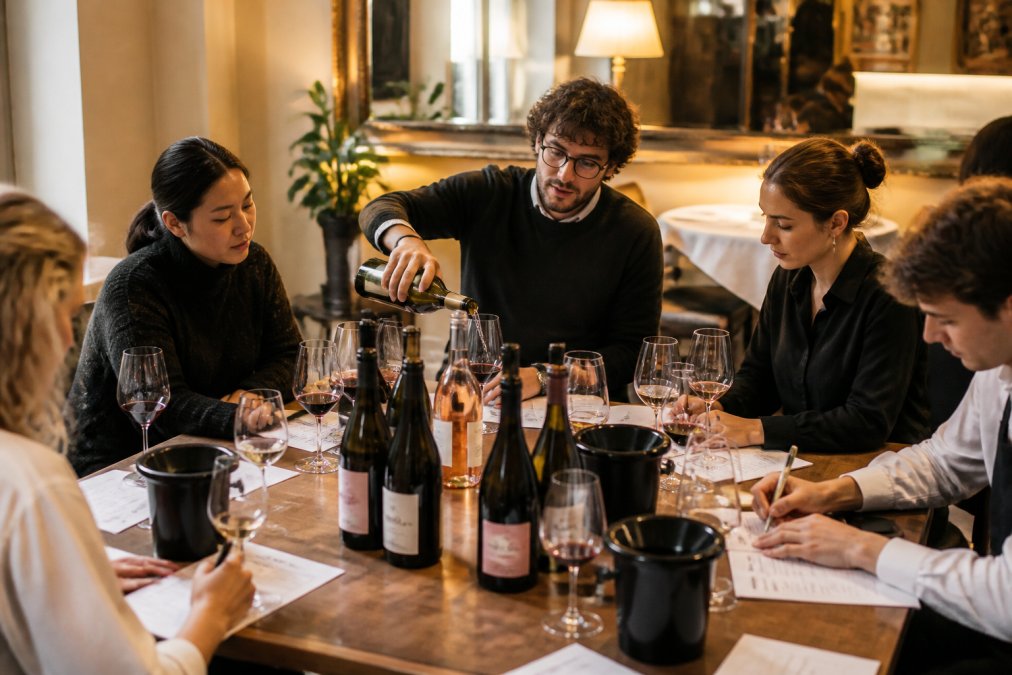
Run a 20-minute tasting before service twice a week rather than a two-hour session once a quarter, frequency beats intensity for retention (pubmed.ncbi.nlm.nih.gov). Pour small samples and taste the same wine twice across different weeks so staff notice how it changes.
A Repeatable 20-Minute Tasting Format
A repeatable format that works for small teams:
- Two minutes, silent first impression. Pour blind, no talking. Each person writes three words for smell and three for taste. This forces sensory attention before opinion.
- Five minutes, round-robin vocabulary. Each person reads one word aloud. The facilitator groups synonyms on a whiteboard ("citrusy", "lemon", "grapefruit" cluster together). This is how a shared vocabulary forms.
- Five minutes, reveal and compare. Uncover the label. Compare the group's words against the producer's own tasting note. Where do they diverge? Divergence is the lesson, not a failure.
- Five minutes, pitch rehearsal. Each person delivers their one-sentence pitch for the wine out loud. Peers flag any word a customer would not understand.
- Three minutes, one question to keep. Each person writes a single question they still cannot answer ("Why does this taste saltier than the Arinto?") and the facilitator answers it at the next session.
This fits inside a pre-shift briefing and needs only glasses, spittoons and a whiteboard.
Blind Tasting and Guided Flights for Your Team
Blind tasting builds sensory evaluation skills faster than any lecture (pubmed.ncbi.nlm.nih.gov). Cover the label, pour, and ask three questions: what does it smell like, what does it taste like, and where might it come from.
Guided flights work well for lesser known regions. Pour three Portuguese whites side by side, for example an Alvarinho, an Arinto and a Jampal, and let staff compare them directly. The contrast teaches more than any description.
Three flight structures that reliably produce insight:
- Same grape, three regions. Alvarinho from Monção e Melgaço against Albariño from Rías Baixas against a third expression. Staff learn that grape name is not the whole story.
- Same region, three grapes. Three Dão reds, Touriga Nacional, Jaen and Alfrocheiro, side by side. This teaches regional character rather than varietal character.
- Same price band, familiar versus unfamiliar. A well-known New World white against an obscure European white at the same retail price. Staff discover that the unfamiliar bottle often over-delivers, which is the argument they will later make to customers.
Building Sensory Vocabulary Without Jargon
Staff freeze when asked to describe a wine because they reach for words they don't own. Build the vocabulary deliberately:
- Keep a running "flavour wall" of approved descriptors grouped by family: citrus, stone fruit, orchard fruit, herbal, mineral, spice, earth.
- Ban abstract terms ("complex", "well-made", "interesting") from tasting notes (wsetglobal.com). They communicate nothing to a customer.
- Practise translating one descriptor into a customer sentence. "Mineral" becomes "it tastes like rain on stone, clean and a bit salty on the finish."
Facilitating Without Intimidating
The facilitator's job is to keep the session safe. Rules that protect confidence:
- No one is wrong about what they smell. If a person says "wet wool" and the group says "citrus", both are recorded.
- The most senior palate in the room speaks last, not first. Otherwise junior staff simply agree.
- Rotate who leads the session. Leading a tasting is itself a confidence exercise.
- Never test staff publicly on facts. Test the wine, not the person.
Confidence rises fastest when staff can be uncertain out loud. The tasting room is the one place where "I don't know what this is" carries no penalty, so it never happens in front of a customer.
How to Describe Indigenous Grape Varieties Without Intimidation
Describing indigenous grape varieties without intimidation means replacing jargon with sensory anchors. Customers don't need to know Jampal is a near-extinct Portuguese grape, they need to know it tastes crisp, elegant and a little different.
Describe the wine first, the grape second. Lead with what the customer will experience, then reward curiosity with the backstory: "It's fresh and mineral with a long finish. The grape is called Arinto, and it's grown almost exclusively in Portugal."
Avoid stacking descriptors. Three tasting notes are plenty; more and the customer stops listening and starts deciding.
Pronunciation Guides for Obscure European Regions and Grapes
Pronunciation is the biggest source of staff embarrassment with lesser known European wines. Fix it early with a reference sheet staff can check before service.
| Term | Say it like | Region |
|---|---|---|
| Alvarinho | al-vah-REE-nyoo | Northern Portugal |
| Arinto | ah-RIN-too | Vinho Verde |
| Jampal | zham-PAL | Lisboa |
| Touriga Nacional | too-REE-gah nah-see-oh-NAHL | Dão |
| Dão | downg | Central Portugal |
Keep the sheet behind the bar or taped inside the wine list. Ten seconds of checking beats a mispronunciation in front of a customer.
Storytelling That Sells: Terroir, Family and Authenticity
Storytelling turns a bottle into a recommendation. Customers rarely remember a grape variety, but they remember the family who saved it from extinction or the granite slopes where it grows.
Train staff to learn one story per wine: who makes it, where it comes from, and why it matters. One sentence is enough: "This is made by a family in the Dão hills who farm 400 metres up on granite soil."
The Three-Question Story Framework
Rather than memorising paragraphs, give staff three questions to answer for every listing. The answers become the story.
- Who makes it? A person, a family, a generation. Names beat institutions. "The Sousa family" lands harder than "a producer in the region".
- Where does it come from, and what is unusual about that place? Altitude, soil, aspect, age of vines, proximity to coast or mountain. One physical detail is enough.
- Why does this bottle exist? A grape rescued from abandonment, a vineyard replanted by hand, a decision to farm organically before it was fashionable. This is the reason a customer feels good about buying it.
A story that answers all three in under 30 seconds is the right length. Anything longer becomes a lecture.
Where to Source Stories Without Inventing Them
Authenticity is the whole point, so stories must be verifiable. Reliable sources:
- The producer's own technical sheet or back-label copy, often contains the family history and vineyard detail.
- Importer and distributor notes, which frequently carry the human detail the producer is too modest to write.
- Direct conversation with the producer at a trade tasting, recorded as a voice note and transcribed into the staff document.
- The winery's own website or social channels, for dates and family lineage.
If a detail can't be verified, it doesn't go in the story. One invented fact, discovered by a curious customer, destroys the credibility of every other recommendation that staff member makes.
Matching the Story to the Customer
The same bottle has several stories. Choose the one that fits the person in front of you:
- The curious drinker wants the grape's near-extinction and revival.
- The value seeker wants the small-production, family-farmed angle, scarcity explains why it is not in the supermarket.
- The traditionalist wants the region's history and the generations behind it.
- The sustainability-minded customer wants the farming method: organic certification, dry-farmed vines, hand harvesting.
Train staff to hold two or three stories per bottle and select on the fly. This is the difference between reciting a script and having a conversation.
Delivering the Story in Service
Timing matters as much as content. Practical rules:
- Lead with the sensory experience, then reward curiosity with the story. "It's crisp and mineral with a long finish, and it's from a grape that nearly disappeared." Story first feels like a sales pitch; story second feels like a gift.
- Keep it to two sentences during a busy service. Save the full version for a quieter moment or a tasting.
- Use the story to answer an objection, not to pre-empt one. If a customer hesitates at an unfamiliar name, the story is the reassurance.
- Never repeat the same story to the same regular. Rotate the angle so the relationship keeps developing.
Turning Stories Into Repeat Business
A story is not only a closing tool; it is a retention tool. When a customer returns and asks for "the one the family saved", the story has done its job. Encourage staff to note which story a regular responded to, so the next recommendation can build on it. Over time, the stories become the shop's or restaurant's own institutional memory, and that is something no supermarket aisle can replicate.
Digital Training Tools and Micro-Learning for Wine Knowledge
Digital training tools let your team build wine knowledge in five-minute bursts rather than sitting through long sessions. Micro-learning works because it fits around shifts, not instead of them.
A simple approach: record a 60-second phone video for each new listing, covering the pitch, the pronunciation and one story. Share it in a staff group chat. Staff watch it on the bus, then rehearse it before service.
Most guides overlook this entirely. In practice, a short video library becomes the single most-used training asset in a small team, because it is searchable, repeatable and always available.
Measuring Results: From Staff Education to Revenue Growth
Measuring results turns wine training from a cost into an investment. Track three things: bottles sold per staff member per week, average bottle price on lesser known listings, and how often staff recommend a specific wine unprompted.
A simple tracking sheet works. Note the wine, the staff member and the outcome for every recommendation. Within a month you will see which pitches convert and which need rewriting.
Do not judge training by a single week. Unfamiliar wines take time to gain traction, and staff confidence builds over several tastings. Give any new listing at least a month before deciding it is not working. ::: Consistent exposure allows your team to master the nuances of these selections, eventually positioning them as compelling alternatives to popular wines that can redefine your establishment's cellar strategy.
Conclusion
The challenge with lesser known European wines is not the wine itself. It is staff confidence, and confidence is built through repetition, honest scripts and real stories. Bring in bottles your team can taste, talk about and believe in, and the sales follow.
That is exactly what 79North Ltd does. We import premium, family-owned wines from Portugal and Italy, including native varieties like Jampal and Arinto that most buyers have never seen, and we work directly with independent retailers and restaurants of every size. Our portfolio is built around small, innovative wineries and the unique terroirs behind them.
Let's talk about building a wine list your staff will be proud to sell. Get started with 79North Ltd and give your team wines worth talking about.
Frequently Asked Questions
How do you introduce unfamiliar wine regions to restaurant staff?
Start with the story behind the region, not the geography. Explain how a family producer saved a grape from extinction or why volcanic soils give a wine its character. Then run a guided tasting so staff experience the wine before they sell it. Pair each new region with a familiar reference point, such as comparing Alvarinho to a crisp Albariño. This approach builds confidence and gives staff something memorable to share with customers.
What are the best techniques for staff wine tasting sessions?
Keep tastings focused on three to five wines so staff can properly evaluate each one. Use blind tasting to remove label bias and build sensory evaluation skills. Encourage staff to write their own tasting notes before revealing the producer story. Finish with a role-play exercise where each person delivers a one-sentence pitch. Short, regular sessions work better than occasional long ones for retaining wine knowledge.
How can staff overcome customer hesitation toward unknown grape varieties?
Train staff to use the Bridge technique: connect the unfamiliar grape to something the customer already enjoys. For example, describe a Jampal as sitting somewhere between a dry Riesling and a Pinot Grigio. Offer a small taste before commitment. When customers understand what to expect from an indigenous variety, hesitation drops. Staff should also mention the producer's story, as authenticity often outweighs familiarity.
What are the key characteristics of Portuguese and Italian indigenous grapes?
Portuguese varieties like Jampal, Arinto and Alvarinho tend to show high acidity and fresh citrus or stone fruit flavours. These grapes reflect their terroir. Staff should learn three to five signature varieties per region.