
Import Small Batch Wines: A 2026 Guide
Table of Contents
- Why Small-Batch Wine Imports Matter for Independent Retailers
- AWRS Registration for Wine Importers: Your First Compliance Step
- Understanding HMRC Wine Import Duty Rates and Excise Tax
- VI-1 Wine Import Document Requirements Explained
- Customs Declarations, Commodity Codes, and CDS Filings
- Labelling, Certification, and Food Standards Compliance
- Logistics, Freight Forwarding, and Cost Optimization for Small Batches
- Conclusion: Building Your Import Strategy
Last Updated: August 16, 2026
Why Small-Batch Wine Imports Matter for Independent Retailers
The UK wine market has shifted. Independent retailers and restaurants now compete on discovery, authenticity, and access to wines that larger chains cannot source. Small-batch wine imports are essential to this strategy.
When you import small-batch wines, you build a unique value proposition. A sommelier can offer Jampal from a family-owned Portuguese producer that no competitor within 50 miles stocks. A wine shop owner can curate a collection reflecting genuine relationships with winemakers, not purchasing agreements with multinational distributors.
Importing comes with complexity: customs declarations, excise duty calculations, labelling compliance, and freight logistics create barriers for many independent operators. This guide walks you through every step, from AWRS registration through to receiving your first shipment.
At 79North Ltd, our focus is representing premium, family-owned wines from Portugal and Italy. Whether you're a restaurant manager, wine shop owner, or purchasing professional, this guide translates regulatory requirements into actionable steps.
AWRS Registration for Wine Importers: Your First Compliance Step
AWRS registration is mandatory. The Alcohol Wholesaler Registration Scheme (AWRS) is administered by HMRC and is required for anyone moving alcohol commercially into the UK market, including small-batch importers.
You cannot legally import wine without AWRS approval. The process takes 4-6 weeks from application to approval, so begin registration before identifying suppliers.
To register, you'll need:
- Your business registration details (company number or sole trader identification)
- Details of your premises where alcohol will be stored or handled
- Information about your business activities
- Proof of identity and business address
If you're operating as a sole trader importing from home, HMRC will want confirmation that your residential premises are suitable for alcohol storage, a secure, lockable space away from customer areas.
Once approved, AWRS gives you legal status to import and enters you into HMRC's compliance system. They can audit your records, cross-check imports against sales, and verify that excise duty has been properly paid.
Understanding HMRC Wine Import Duty Rates and Excise Tax
HMRC wine import duty consists of two components: the customs tariff and excise duty.
The customs tariff on still wine from non-EU countries is currently 0% under most trade agreements. For wines from Portugal and Italy (EU-origin), the tariff is also 0%.
Excise duty is calculated per litre of alcohol by volume (ABV). For wines between 5.5% and 15% ABV, the standard rate applies. A wine at 14% ABV incurs more duty per bottle than a wine at 11% ABV.
The excise duty rate for still wine currently stands at approximately £2.84 per litre of pure alcohol. For a standard 75cl bottle at 14% ABV, this translates to roughly £0.30 per bottle in excise duty. For a 12-bottle case, that's £3.60 in excise before VAT.
VAT is then applied on top of duty. You'll pay VAT on the product cost plus the duty. A case costing £180 ex-VAT, plus £3.60 in duty, becomes £219.12 after 20% VAT is applied to the £183.60 subtotal.
Many importers use duty deferment accounts with HMRC, allowing you to defer payment of excise duty for up to one month, improving cash flow. Apply for a duty deferment account separately from AWRS.
VI-1 Wine Import Document Requirements Explained
The VI-1 form is your proof of origin for wine imports. It confirms the wine originates from a legitimate producer and meets EU production standards. HMRC requires this document for every shipment.
Your supplier should provide the VI-1 before shipment. It includes the producer's name, wine's region of origin, vintage, ABV, and total quantity.
For Portuguese wines, the VI-1 is issued by the Instituto da Vinha e do Vinho (IVV) or equivalent regional authority. For Italian wines, it comes from the regional wine authority.
When your shipment arrives, customs will cross-check the VI-1 against your customs declaration. Missing or discrepant VI-1 forms cause holds pending clarification, delaying shipment 2-3 weeks and incurring storage fees.
Request the VI-1 when you place your order. Build a 3-week buffer into your timeline specifically for obtaining this document. Some producers issue it automatically; others require a formal request. Clarify the process with your supplier before committing to a shipment date.
The VI-1 is valid for the quantity and vintage specified. If your shipment size changes, you may need a revised VI-1.
Customs Declarations, Commodity Codes, and CDS Filings
Every shipment requires a customs declaration filed through the Customs Declaration Service (CDS). This is how HMRC knows what's entering the country, where it's coming from, and how much duty is owed.
The customs declaration must include:
- Your EORI number (Economic Operator Registration Identification)
- The commodity code for wine (currently 2204.21 for still wine of 11-15% ABV, with variations for other ABV ranges)
- The origin country
- The declared value of the goods
- The quantity and unit of measurement
- Any applicable trade agreements or duty suspensions
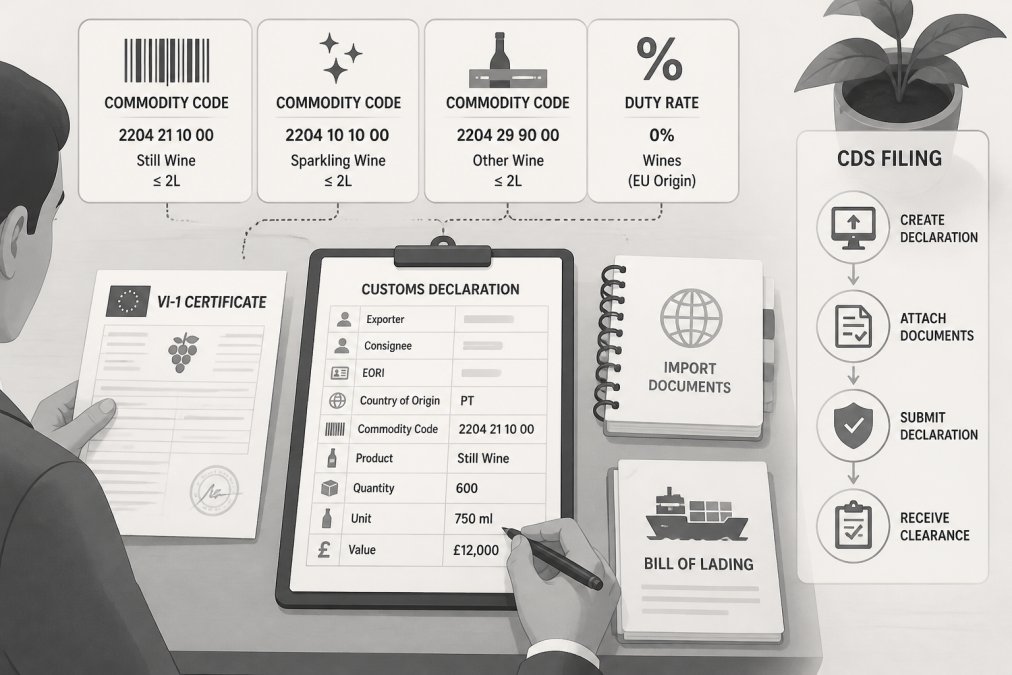
The commodity code is crucial. Wine is classified by ABV, and different codes apply to different ranges. Your freight forwarder typically handles commodity code selection, but verify they've assigned the correct code because it directly affects duty calculations.
The declared value is the cost of goods plus shipping and insurance up to the UK border (CIF value). This is the basis for customs valuation and duty calculation. Undervaluing goods to reduce duty is illegal and triggers penalties far exceeding any duty savings.
CDS filings can be submitted directly, but most small importers use a customs broker or freight forwarder. The filing must be submitted before goods arrive at the UK port or within a specific timeframe after arrival.
If you're using a duty deferment account, the CDS filing will reference your account number, and duty will be charged to that account rather than paid upfront at clearance.
Common mistakes include filing CDS with incorrect commodity codes, declaring value that doesn't match the commercial invoice, and failing to include the VI-1 reference in the declaration.
Labelling, Certification, and Food Standards Compliance
UK labelling regulations for wine are detailed. Every bottle must display specific information in English and meet Food Standards Agency (FSA) requirements.
Mandatory label information includes:
- The type of wine (still, sparkling, fortified)
- The origin (country of production)
- The producer's name and address
- The alcohol by volume (ABV) as a percentage
- The net volume of the bottle
- Any allergen warnings (sulphites are mandatory for all wine)
- The lot number or vintage year
- Any health warnings
Many small producers from Portugal and Italy use labels in their native language or without full English translations. You cannot legally sell these wines in the UK without relabelling or applying supplementary labels providing required English information.
Relabelling adds cost (typically £0.10-0.30 per bottle) and time (2-3 weeks for small runs). Some importers use front-label stickers with essential information in English, but back-label compliance is stricter.
Before committing to a supplier, confirm whether their bottles are already compliant with UK labelling standards or whether relabelling will be necessary. This significantly affects your landed cost.
Allergen declarations are non-negotiable. Even if a wine is not fortified with added sulphites, it naturally contains them as a byproduct of fermentation. The label must state "Contains Sulphites" or equivalent.
Logistics, Freight Forwarding, and Cost Optimization for Small Batches
Freight forwarding for small-batch wine imports is where many independent importers encounter unexpected costs. A single case of wine is uneconomical to ship alone. Freight forwarders consolidate small shipments into larger container loads, reducing per-unit cost but extending timeline.
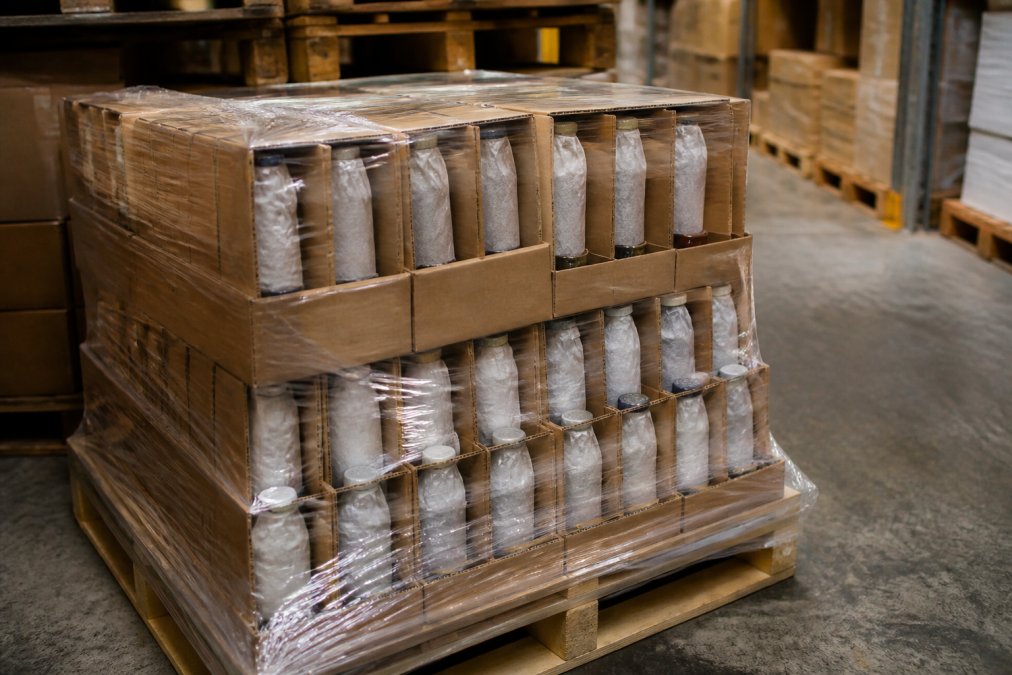
For a 5-case shipment from Portugal, you have two primary options:
Groupage (consolidated shipping): Your shipment is combined with others heading to the UK. Cost per case drops to £15-25, but transit time extends to 3-4 weeks.
Direct container (Less Than Container Load or LCL): You pay for dedicated space in a shared container. Cost per case is £25-40, but transit time is faster (10-14 days) with more control over departure timing.
For most small importers, groupage makes sense initially. As you scale to 10+ cases per shipment, direct container arrangements become cost-effective.
Freight forwarders also handle customs brokerage, preparing the CDS filing, coordinating with HMRC, and arranging clearance at the UK port. This service typically costs £50-100 per shipment but prevents costly delays.
Insurance is another consideration. Standard freight insurance covers loss or damage in transit but not spoilage from temperature fluctuation. Wine is sensitive to heat and cold. Temperature-controlled shipping adds 20-30% to freight costs but is essential for premium small-batch wines, especially during summer months.
Total landed cost for a 12-bottle case typically breaks down as:
- Wholesale cost from producer: £12-18 per bottle
- Freight and handling: £2-4 per bottle
- Excise duty: £0.25-0.40 per bottle
- Customs clearance and brokerage: £4-8 per case (£0.35-0.65 per bottle)
- Relabelling (if needed): £0.10-0.30 per bottle
- VAT on all of the above: 20%
A case costing £180 wholesale becomes £280-320 landed, all-in. Your retail margin must account for this. A case you sell for £600-700 retail (£50-58 per bottle) delivers reasonable margin for independent retailers.
Starting with 79North Ltd gives you access to established relationships with producers like Herdade da Calada, Manz, and Casa Américo, wines that are already compliant, already imported, and ready to order at scale without the logistical complexity of first-time importing.
Conclusion: Building Your Import Strategy
Importing small-batch wines to the UK is legally straightforward but operationally complex. AWRS registration, excise duty calculations, VI-1 forms, CDS filings, and labelling compliance are not optional, they're the regulatory foundation.
The competitive advantage for independent retailers lies in curating wines that larger distributors won't touch. This is where 79North Ltd adds genuine value. We've already handled the regulatory complexity, built relationships with premium producers, and ensured every wine in our portfolio meets UK compliance standards.
Our current selection includes Herdade da Calada's Vale da Calada Tinto (£17.00 per bottle wholesale) and Caladessa Reserva (£21.00), Quinta Pousada de Fora's Arinto Reserva (£26.00), the distinctive Manz Dona Fátima Jampal (£35.00), and Casa Américo's Sonante DOP (£14.00). Each represents a producer committed to authentic, small-batch production.
Rather than managing suppliers, customs brokers, and freight forwarders yourself, focus on what you do best: selling wine to customers who value discovery and authenticity. Let's talk about how 79North Ltd can simplify your import strategy and give you access to wines your competitors cannot source.
Frequently Asked Questions
What is the current excise duty on wine imported into the UK?
Excise duty on still wine is charged per litre of alcohol by volume (ABV). Rates vary by ABV level: wines up to 5.5% ABV face lower rates, while wines between 5.5% and 15% ABV incur standard duty. Sparkling wines and fortified wines have different rates. Duty is calculated on the total volume imported multiplied by the ABV percentage. HMRC updates these rates annually, so check the current schedule before importing. Duty is separate from VAT, which applies to the total landed cost.
Do I need AWRS registration for wine importers before importing commercially?
Yes. If you're importing wine for commercial resale, you must register with HMRC's Alcohol Wholesaler Registration Scheme (AWRS). Registration is free and mandatory for any business trading in alcohol, including importers, retailers, and restaurants. Without AWRS registration, you cannot legally import or sell alcohol. The process takes 4-6 weeks. You'll need business details, premises information, and proof of identity. Once registered, you receive an AWRS number required on all customs declarations and duty deferment accounts.
What does the VI-1 wine import document do, and when is it required?
The VI-1 form certifies that wine being imported meets origin and authenticity standards under trade regulations. It's required for wines imported from non-EU countries and confirms the wine's country of origin, grape variety, and vintage. For EU imports (including Portugal and Italy), VI-1 documentation may not always be mandatory, but many importers obtain it to strengthen provenance claims and support marketing. Your freight forwarder or customs agent can help determine whether your specific shipment requires it. Always verify with HMRC or your supplier before shipment.
What are the main hidden costs when importing small batches of wine?
Beyond duty and VAT, expect costs for: customs clearance fees (typically £20-£50 per shipment), freight forwarding (varies by volume and origin; small batches cost more per unit), import insurance, commodity code classification, labelling compliance adjustments, and duty deferment account setup. Groupage services (consolidating shipments with other importers) reduce per-unit freight costs but add handling time. For small batches, freight and handling often exceed the product cost. Shipping 12 bottles from Portugal might cost £40-£80 in logistics alone. Budget 30-40% above the wine's purchase price for a realistic total landed cost.
Can I import wine directly from small European producers, or do I need an importer like 79North?
You can import directly, but it's complex. Direct imports require you to manage HMRC compliance, customs declarations, VI-1 forms, duty deferment, labelling adjustments, and logistics independently. Small producers often lack export experience and may not understand UK regulations, leading to delays and rejections. Working with a specialist importer like 79North handles these barriers: we manage AWRS compliance, customs clearance, duty calculations, and ensure wines meet UK labelling standards. We also guarantee supply reliability and handle paperwork, freeing you to focus on selling. For independent retailers and restaurants, this simplifies sourcing significantly.
What labelling requirements apply to imported wine in the UK?
Imported wine must display: producer name and address, wine type (still, sparkling, fortified), vintage (if stated), ABV, volume, origin country, allergen warnings (sulphites), and lot/batch number. Labels must be in English or include English translations of key information. If the original label doesn't meet these requirements, you must add a supplementary label or relabel entirely. The Food Standards Agency (FSA) enforces labelling standards. Costs for relabelling small batches range from £0.50-£2 per bottle depending on complexity. Plan labelling adjustments into your timeline; it can add 2-3 weeks to your import process.
How long does the customs clearance process take for small wine shipments?
Standard customs clearance typically takes 3-7 working days once documentation is submitted to HMRC via the Customs Declaration Service (CDS). This timeline assumes all paperwork is complete and correct. Delays occur if commodity codes are wrong, origin documentation is missing, or duties aren't paid promptly. Using a freight forwarder or customs agent speeds this up; they handle CDS filings and duty payments on your behalf. For small batches, expect total import time of 2-4 weeks from order to delivery, including freight transit, customs clearance, and final UK delivery.
What is a duty deferment account, and do I need one?
A duty deferment account allows you to defer payment of excise duty and VAT until after goods are imported, rather than paying upfront. This improves cash flow for regular importers. You must apply to HMRC and provide financial guarantees (typically a bank guarantee or deposit). Setup takes 2-4 weeks. For occasional small-batch imports, paying duty upfront at customs clearance may be simpler and cheaper than maintaining a deferment account. However, if you import regularly, a deferment account becomes cost-effective. Your customs agent can advise whether it's worthwhile for your import volume.
Ready to stock distinctive wines that set your business apart? Contact 79North Ltd to discuss your import needs and explore our current portfolio of premium Portuguese and Italian wines. We handle the complexity so you can focus on building your unique wine list.
This article was written using GrandRanker