7 Steps to Build a Profitable By the Glass Wine Program
Quick Summary
A profitable by the glass program picks a tight set of wines, prices each glass from its real bottle cost and a target margin, and checks sales weekly. Start with a balanced mix of about five styles, then cost every pour before setting the menu price.
- Offer one crisp white, one richer white, one light red, one fuller red, and one sparkling or rosé.
- A 750ml bottle yields about five 150ml glasses, so divide bottle cost by five.
- Assume 5-10% of each bottle is lost to spillage and over-pour when pricing.
- Divide cost per glass by 0.30 to back-calculate a price for a 70% margin.
- Run all margin figures on the VAT-exclusive price, since UK VAT is 20%.
Table of Contents
- How do you build a profitable by the glass program?
- Selecting a Balanced Wine Mix for Your By the Glass List
- How to Price Wine by the Glass and Protect Your Margin
- Wine by the Glass Menu Examples That Sell Through
- Wine Preservation Systems for Restaurants and How to Use Them
- How to Reduce Wine Waste in Restaurants
- Tracking Glass Sales and Setting Up Your Replenishment Routine
- Frequently Asked Questions
How do you build a profitable by the glass program?
A profitable by the glass program starts with a simple rule: sell what you pour, and pour what you can afford to waste. Most restaurants lose money on glasses because they pick wines by taste alone, price them by habit, and never track what moves. A good program picks a tight set of wines, prices each glass against its real cost, and checks the numbers every week.
Here is the sequence we recommend, in seven steps:
- Choose a balanced mix of styles that suits your guests.
- Set glass prices from bottle cost and target margin.
- Work out pour cost and gross profit for every wine.
- Design a menu that makes the glasses easy to order.
- Preserve open wine so each bottle earns its keep.
- Cut spoilage with a clear rule for open bottles.
- Track sales weekly and replenish on a fixed routine.
Each step builds on the last. Skip the costing and the menu will look good but earn little. Skip the tracking and you will not know which glasses to drop.
Selecting a Balanced Wine Mix for Your By the Glass List
Your list should cover a few clear styles rather than many similar wines. Aim for a small range: one crisp white, one richer white, one light red, one fuller red, and one sparkling or rosé. This gives guests a choice without overwhelming them, and it keeps your stock manageable.
Choose producers with a story your guests can repeat. You can also weigh wholesale against direct import before committing to a supplier. Small, family-run estates from Portugal and Italy often offer distinctive styles. Native grape varieties such as Jampal can give your list a distinctive character.
Watch out: a list full of bottles that sell only once a month ties up cash and ends up in the bin. Keep fewer wines, and rotate one or two of them each season. For a fuller look at supply and wholesale sourcing for small restaurants, see small restaurant wine supply solutions.
How to Price Wine by the Glass and Protect Your Margin
Pricing a glass starts with the bottle cost, not the price a guest is used to paying.
Step 1: Establish the true cost per bottle. Take the wholesale price you pay, add delivery and any duty already included, and divide by the number of bottles in the case.
Step 2: Decide your pour size and yield. A standard 150ml pour gives five glasses per 750ml bottle. A 175ml pour gives roughly four and a quarter, and a 125ml pour gives six. Smaller pours increase yield but may feel stingy; larger pours feel generous but erode margin. Most operators settle on 150ml as the default and offer 175ml or 250ml as upgrades.
Step 3: Calculate cost per glass. Divide the bottle cost by the number of pours. At £16.00 per bottle and five 150ml pours, the wine cost per glass is £3.20.
Step 4: Add an allowance for waste. No bottle pours perfectly.
Step 6: Check the price against the bottle price on your list. If the same wine sells as a bottle for £32.00, five glasses at £11.50 bring in £57.50, a significant uplift that reflects the service, glassware, and preservation costs of selling by the glass. If the gap feels too wide for your guests, adjust the pour size or accept a lower margin on that wine.
Step 7: Account for VAT. All menu prices in the UK include VAT at 20% for hospitality. Your gross margin calculation should use the VAT-exclusive selling price.
Calculating Pour Cost and Target Gross Profit
Pour cost is the share of a glass price that goes to the wine itself. Use this formula:
Pour cost (%) = cost per glass ÷ glass price × 100
Worked example: a glass costs £3.20 and sells for £9.00. Pour cost is 3.20 ÷ 9.00 × 100, which is about 35.6%.
Target gross profit is what you keep after the wine's cost. For the same glass, £9.00 minus £3.20 leaves £5.80 gross profit per pour. Multiply that by the glasses you expect to sell each week to see the real weekly return.
A more complete view includes the waste allowance and VAT.
Watch out: pricing by habit, copying the pub down the road or applying a fixed cash markup, ignores your own cost base and waste rate, and can leave you selling popular wines at a loss once VAT and spoilage are counted.
The article walks through the costing steps, which the table below summarises.
| Step | What to do | Figure from the article |
|---|---|---|
| 1. True bottle cost | Add delivery and duty, divide by bottles per case | £16.00 example bottle |
| 2. Pour size and yield | Choose a standard pour | 150ml gives five glasses per bottle |
| 3. Cost per glass | Divide bottle cost by pours | £3.20 per glass |
| 4. Waste allowance | Add for spillage and over-pour | 5-10% waste, 8% example |
| 5. Back-calculate price | Divide cost by 0.30 for 70% margin | £11.53, rounded to £11.50 or £12.00 |
| 6. Check bottle uplift | Compare five glasses to bottle price | Five glasses at £11.50 bring £57.50 |
| 7. Account for VAT | Run margins on net price | 20% VAT; £12.00 returns £10.00 |
Wine by the Glass Menu Examples That Sell Through
Menu placement changes what people order. Put your glass wines in a separate block near the top of the wine list, with short descriptions of two or three words each. If you want to offer sparkling options, compare traditional and tank-method sparkling wines to present the differences clearly. Long tasting notes slow decisions down.
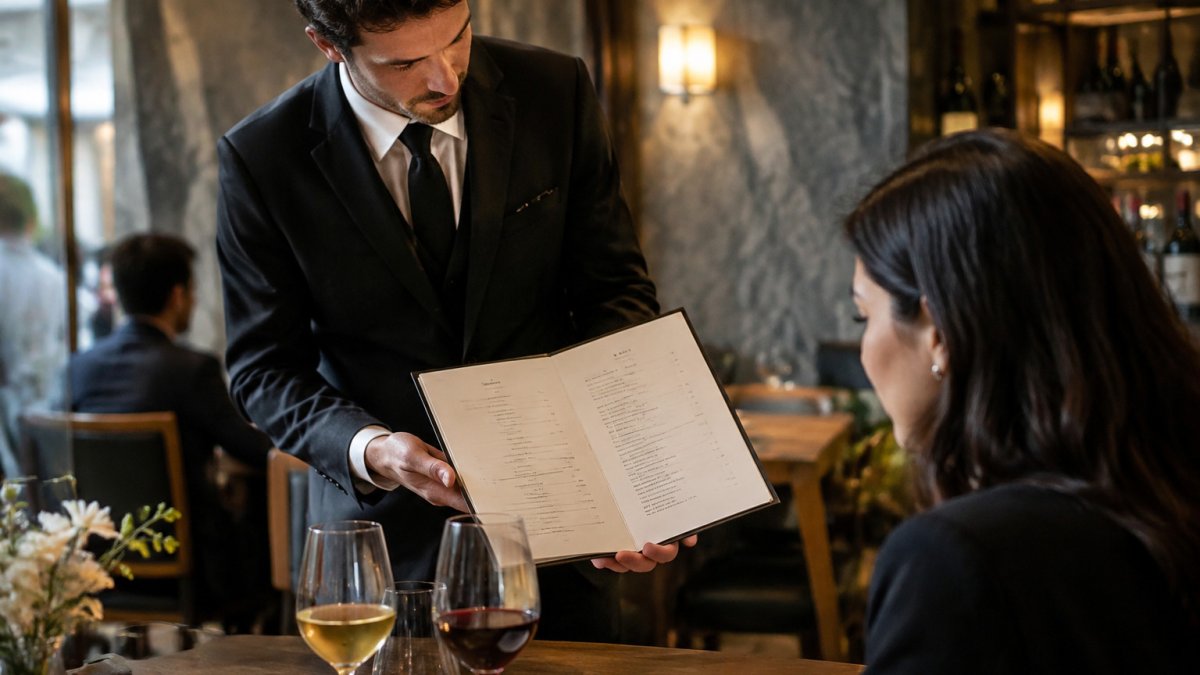
A sommelier presenting a printed by-the-glass list at a table works well, because it shows that glasses are a real choice, not an afterthought. Write one line per wine that names the style and a food match, such as "crisp, citrus, good with seafood."
Here is a simple layout to test:
- Sparkling: one wine, served by the glass
- Whites: two styles, one light and one fuller
- Reds: two styles, one light and one fuller
- Rosé or orange: one seasonal option
Using Menu Psychology to Guide Guests Toward Profitable Pours
Guests scan a wine list in a predictable pattern: they look at the top, the bottom, and the prices on the right-hand side. Use that to your advantage. Place your highest-margin glass, usually a distinctive white or a lighter red, in the first position of its section, where the eye lands first.
The middle of each section is where guests default when they feel uncertain. Reserve that slot for a wine that is both popular and reasonably priced, so the safe choice still earns a fair margin.
Price anchoring works by the glass too. If you offer a 175ml and a 250ml pour of the same wine, show the 250ml price first or more prominently. Guests anchor on the larger number and perceive the smaller pour as better value, even though the larger pour often carries a lower margin per millilitre.
Writing Descriptions That Sell
A good by-the-glass description does three jobs: it names the style, gives one flavour cue, and suggests a food match. Keep it to a single line. "Light, red-fruit, good with charcuterie" tells a guest more than a paragraph of tasting notes and is easier for staff to repeat.
Use language that signals value without discounting. Words like "house pour," "sommelier's choice," or "limited parcel" create interest without implying cheapness. Avoid vague terms like "smooth" or "easy drinking", they describe almost every wine and give the guest no reason to choose one glass over another.
Training Staff to Recommend Higher-Value Pours
Staff recommendations are the single most effective menu tool you have, and they cost nothing to deploy. Give every server three sentences to learn per wine: what it tastes like, what it goes with, and who it suits.
Build a simple upselling script. When a guest orders a glass of the house white, the server can offer a taste of the wine one step up: "Would you like to try the Albariño instead? It's a little more textured and pairs well with your fish." This works because it is a genuine recommendation, not a push.
Watch out: a list that is too long or too clever defeats itself, guests default to the cheapest familiar wine, and your best-margin glasses sit untouched. Keep the by-the-glass block to seven or eight wines and make each one easy to describe in a single line.
Wine Preservation Systems for Restaurants and How to Use Them
A preservation system lets you pour from an opened bottle for several days without loss of quality.
Set a date label on each opened bottle.
How to Reduce Wine Waste in Restaurants
Waste comes from bottles opened too often and kept too long. Limit each wine to the bottles you can sell in a few days, and open new bottles only when stock runs low.
A clear rule helps staff act without guessing. For example: open a new bottle only after the last one is half gone, and pour off any wine that fails the taste check at close. Record every bottle that goes down the sink, so you can see which wines are costing you money.
Waste is also a pricing problem. A glass that does not sell gets poured away, so drop slow sellers rather than hoping they will move.
Tracking Glass Sales and Setting Up Your Replenishment Routine
Track glass sales each week. Record how many glasses each wine sold, how many bottles you opened, and how many you poured away.
Set a replenishment routine tied to that data. Order when a wine drops below a set level, not when a guest asks for it. Review the list monthly: keep wines that earn their place and replace the rest.
Our advice is to decide your thresholds before you open the doors. Knowing that a wine needs to sell two bottles a week to stay on the list is far easier than deciding under pressure on a busy night.
Ready to build a by the glass list with wines that sell? Talk to 79North Ltd about small-batch Portuguese and Italian imports, from Quinta Pousada de Fora sparkling wines to Herdade da Calada's Alentejo rosé. Let's talk.
Frequently Asked Questions
How do you price wine by the glass?
Start from the bottle cost, then divide the bottle into pours. A 750ml bottle yields about five 150ml glasses, so the cost per glass is the bottle cost divided by five. Set the glass price so that cost sits at a target pour cost, commonly between 25% and 35% of the menu price for a by-the-glass program. Check the result against nearby competitor prices and adjust, keeping in mind that a glass priced too low erodes margin across every pour sold.
How many glasses should a bottle of wine serve?
A standard 750ml bottle serves five 150ml glasses, or six 125ml glasses for smaller pours. Pour size directly changes your pour cost, so decide on one standard pour per style and enforce it with measured pourers or calibrated glassware. Inconsistent pours are one of the fastest ways to lose gross profit on a by-the-glass program, even when the wine list itself is well chosen.
How long does wine last once opened?
Still wines typically last three to five days once opened and kept sealed and refrigerated, though lighter whites and rosés often hold for the shorter end of that range. Sparkling wine loses its fizz within a day or two even when resealed. Track the opening date on every bottle so you can sell or discard it before quality falls.
How can restaurants reduce wine waste in a by-the-glass program?
Reduce waste by stocking fewer wines with slower sell-through, sizing the list to how quickly each bottle moves, and labelling every open bottle with its opening date. Rotate stock so older bottles are poured first. Review waste weekly against sales so you can spot which wines consistently go to waste and replace them with products guests actually order.
